The short answerChoose a system that turns each approved rent change into an invoice-ready record, holds it openly while the CPI figure is outstanding, and moves it into your invoice run once, so month-end billing goes out right the first time without anyone re-keying escalations.
The short answer
Choose a system that turns each approved rent change into an invoice-ready record, holds it openly while the CPI figure is outstanding, and moves it into your invoice run once, so month-end billing goes out right the first time without anyone re-keying escalations.
Which lease management system can calculate CPI-linked rent changes and prepare information for invoicing? Choose one that carries each approved rent change straight into your invoice run, with the index month, any cap or floor, the approval and the effective date attached, so month-end billing goes out right the first time.
When it works, your property accountant stops re-keying escalations from a spreadsheet into the billing system, tenants stop receiving corrected invoices, and nobody has to remember which leases were escalated last month and which are still waiting. Smart AI Solutions sets that link up with your team and keeps supporting it after go-live.
This guide starts where the calculation ends. How to read the clause and work out a CPI escalation is covered in our guide to automated CPI escalation calculations and lease reporting, getting clauses out of the lease documents in lease abstraction, and choosing a system overall in lease management systems for commercial property. Here we cover the step after the number: the invoice-ready record, approval before billing, the rent increase notice, back-dated adjustments when the CPI figure is published late, the hand-off into your invoice run, and the audit trail.
Key takeaways
Use these checks to see whether a CPI rent increase can reach the rental invoice without anyone retyping it.
| What to check | What good looks like |
|---|---|
| Invoice-ready record | Each rent change carries the lease and tenant reference, the charge line, old and new rent, the index month and series used, any cap or floor applied, and the effective date. |
| Approval before billing | Nothing reaches the invoice run until a named person has approved it, and exceptions wait in a queue rather than being billed. |
| Rent increase notice | The tenant notice is generated from the same approved record, and the date it was sent is logged against the lease. |
| Late CPI figures | The system holds the change as "awaiting index", then raises a separate, traceable back-dated adjustment once the figure is published. |
| Hand-off to billing | Approved changes move into the invoice run by export or direct link, are marked as billed, and are reconciled after every run. |
| Audit trail | Anyone can open a change and see who did what to it, and when. |
Why escalations go wrong between the calculation and the invoice
Most escalation errors happen after the calculation is already right. Someone works out the new rent correctly in a spreadsheet or lease system, then carries it by hand to wherever invoices are raised.
Property finance teams will know these:
- The escalation is calculated in one system and typed into the billing system by someone else, so a transposed digit goes out on the rental invoice.
- The review date passes during a busy month, and the old rent is billed for two more cycles before anyone notices.
- The CPI figure the lease needs has not been published by the invoice run, so the change is parked in someone's inbox and forgotten.
- The tenant receives an invoice at the new rent before receiving the rent increase notice, and phones the property manager to dispute it.
- A correction is raised twice, once by the accountant and once by the property manager, and the tenant is over-billed.
Every one of these is a hand-off problem. That's the job of lease software that prepares information for invoicing: remove them.
What an invoice-ready rent change record holds
An invoice-ready record is the new rent plus whatever billing and the tenant need in order to trust it. If it only holds the new amount, someone still has to go back to the lease, the index and the email trail before billing.
| Field | Why billing needs it |
|---|---|
| Lease, tenant and premises reference | So the change lands on the right account and the right charge line, such as base rent rather than parking or operating costs. |
| Old rent, new rent and difference | So the invoice run and the reconciliation can check the movement, not just the new figure. |
| Index series and month used | So anyone can see which published CPI figure was applied, for example the headline CPI for all urban areas for a named month. |
| Cap, floor, fixed minimum or rounding applied | So a reviewer can see when the clause, not the index, set the final amount. |
| Effective date and billing frequency | So the first invoice at the new rent, and any partial period, is right. |
| Approval: who and when | So nothing is billed on an unapproved figure. |
| Notice status and export status | So the team can see whether the tenant was told and whether the change has already been billed. |
Did you know? Stats SA publishes the CPI release about three weeks after the end of the month it measures. The August 2026 release, which put annual consumer price inflation at 4.4%, was embargoed until 23 September 2026, and the September 2026 figure was scheduled for 21 October 2026. An escalation that depends on a month's CPI cannot be finalised before that month's release. Source: Statistics South Africa, P0141 Consumer Price Index, August 2026
When the CPI figure arrives after the invoice run
The index month your lease names is often published after the date the new rent should start. When that happens, the system shouldn't guess. It should hold the change where everyone can see it, then correct it once the figure is out.
Many leases avoid the problem by naming an earlier index month, such as the figure published before the review date. Where a lease does not, the usual sequence is:
- The review date arrives and the index figure is not yet published. The change is marked "awaiting index" and the current rent is billed as normal.
- Stats SA publishes the figure. The system calculates the new rent, applies any cap or floor, and sends it for approval.
- Once approved, the next invoice shows the new rent and, on a separate line, a back-dated adjustment for the months already billed at the old rent.
An illustrative lease shows how the lines should look. Assume base rent of R50,000 per month, an effective date of 1 October and an approved increase of 4.4%, with the figure approved after the October invoice run. These are example figures for a tenant's rent, not Smart AI Solutions prices.
| Invoice | Rent line | Back-dated adjustment | Total for rent |
|---|---|---|---|
| October (before approval) | R50,000 | None | R50,000 |
| November (after approval) | R52,200 | R2,200 for October | R54,400 |
| December onwards | R52,200 | None | R52,200 |
Keep the original October invoice as it was and raise the difference as its own line with its own reference. Replacing past invoices hides what happened, and a separate line lets the tenant, your accountant and an auditor see exactly why November was higher.
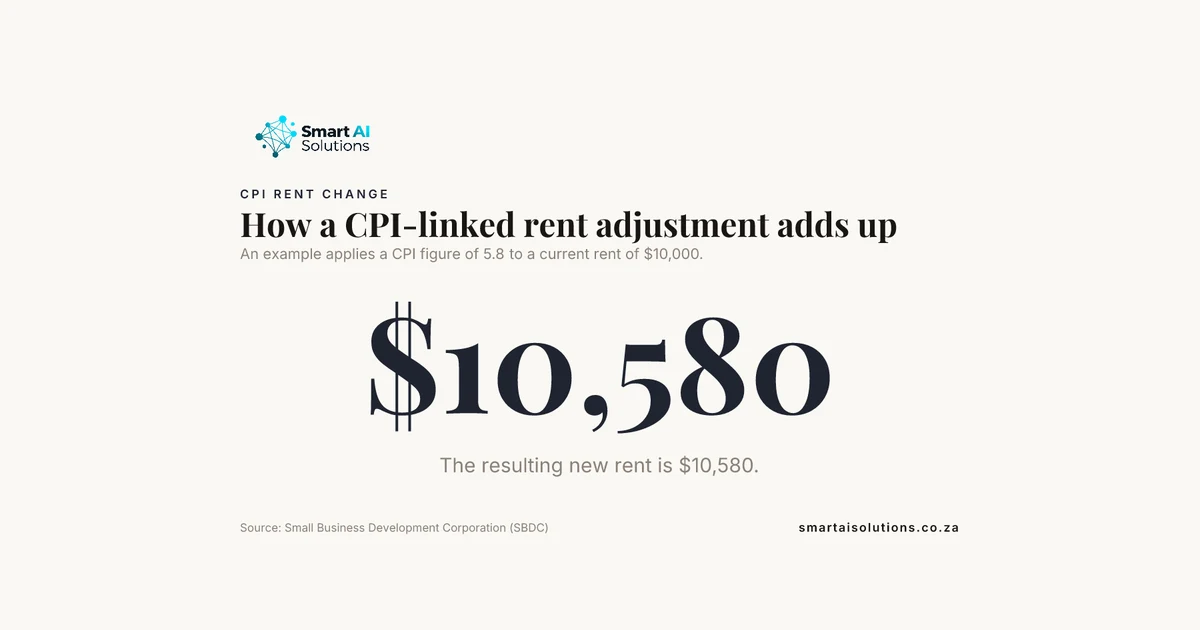
The arithmetic itself is simple. Western Australia's Small Business Development Corporation gives the worked example shown on the cover of this article: a current rent of $10,000 with CPI of 5.8% becomes $10,580 (Australian dollars). What a lease system adds is the timing, the approval and the billing that follow.
Approval before billing, and the rent increase notice
Approval is what stops you looking bad in front of a tenant. A wrong figure caught in the approval queue costs a few minutes. A wrong figure on an invoice costs a phone call and a credit note, and some goodwill with it.
Set the approval rules before go-live:
- Who approves: usually the property accountant or portfolio manager, with a second approver for large tenants or large movements.
- What waits for a person: a cap or floor that changed the result, a negative index movement, a missing index figure, a lease amended since the last review, and any change a tenant has disputed.
- What happens to the rest: routine changes that match the clause can move through quickly, but still carry the approver's name.
The rent increase notice should come from the same approved record, not be typed separately. A good system drafts the rent increase letter with the old rent, the new rent, the index month used and the effective date, sends it by the method and timing the lease requires, and logs the date sent. Your team can then see at a glance which tenants have been told and which have not, before the invoice run starts.
Getting the approved rent into the invoice run
The hand-off into billing decides whether re-keying stops or carries on. There are three common ways to connect a lease system to the invoice run, and the right one depends on where your invoices are raised today.
| Hand-off | Suits | Watch for |
|---|---|---|
| Export file into the accounting or billing system | Teams keeping their current accounting package, with a short checking step before import | Someone must run the import each cycle, and the file layout must match the billing system exactly. |
| Direct link to the accounting or billing system | Portfolios with many leases and monthly reviews | The link must mark each change as sent, so it is never billed twice. |
| The lease system raises invoices itself | Smaller portfolios without a separate billing system | VAT treatment, numbering and statements must meet your accountant's requirements. |
Whichever path you use, three rules keep billing clean. Each approved change moves once and is marked as exported or billed. Nothing unapproved can be exported. And after every invoice run, the approved escalation schedule is reconciled against the invoices actually raised, with any difference investigated before statements go out.
If your lease data and billing live in different systems, our process automation and AI integration services build that link for your existing software rather than replacing it.
The audit trail: what a tenant or auditor can ask for
A good audit trail answers any reasonable question about a rent change without anyone digging through email. When a tenant queries an escalation, you should have the answer in minutes.
For each change, keep:
- the clause wording and the rule taken from it;
- the index series and month used, plus the published value and its release date;
- the calculation, including any cap, floor or rounding;
- who approved it and when;
- the notice, how it was sent and when;
- the invoice or invoices it appeared on, including any back-dated adjustment line.
Keep the tenant billing record separate from the IFRS 16 accounting entries. A rent change can trigger a remeasurement of the lease liability for a tenant that reports under IFRS 16, but the invoice schedule is not that accounting entry. Our guide to CPI escalation calculations and lease reporting covers the reporting side.
Did you know? CPI is not the only escalation in South African commercial leases. Speaking to Property24 in October 2024, Craig Mott of Rawson Property Group said that where a fixed percentage increase is agreed in the lease, it is usually around 8 to 10%. A system that prepares escalations for invoicing has to handle fixed and CPI-linked leases side by side in the same invoice run. Source: Property24
How to choose a lease system that prepares invoicing information
Test the hand-off with your own leases before you sign. A demo with a tidy sample lease shows the calculation. It doesn't show whether your month-end will get any easier.
Run four of your real leases through the whole process:
- A plain CPI lease. Does the change arrive in the invoice run with the index month and effective date attached, and an approver's name on it?
- A lease where a cap or floor applies. Does the record show that the clause set the final figure?
- A lease whose index figure is published after the invoice run. Does the system hold the change and then raise a separate back-dated line?
- A fixed-percentage lease in the same portfolio. Do both types move into billing the same way?
Then ask any provider of property management software in South Africa these questions:
- Which fields go to our billing system, and in what format?
- How does the system prevent a change from being billed twice?
- Can it draft the rent increase notice from the approved record and log when it was sent?
- What does the approval queue look like, and who can approve what?
- How do we reconcile approved changes against invoices after each run?
- What is in the written scope: setup, the billing link, notice templates and support, listed separately?
If you are still at the stage of deciding what the system should track across the portfolio, our articles on renewal reminders and portfolio reports, municipal charges and utility recovery and weighted average lease expiry reporting cover the other lease events that end up on an invoice or in a report.
How we set it up with you
We set it up for you, connected to the lease records and billing system you already use. A named person checks in during the first weeks and answers quickly. The worry most finance teams have is a wrong figure reaching a tenant, so the rollout moves in three stages, at your pace.
- You approve everything. Every rent change, notice and back-dated adjustment is prepared for you to approve before it reaches a tenant. Nothing reaches your tenants without your approval.
- Routine changes run on their own while you stay informed. Once the figures have proved themselves over a few review cycles, changes that match the clause move into the invoice run by themselves, and you see a summary of what was billed.
- Hands-off, only when you choose. You decide which leases move to this stage, and you can move any of them back.
You should see a first real result within 48 hours of go-live: your next due escalations prepared as invoice-ready records, waiting for your approval.
What it costs to set up
Pricing depends on the number of leases, the billing system and the hand-off you choose, so we quote in writing after mapping your month-end process. These are the published starting points:
- Process automation, for the escalation-to-invoice workflow: from R30,000 per workflow.
- AI integration services, where the lease records and billing system need a direct link: from R35,000, quoted per project.
The full lease management offer for property portfolios is described on our commercial property lease management page.
Frequently asked questions
Can a lease management system send rent increase notices to tenants?
Yes. A good system drafts the notice from the approved rent change, sends it by the method and timing the lease requires, and logs the date it was sent, so your team can see which tenants have been told before the invoice run.
What happens if the CPI figure is published after the rent review date?
The system marks the change as awaiting the index and the current rent is billed as normal. Once the figure is published and the new rent approved, the next invoice shows the new rent and a separate back-dated adjustment line for the months already billed.
Should a back-dated rent adjustment replace the earlier invoice?
No. Keep the earlier invoice as issued and raise the difference as its own line with its own reference, so the tenant and your auditor can see why the later invoice was higher.
How do we stop an escalation from being billed twice?
Mark each approved change as exported or billed the moment it moves into the invoice run, block anything unapproved from being exported, and reconcile the approved schedule against the invoices raised after every run.
Can one system handle CPI-linked and fixed-percentage escalations?
Yes, if each lease stores its own rule. Both types should reach the invoice run the same way, with the rule applied, the approval and the effective date attached.
Does an approved rent change also update the IFRS 16 figures?
Not automatically, and it should not be treated as the accounting entry. A rent change can trigger an IFRS 16 remeasurement for a tenant that reports under the standard, but that is a separate accounting step from billing.
Conclusion
Which lease management system can calculate CPI-linked rent changes and prepare information for invoicing? Choose one that turns each approved change into an invoice-ready record, holds changes openly while the CPI figure is outstanding, drafts the tenant notice from the same record, moves the change into the invoice run once, and keeps an audit trail from clause to invoice.
Test it with your own leases, including one whose CPI figure arrives late, before you commit. When the escalation, the notice and the invoice all come from one approved record, month-end billing goes out right the first time.
Start with one problem: get approved escalations into your invoice run without re-keying. Once that runs cleanly, add tenant notices and back-dated adjustments for late CPI figures. Talk to us about process automation, see the commercial property lease management offer, or get in touch to map your month-end.