
The short answerMatch each municipal and utility bill to the lease, recover only the charges each lease allows, and compare every tenant's payments with their actual share each month. You stop losing money on charges that were never recovered, and month-end stops being a spreadsheet marathon.
The short answer
Match each municipal and utility bill to the lease, recover only the charges each lease allows, and compare every tenant's payments with their actual share each month. You stop losing money on charges that were never recovered, and month-end stops being a spreadsheet marathon.
How can a commercial landlord reconcile municipal charges and utilities against lease recovery clauses? Match each municipal bill to the lease and the property, check the account and billing period, allocate only the charges each lease allows, then compare what every tenant has paid with their actual share. Do that every month and you stop losing money on charges that were never recovered, and month-end stops being a spreadsheet marathon.
The method is simple to describe and tedious to do by hand. Every recovered amount has to point back to two things: a lease term that permits it, and a line on a municipal or utility bill that proves it. When both links are kept, tenant statements are easy to explain and under-recovery shows up within weeks instead of waiting for year-end.
Disclosure: Smart AI Solutions wrote this guide and sells the lease management and energy services linked in it.
Key takeaways
Six questions decide whether your municipal recoveries are complete and defensible.
| Question | Practical answer |
|---|---|
| What can you recover? | Only the categories the lease allows, applied with the lease's own allocation method and caps. |
| How do you match a bill to the property? | Check the account reference, service period, charge lines, meter readings, adjustments and credits before posting costs. |
| How do you connect lease wording to the calculation? | Keep a recovery schedule per lease. Our lease management service structures dates, escalations, option rights and special conditions from the lease documents. |
| How do you check utility evidence? | Compare readings with meter records and earlier periods. Our energy optimisation service reviews utility accounts, building-management data and generator logs and specifies sub-metering. |
| How do you handle shared use? | Apply the lease formula: direct readings where available, and a consistent, documented basis for common-area costs. |
| What should the tenant statement show? | Actual charges and the tenant's allocation, then estimates paid and any credit, ending in a balance that traces back to the source bill. |
Start with the lease recovery clause
A recovery holds up when it starts from the lease. Habit is not a source. Read the recovery clause alongside the rent and operating-cost provisions. A net lease may pass specified outgoings to tenants, while a gross lease may include some costs in rent, but the wording of the agreement decides what you can recover.
Make a schedule of every named category, such as rates, refuse, water and electricity. For each one, record the exclusions, caps, allocation formula, review rights and reconciliation dates, so the calculation follows the contract rather than a general assumption about lease type.
Can a landlord charge a tenant extra for electricity? Yes, if the lease permits electricity recovery and the charge follows its stated method. Keep consumption charges separate from rent where the agreement requires it, and make the meter reading, tariff basis and calculation clear.
The lease decides which municipal-account lines are recoverable. Treat capital works, administration fees, penalties and interest as non-recoverable unless the lease clearly authorises that specific category.
If the clauses sit across dozens of PDFs, extract them once into a structured record and have a leasing specialist check it. Our guide to turning lease documents into trackable obligations covers that step, and the same record keeps your recovery schedule tied to the agreement.
Check the municipal account line by line
Most recovery errors start on the bill itself. Check it before you allocate a single rand. Start with the account number or property reference, the billing dates, rates, fixed service charges, refuse, water and electricity. Separate consumption-based items from fixed charges so each can be checked against the right evidence and recovery category.
Match the account and dates to the property and the reconciliation period. If an account covers another site or includes dates outside the period, investigate it. Look at opening and closing balances, and at whether each reading is estimated or actual. Then check every adjustment or reversal, and every credit, before you add any amount to the property's costs.
Compare water and electricity readings with meter records and earlier periods. Query unexplained spikes, repeated charges and estimates that stay uncorrected after actual readings are available. Remove, or resolve separately, any bill line the lease does not let you recover.
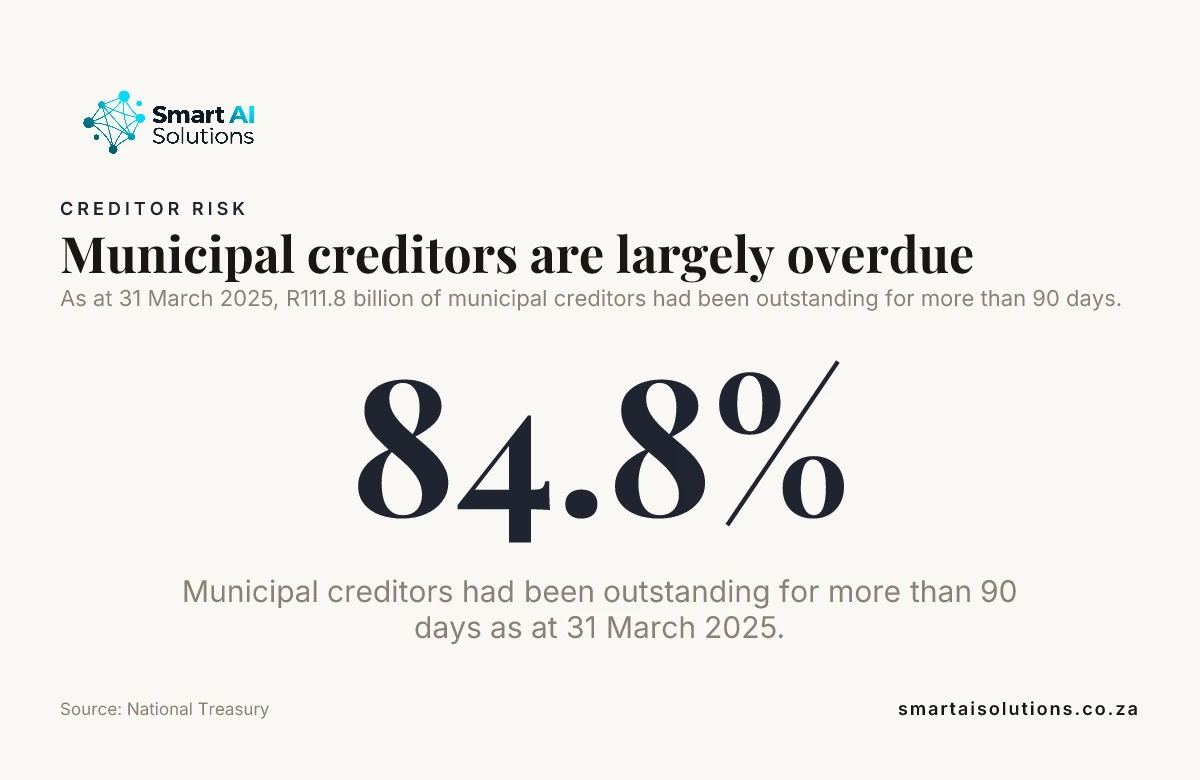
As at 31 March 2025, R111.8 billion of municipal creditors had been outstanding for more than 90 days. Source: National Treasury
When consumption looks wrong and the records cannot explain it, the problem is usually measurement. A review of utility accounts, building-management data and generator logs shows where a sub-meter or sensor would turn an argument into a reading.
Did you know? A total of 113 municipalities failed to pay their creditors within the legislated timeframe of 30 days after receiving invoices in the 2023/24 financial year. Source: National Treasury, State of local government finances report
Allocate direct and shared utility use fairly
A fair allocation is one you can explain to any tenant in a sentence. Charge directly metered consumption to the tenant whose meter records it, using readings for the relevant period. Keep that amount out of the shared pool so the same electricity or water is never recovered twice.
How should you allocate shared water or electricity when there are no separate meters? Use the allocation method in the lease. If it allows a choice, use a supportable basis such as a documented usage measure or floor area, and record why that method suits the shared service.
For a floor-area allocation, divide the tenant's applicable area by the total area in the relevant pool. Use the same area basis for every tenant in that pool, and document how shared meters, vacant space and any lease-approved occupancy adjustments affect the calculation.
Keep tenant-specific costs out of common-area charges. A clear allocation schedule names each meter or cost pool, the tenants included, the chosen basis and any adjustment, so you can explain each tenant's share.
Reconcile estimates against actual costs
The year-end reconciliation separates the final cost from the instalments already collected. For each recoverable category, calculate the tenant's share of actual charges, apply any municipal credit on the same allocation basis, then subtract the tenant's estimated payments for that period.
For example, assume recoverable rates are R12,000, shared water is R3,000, direct tenant electricity is R2,000 and a property credit is R500. A tenant with a 25% share of rates and shared water, and all of the direct electricity, has actual costs of R5,625: R3,000 + R750 + R2,000 − R125.
If the tenant has already paid R5,000 in estimates, the balance due is R625. If payments exceed actual costs, show the resulting credit rather than carrying the estimate forward as though it were the final cost.
Estimated, disputed, corrected or delayed municipal bills need a clear status in the working papers and on the tenant statement. Mark provisional amounts as provisional, then make any later adjustment under the lease and applicable South African law. The lease and the circumstances decide the deadline or remedy.
Find under-recovery before it becomes a write-off
Under-recovery is money you paid the municipality and never billed on, and it hides in the gap between what the bill says and what the tenant statement says. Compare, category by category and property by property, the recoverable cost on the bills with the amount actually billed to tenants. Any gap that the lease does not explain is a leak. Accountants call this work tenant recoveries, and in shopping centres it usually sits inside the CAM (common-area maintenance) reconciliation.
The usual causes are predictable:
- Tariff changes not passed through. The municipal financial year starts on 1 July, so check each account against the new year's tariffs then. Tenant estimates left at last year's rate fall behind the bill.
- Meters not read or not mapped. A tenant sub-meter that nobody reads, or that is linked to the wrong unit, sends that tenant's usage into the shared pool or the landlord's own cost.
- Vacancy and occupancy changes. Costs for vacant space correctly stay with the landlord, but a unit that has been let again keeps being treated as vacant.
- Categories missing from the schedule. A lease allows a recovery, such as refuse or a fixed service charge, but the category never made it into the recovery schedule.
- Credits and reversals posted once, never shared. The property receives a credit and the matching tenant adjustment is never calculated.
Give each gap an owner and a status: explained by the lease, to be billed, or to be queried with the municipality. An understood gap isn't a loss yet. Leave one alone for a year and it usually becomes one, because older amounts are harder to bill and harder to defend.
Run a monthly recovery check
A short monthly check ends the year-end scramble. Instead of reconciling twelve months at once, check each new municipal and utility bill when it arrives and keep the reconciliation current.
- Bill in. Confirm the account, property, period and readings, and flag any utility charges based on estimated readings.
- Lines classified. Map each charge line to a recovery category, or mark it non-recoverable with the reason.
- Allocated. Apply direct readings and the lease formula for shared pools, tenant by tenant.
- Compared. Set the month's allocated cost against tenant estimates billed, and list every gap.
- Actioned. Raise under-billed amounts, adjust estimates that are drifting, and log queries with the municipality.
Teams that run this every month find the year-end reconciliation becomes a review of twelve closed months rather than a rebuild. If several reporting feeds have to come together for it, the same approach appears in our guide to automated CPI escalation calculations and lease reporting.
We set this up with you. The worry nobody says out loud is a wrong statement landing on a good tenant's desk, so the rollout runs in three stages:
- Everything is drafted and you approve it. Allocations, statements and query letters wait for your sign-off, so nothing reaches your tenants without your approval.
- Routine tasks run on their own while you stay informed. Bill capture, line classification and the monthly gap list run by themselves, and you see a summary.
- Hands-off, only when you choose. You decide whether, and for which properties, statements go out without a check.
We do the setup for you. You should see a first real result within 48 hours of go-live, and a named person checks in during the first weeks and answers quickly.
Make the calculation independently verifiable
Tenants accept a recovery they can follow from the bill to their balance. Trace every amount through the same sequence: municipal account line, property ledger entry, allocation worksheet and tenant statement. Reconcile the totals at each step.
Itemise the statement by category and period. Show the actual property cost and the tenant's allocation percentage or meter reading. Below that, show estimates paid and any credit, ending with the final balance. Never fold unrelated municipal charges into one unexplained recovery line.
Keep the municipal bills, meter readings, area schedule, ledger entries, allocation workings, tenant payments and correction history. These records support the lease's review or audit process and settle questions about source amounts, allocation choices and revisions.
A lease management system that holds lease dates and obligations, calculates escalations, sends notifications and produces portfolio reporting can keep the recovery category, allocation basis and supporting calculation in the same record. Our guide to choosing a lease management system for a commercial property portfolio covers what to evaluate.
Did you know? South Africa's metros budgeted for an 87.9 per cent collection rate and collected only 58.2 per cent in the third quarter of 2024/25. Source: National Treasury
Resolve exceptions, disputes and tenant changes
Disputes go quickly when the evidence is already assembled. What should you do when a tenant disputes a reconciled charge? Respond with the source bill, the calculation and the lease provision, then follow the agreement's review or audit process. Keep disputed amounts separate from undisputed amounts in correspondence and in the account records.
If a municipal bill is estimated or challenged, record that status instead of presenting it as a settled actual cost. Update the tenant calculation when a corrected bill, reading or credit changes the amount, and keep both the original and the revised workings.
For a tenant moving in or out mid-period, use the lease's apportionment rule and align the calculation with occupancy dates, meter readings and the municipal billing period. Check whether direct consumption can be split from readings at the changeover, then apply the lease's rule to the remaining shared costs.
Before you issue the statement, check for duplicate recovery. A tenant-specific utility charge must not also sit inside shared costs. Document any correction and show the resulting credit or balance clearly.
Frequently asked questions
How should a landlord allocate a municipal account that covers more than one commercial property?
Separate each property's charges using property-specific meters, municipal valuations, service records or another documented driver that reflects the cost. Reconcile each property's share before any tenant-level allocation, and keep the basis used for charges that cannot be separated directly.
What should happen if a municipal credit arrives after a tenant has moved out?
Recalculate the former tenant's share for the period that generated the credit and issue an updated closing statement. Apply or return the credit according to the lease and the parties' account arrangements, rather than assigning it automatically to the incoming tenant.
Can a landlord recover a disconnection or reconnection fee from a tenant?
That depends on whether the lease covers that specific fee and whether the charge arose from the tenant's responsibility. Keep the municipal fee evidence and the reason for the disconnection with the reconciliation so the basis for recovery is clear.
Should VAT be added to municipal and utility recoveries?
Do not add VAT automatically to every pass-through amount. The treatment depends on the landlord's VAT position and the nature of the recovery, so keep it consistent with the underlying transaction and get tax advice for the arrangement.
How should you handle a municipal tariff change during a billing period?
Use the municipality's billed tariff breakdown, or divide the consumption across the tariff's effective dates when the records support that split. Apply the lease's recovery terms to the resulting charge and keep the tariff dates and calculation with the account evidence.
Can a tenant ask to inspect the documents behind a utility recovery?
The lease may set the scope and process for reviewing supporting records, including notice and access arrangements. Keep a tenant-ready evidence pack with the relevant bill lines and calculation extracts so the review can focus on that tenant's charges.
Conclusion
How can a commercial landlord reconcile municipal charges and utilities against lease recovery clauses? Confirm the lease category, check each municipal line, allocate direct and shared use consistently, compare actual costs with estimates and credits, and look for under-recovery every month. Do that and unbilled charges stop leaking money. Month-end turns into a check. Every recovered amount then connects to a permitted lease term and to verifiable property evidence.
Start with one problem: the recovery schedule. Our lease management service captures each lease's recovery clauses so every bill line has a rule to follow. Once that runs, add the next one: energy optimisation reviews your utility accounts and specifies sub-metering, so shared costs become readings. To talk through your portfolio, contact us.