The short answerYes. AI lease abstraction software can find the obligations in commercial lease documents and organise them into structured fields, and once a person has reviewed them, the approved records can drive tasks, reminders and lease administration workflows.
The short answer
Yes. AI lease abstraction software can find the obligations in commercial lease documents and organise them into structured fields, and once a person has reviewed them, the approved records can drive tasks, reminders and lease administration workflows.
Yes, AI lease software can extract obligations from commercial lease documents and turn them into trackable records. Lease abstraction finds the relevant lease language, organises it into structured fields and, once a person has reviewed it, feeds the approved information into tasks and reminders, and from there into lease administration workflows.
Extraction is the easier half. A record becomes trackable only when it has an owner, a trigger, a due date, a status and a link back to the clause it came from.
Key takeaways
Property teams usually ask the same six questions about AI lease abstraction.
| Question | Short answer |
|---|---|
| Can AI review a commercial lease? | Yes. Document processing and natural language processing can locate and classify terms for a person to review. |
| What makes a lease record trackable? | It holds the obligation, owner, trigger, deadline, status and supporting clause as separate fields. |
| Can AI create reminders and tasks? | Approved records can drive tasks with an owner, a due date and a place for completion evidence. |
| How should teams handle amendments? | Update the lease record while keeping the earlier terms, their effective dates and the source documents. |
| How can a reviewer check an extraction? | Use the source-clause reference to compare the extracted field with the original wording and its context. |
| Where can we learn more about clause review? | Our AI contract review and analysis service covers structured clause review for legal teams. |
Can AI extract obligations from commercial leases?
AI lease abstraction reads a lease with document processing and uses natural language processing (NLP) to identify and classify the relevant wording. It fills structured fields with candidate terms, but the output is a lease abstract for review. It is not a legal interpretation.
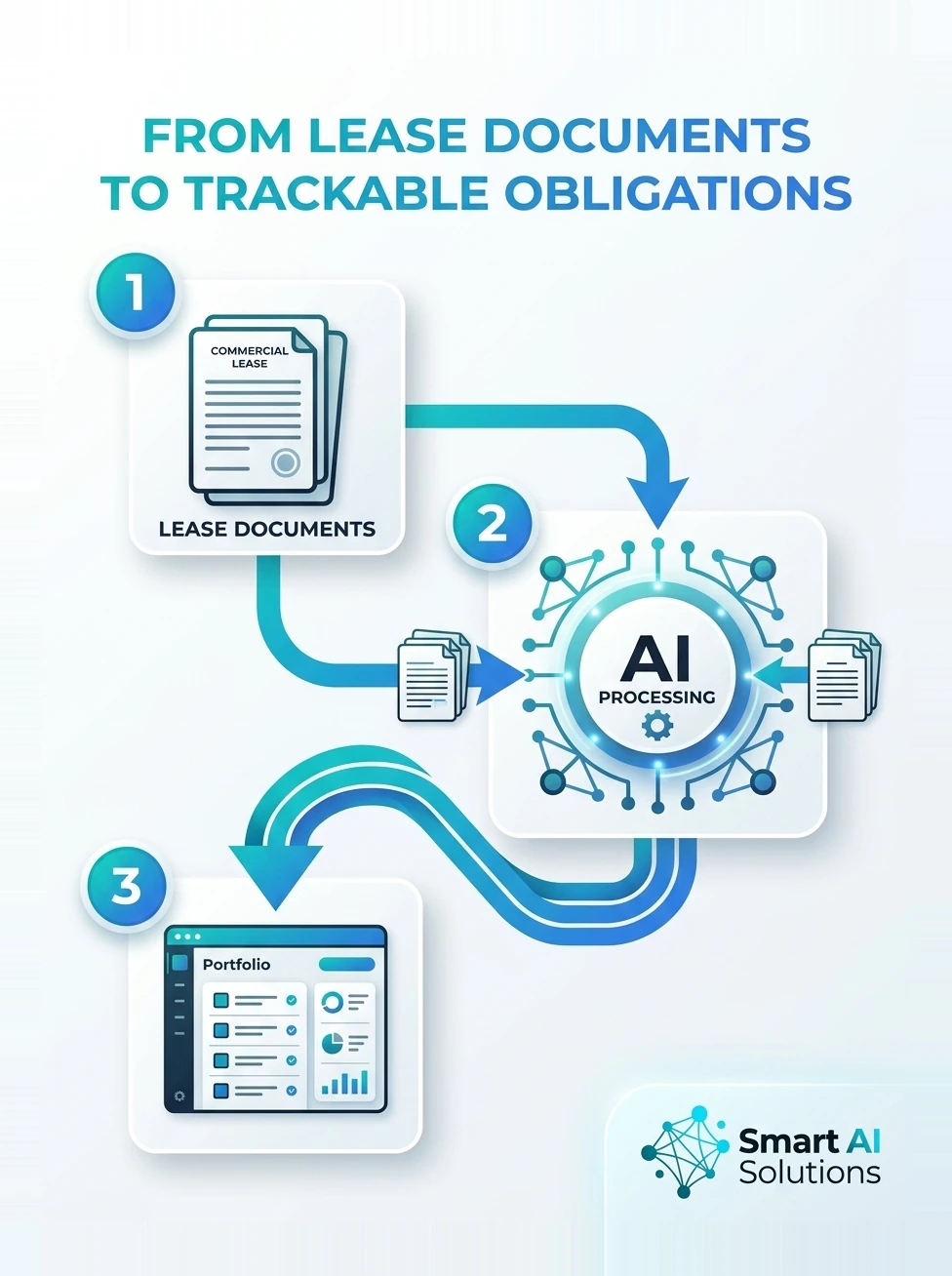
A typical workflow has five stages:
- Add the lease as a PDF, a Word document or an existing data extract.
- Extract machine-readable text, using optical character recognition (OCR) where pages are scanned.
- Locate candidate clauses, dates, rights and duties.
- Map what was found into defined fields.
- Check the material entries, approve them and send the right records into an operating workflow.
A narrative lease summary gives someone a quick overview. A trackable record captures one obligation in separate fields: who must act, what triggers the action and when it is due. That lets the team search for it, assign it and follow it through.
For portfolios that need structured lease data extraction, our AI Lease Abstraction Engine processes lease PDFs, Word documents and existing data extracts. It pulls critical dates, escalation mechanisms, option rights and special conditions into a structured database that leasing specialists validate. That is the better fit when teams need to move from document review to an approved abstract.
Which lease terms should become structured fields?
Financial terms work best when each part of the payment obligation has its own field. Useful fields include the parties, the premises, rent, operating costs, the escalation method, payment timing and any condition that changes the amount due.
Critical dates need the details that explain them. A renewal or option deadline, for example, belongs with its trigger, notice period, responsible party and required action. A date by itself doesn't tell the team what to do.
Rights and responsibilities need separate entries too. Depending on the lease, these may include:
- Renewal, expansion, termination or other option rights
- Maintenance and repair duties assigned to the landlord or the tenant
- Insurance requirements and the evidence that goes with them
- Permitted uses, restrictions and conditions
- Recurring obligations, and duties that only apply after a specified event
Keeping these terms apart lets a team find the particular right or duty it has to administer, instead of searching a broad abstract for a one-line description.
Build a record that can drive follow-through
A consistent schema is what makes lease obligations searchable across a portfolio. For each record, capture the obligation, the responsible party, the trigger, the due date, the notice period, the frequency, the status, the source clause and the evidence of completion.
An extracted summary does not complete anything. Every obligation that needs action should become an operational task with an owner, a trigger, a due date, a status and somewhere to keep the completion evidence. That keeps responsibility and progress visible.
Recurring and conditional duties need fields that keep their logic intact. Give a recurring obligation a recurrence rule. Record a conditional obligation's condition and the event that activates it. Without those fields, repeated or event-dependent requirements tend to become vague notes, which is where the trouble usually starts.
Approved records can then support reminders, portfolio views, reporting and connected lease management workflows. Our AI commercial lease management system is built to centralise critical dates and obligations, calculate escalations, trigger notifications and action workflows, and produce portfolio-level reporting for teams that need extraction to lead straight into administration.
Use the same core fields across the portfolio so teams can search and report consistently. Keep lease-specific details in extra fields or linked notes. That balance supports portfolio work without squeezing different conditions into an oversimplified record. If you are still choosing the system that will hold these records, our guide to evaluating a lease management system sets out what to check.
Reconcile amendments without erasing the record
Amendments, addenda, notices and related documents are updates to the same lease record, not new records. Keep the earlier terms, their effective dates and the documents they came from, so anyone can follow how the agreement changed.
When wording conflicts, identify which later document changes which clause, and from when. Keep the previous entry and its history rather than silently overwriting it. That trail explains why a current task or deadline differs from the original lease.
Send unclear, inconsistent or condition-dependent changes to a reviewer before they touch live tasks. A revised trigger or notice deadline can change what the team must do, so an uncertain change should never reset an operational reminder on its own.
Review source clauses, scans and uncertain extractions
Every material field should be checked against the exact clause it came from. Compare the extracted value with the source wording and the text around it. A clause reference or document link gives the reviewer a direct route to that check, instead of making them rely on a summary.
Use confidence indicators to decide what a person reviews first, not to replace the review. Send ambiguous or conflicting clauses for judgement, and keep a correction history so the team can see what changed and who approved the updated record.
OCR turns scanned pages into machine-readable text, but that text still needs quality checks. A missing or garbled character can change a number, a date or a condition. Embedded tables, handwritten changes, exceptions and cross-references all need a closer look.
Qualified people decide how ambiguous legal language applies. Automated extraction can organise the wording and point reviewers to the relevant clauses. Legal judgement stays with the people responsible for interpreting the agreement.
Track rent changes through the right workflow
A rent escalation is easier to check when its parts are recorded separately. Store the escalation method, the rate or index, the effective date and any condition as separate fields, so the team can check the inputs and schedule the change against the clause rather than a broad note about an upcoming increase.
The lease management system can calculate index-linked and fixed-percentage escalations and trigger notifications and action workflows at the lead times you configure. Our article on rental escalation calculations and lease reporting covers the calculation side in detail.
Keep each calculation traceable to the approved lease data. If a reviewer changes the escalation method, the rate or the trigger date, update the record and check the resulting timing before billing goes ahead.
Evaluate lease abstraction software against the workflow
Lease abstraction software should be judged on the whole workflow, not extraction alone. Compare manual abstraction with AI-assisted review on repeatability, review effort, exception handling and how easily approved information moves into ongoing administration. Keep human approval for uncertain or consequential terms, where an extraction error could affect a right, a deadline or a payment.
Test with the lease types and document formats your team actually handles. Include amendments, tables, scanned pages, conditional clauses and source-clause traceability, so the evaluation reflects the hard parts of commercial lease abstraction and daily lease administration.
Check whether the system can search and report on records, export data and connect to property management or billing systems. Access controls and correction histories matter as well, because they support accountable handling of sensitive lease information and changes.
Define a shared core schema for the portfolio, then preserve the differences that matter in wording, jurisdiction and lease-specific conditions. A common structure makes records easier to manage. Room for specific terms stops important distinctions from disappearing.
During a pilot, track whether reviewers can verify extracted fields efficiently and whether approved tasks reach the right people at the right time. Treat exception handling and change history as part of the workflow, not as extras added after extraction.
Frequently asked questions
These are the questions property teams ask most often once a lease abstraction pilot is on the table.
Can AI lease abstraction process handwritten changes in a lease?
Some systems can attempt to read handwriting, but results depend on legibility and the document-processing tools in use. For an alteration, keep the marked-up page and read the changed wording together with the initials and the date beside it, so the record reflects the complete change.
What should a team do if a lease scan is missing pages?
Reconcile the page numbers, schedules and annexures against the document's contents, and obtain a complete signed copy before treating the abstract as complete. Flag any records that depend on the missing material, so nobody mistakes an incomplete review for an approved set of obligations.
Can AI extract obligations from leases written in more than one language?
It can when the software supports the relevant languages and the extraction model has been configured for them. Keep the original wording alongside any translated field, and have a reviewer fluent in the source language resolve terms whose meaning depends on local phrasing.
Should an AI-generated lease record be treated as the legal source of truth?
No. The record is an administrative representation of the lease, while the signed agreement and its signed amendments remain the documents to consult when legal effect matters. Link each approved record to those documents so a user can move from a task to the underlying agreement.
How can we pilot AI lease abstraction without disrupting current lease administration?
Run a controlled pilot on a defined group of leases and keep the established process running for active deadlines. Compare reviewer corrections, the time spent resolving exceptions and successful task handovers to decide whether the workflow is ready to expand.
Can a lease obligation involve more than one responsible party?
Yes. Record each party's role separately, including whether they must act jointly, provide information or approve another party's action. That gives the team a clearer way to assign follow-up without implying that one person controls the whole obligation.
Conclusion
AI lease software can extract obligations from commercial lease documents and turn them into trackable records. It works when teams move beyond a narrative abstract to structured fields, connect each actionable obligation to an assigned task and keep a clear trail back to the source clauses and later changes.
Lease abstraction can make commercial lease administration more searchable and consistent, but reliable tracking still depends on review, a practical record schema and careful handling of amendments. The most useful result comes when approved records drive real workflows while the underlying documents and their change history stay easy to inspect. To see how this would work on your own leases, talk to us about a pilot.