The short answerChoose a provider that builds the call routing as well as the voice: every call answered, each qualified caller passed to the right staff member live or as a booked callback, and their details and a short summary already captured for your team.
The short answer
Choose a provider that builds the call routing as well as the voice: every call answered, each qualified caller passed to the right staff member live or as a booked callback, and their details and a short summary already captured for your team.
Which provider can build a voice agent that answers customer calls and routes qualified enquiries to staff? Choose one that designs the call routing as carefully as the conversation, so every call is answered and each qualified caller reaches the right person, live or as a booked callback, with their details and a short summary already captured.
That is the part owners feel. No more missed calls during a busy morning, and no more staff phoning back strangers with nothing but a number on a sticky note. Smart AI Solutions builds that routing step with you and stays with it after launch.
This guide covers the step after qualification: who gets which call, when to transfer live and when to book a callback, what lands in front of your staff, what happens after hours and when nobody picks up, and how to choose a provider that will build all of it. If you still need to decide what the agent should ask, start with our guide to a voice agent that qualifies customer enquiries.
Key takeaways
These are the choices that settle whether a qualified caller ends up talking to the right person.
| What to decide | What good looks like |
|---|---|
| Live transfer or callback | Each enquiry type has a rule: transfer now when someone suitable is free and the caller is ready, otherwise book a callback slot the caller agrees to. |
| Who gets which call | Calls go by enquiry type, area, existing customer and skill, with a named backup for every destination. |
| What staff receive | A short summary with the caller's name, confirmed number, reason for calling, qualification answers and the promised next step. |
| Nobody available | A fallback chain that ends in a booked callback or a message, never a dead line or an endless ring. |
| After hours | A separate path for urgent calls to an on-call person, and a morning list for everything else. |
| Provider fit | A written scope that covers routing rules, telephony, integrations, testing and who tunes the agent after launch. Our AI integration services cover the connections between the phone system, CRM and calendars. |
What routing does once a call is qualified
Routing is the step that turns an answered call into a conversation with the right person on your team. A phone-based voice agent combines telephony, which connects the call, speech recognition, which turns spoken words into text, conversational AI, which works out what the caller needs, and text-to-speech, which speaks the reply. Those parts handle the talking. Routing decides where the call goes next.
Most voice-agent demos stop at a pleasant voice and a few good answers. Fine, but that's the easy bit. The call only pays off when it ends with the right outcome: a quote request reaching the estimator, a booking reaching the person who runs the diary, an existing customer reaching their account manager.
The questions that decide who is qualified are covered in our voice agent qualification guide. If most of your calls are inbound sales calls, our guide to voice agents for inbound sales calls covers the sales flow. This article picks up from the moment the agent knows what the caller wants and whether they are ready for a person.
A traditional keypad IVR menu ("press 1 for sales, press 2 for accounts") routes by the button the caller chooses. IVR simply means an automated phone interaction, so a modern IVR can include AI; the difference that matters is how the routing decision is made. A voice agent routes by what the caller actually said, plus what it has confirmed, plus who is free right now. That difference is why you'd build one. It's also why the rules have to be written down before anyone configures anything.
Live transfer or booked callback: decide per enquiry
A live transfer is the best outcome when a suitable person is free and the caller is ready to talk now. A booked callback is better when the right person is busy, the enquiry needs preparation, or the caller would rather speak at a set time.
Write the rule for each enquiry type. For example:
| Enquiry type | Default route | Why |
|---|---|---|
| Urgent service or breakdown | Live transfer to the on-duty person, then their backup | The caller has a problem now, and a callback feels like being ignored. |
| New quote with clear details | Live transfer if an estimator is free, otherwise a callback slot within business hours | A warm caller is easiest to win while they are still on the phone. |
| Appointment or booking | Book directly in the shared calendar where the agent is allowed to, otherwise a callback from the person who runs the diary | Many bookings need no conversation at all. |
| Existing customer with an account query | Transfer to the account owner, or a message to them with the query attached | The person who knows the account answers faster. |
| Complaint or distressed caller | Live transfer to a senior person, with a callback as the fallback | These calls need someone's judgement. |
A warm transfer, where the agent briefly tells the staff member who is on the line before connecting, is worth the extra seconds for high-value or sensitive calls. A cold transfer suits simple, high-volume calls where the summary on screen is enough.
When the agent books a callback, it should confirm the time and the number back to the caller, say who will call, and put the booking in that person's calendar. A callback promised by the agent and then forgotten is worse than a missed call. The customer was told it would happen, and it didn't.
Who gets which call
Routing rules work best when they match how your team already divides the work. Start with the questions your receptionist or office manager answers in their head on every call.
- By enquiry type. Sales, bookings, support and accounts go to different people or teams.
- By area or branch. A caller in Paarl goes to the Paarl branch, a caller in Durban to the Durban team.
- By customer status. A known customer's number can go to their account owner first. A new caller goes to whoever handles new enquiries.
- By skill. Skills-based routing sends a technical question to the person who can answer it, and a Zulu-speaking caller to a staff member who speaks Zulu where you have one.
- By availability. Ring the first free person in a group, rotate new enquiries fairly between salespeople, or ring a whole group at once for urgent calls.
Recognising a known number identifies the phone, not the person holding it. Decide how the agent confirms who is calling before it shares anything account-specific, such as a balance, an order status or an appointment detail.

Give every destination a named backup. People go on leave. They step out for lunch, or they're stuck in a meeting. The rule "if Thabo does not answer in 20 seconds, try Lerato, then book a callback" is easy to write down and easy to test.
Keep the rules short enough that a new staff member can read them on one page. If your team needs a flowchart with thirty branches to understand where calls go, callers will feel it too.
What lands with staff: the call summary
The summary is what makes a routed call useful. Staff should be able to pick up the conversation without asking the caller to repeat themselves.
| Field | Example of what it holds |
|---|---|
| Caller | Name as confirmed on the call, and whether they are an existing customer |
| Contact number | The number the caller confirmed, read back to them, including when their number was withheld |
| Reason for calling | One or two plain sentences in the caller's own terms |
| Qualification answers | The answers your rules require, with unknown answers marked as unknown, never guessed |
| Urgency | What the caller said about timing |
| Promised next step | Transfer, callback at a stated time, or message, and who owns it |
| Transcript or recording link | For checking detail, where your privacy rules allow it |
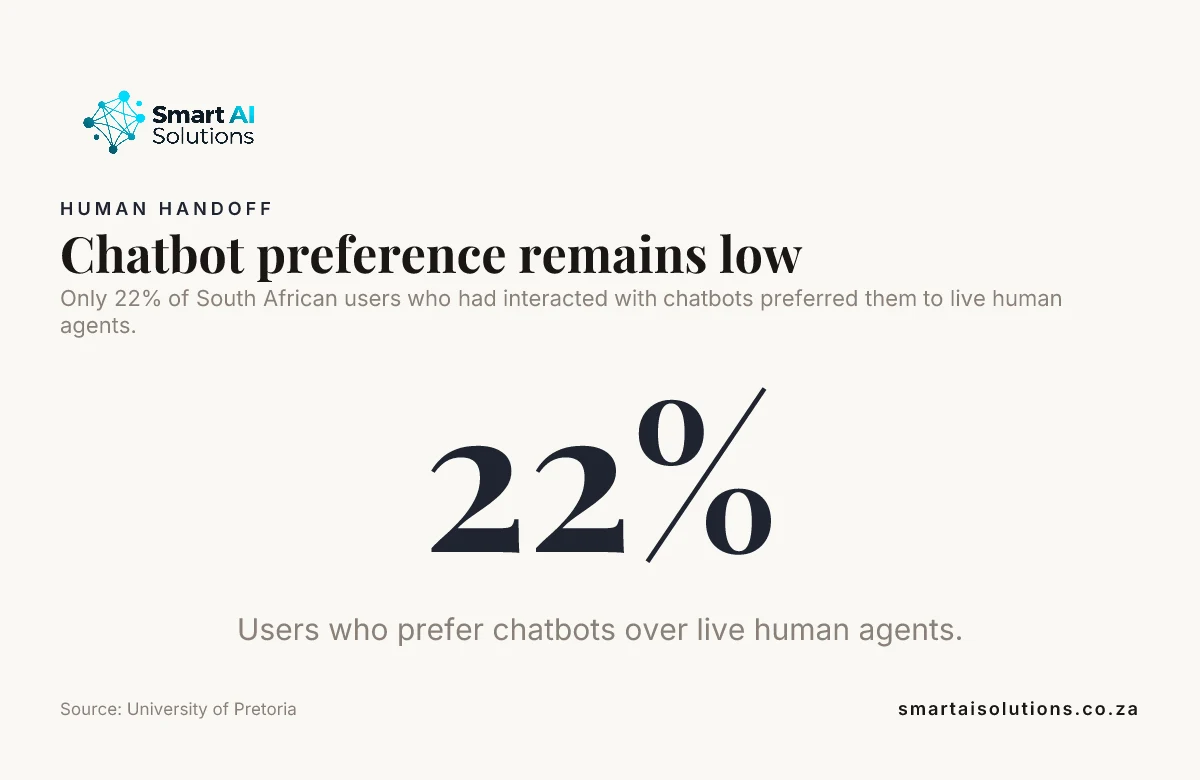
Did you know? In a 2025 University of Pretoria study of South African chatbot users, 77% said chatbots were helpful with their customer service queries, yet only 22% preferred a chatbot to a live human agent. Customers are happy to be helped by automation, as long as a person is easy to reach when it matters. Source: University of Pretoria (Boikanyo, 2025)
Decide where the summary appears. During a live transfer, staff need it on screen or on their phone before they say hello. For callbacks, it belongs in the CRM record and in the calendar booking, so the person calling back has it in one place. If your enquiries already flow into a CRM, our article on connecting enquiries to your sales team shows the same principle for WhatsApp, and CRM and sales automation covers the CRM side.
When nobody picks up
A call that nobody answers should still end with a clear next step for the caller. Design the fallback chain before launch, because this is where callers decide whether the business is reliable.
- Try the first destination for a set number of seconds.
- Try the named backup, or ring the group.
- Tell the caller plainly that nobody is free right now. Never imply they reached a person when they did not.
- Offer a callback at a time they choose, and confirm it back to them.
- If they decline, take a message with the summary attached and send it to the right person.
- Flag the call on the missed-call list so someone checks it was handled the same day.
Also plan for a failed transfer or a system outage. If the transfer drops, the caller should hear an explanation and be offered a callback, and the summary should still reach staff. It should never just go dead.
Inside the business, a callback that nobody accepts needs its own time limit and escalation. Our guide to handovers between support, operations and sales covers ownership and escalation between teams, so the voice agent only needs to hand the case over cleanly.
After-hours and urgent calls
After-hours calls are where a voice agent often earns its keep first. A caller at 19:30 still gets an answer. The urgent ones reach someone, and the rest wait for your team in the morning with the details already captured.
Write three things down:
- What counts as urgent. A burst geyser for a plumbing firm, a client locked out of their building for a security company, a sick animal for a vet. Be specific, so the agent does not wake someone for a quote request.
- Who is on call, and how they are reached. Call forwarding to the on-call mobile, with a backup number if they do not answer.
- What everyone else hears. A clear statement of when the office opens, a callback booked for the morning, and a message for the right person.
Business-hour rules should follow your real hours, public holidays included. A Friday afternoon early close or a December shutdown needs its own setting, otherwise callers are routed to empty desks.
Test the routing with real calls before go-live
Testing proves that every route ends where it should. Run messy, unpredictable calls as well as the prepared script: misheard names and numbers, background noise, interruptions, callers who change their minds and callers who refuse to answer qualification questions.
Check each route end to end:
- Qualified enquiry. The caller reaches the intended person or team, and the summary arrives with the required fields.
- Unqualified enquiry. The agent follows the agreed alternative, such as a brochure by email or a general callback.
- Incomplete enquiry. It asks one focused follow-up question or offers a callback.
- Staff unavailable. The fallback chain runs, and the caller ends with a booked callback or a message.
- Failed transfer or outage. The caller hears an explanation and the summary still reaches staff.
- After hours. Urgent calls reach the on-call person, and everything else lands on the morning list.
For South African deployments, test your local numbers and telephony provider, and the languages, accents and place names your callers use. Include callers who switch between languages mid-sentence. When the agent is unsure of a phrase, it should ask or hand over, not guess the enquiry type. Listen to what callers hear while a transfer connects, too. Run the tests with the people who take those calls today. They'll spot a confusing question or a missing detail faster than anyone.
Did you know? The same University of Pretoria study found that 58% of South African users experienced improved customer service through chatbots. That improvement depends on what happens when the conversation needs a person, which is why the routing and the fallback chain deserve as much testing as the greeting. Source: University of Pretoria (Boikanyo, 2025)
Record acceptance criteria before testing, such as "the call reaches the correct destination" and "the summary contains the confirmed number and the reason for calling". Then use transcripts and summaries to find where a route or an integration needs adjusting.
How to choose a provider that builds it
The right provider starts with your calls and your team, and only then shows you a product. Ask them to map your routing rules before they quote, and to show a test call reaching a real staff phone with a real summary.
Providers usually offer one of three things:
- A managed service. The provider shapes the call flows and routing, connects your systems and supports the agent after launch. This suits businesses without someone in-house to own it.
- A configurable platform. You or your team build and maintain the flows in the provider's tool. This needs a clear internal owner.
- Developer tools. Voice and telephony building blocks for a team that will write and run the integration itself.
Whichever you choose, ask these questions:
-
Can the agent transfer to mobile numbers as well as desk phones, and do a warm transfer?
-
Can you show a full test call, with interruptions, an unclear request and a change of mind, rather than a scripted demo?
-
Can it book callbacks into our calendars and write the summary into our CRM?
-
What happens, exactly, when a transfer fails?
-
How are after-hours, public holidays and on-call rotations set?
-
Who changes the routing rules when staff or branches change, and how quickly?
-
What is in the written scope: setup, telephony, integrations, ongoing support and any usage-based charges, listed separately so proposals compare on the same basis?
Smart AI Solutions builds voice agents as a managed service. We map your routing rules with you, connect the phone system, CRM and calendars, test with your team, and keep looking after it once it's live.
Privacy, recordings and ongoing ownership
Callers should know what is captured and why. Agree what the system collects, including recordings, transcripts and summaries, who can see each one, and how long each is kept. Set those rules to fit your business and South Africa's privacy law, and tell callers clearly that they are speaking to an automated agent. Our article on POPIA compliance for AI chatbots covers the basics.
Measure the outcomes that matter to the business: how many qualified calls reached the right person, how many transfers succeeded, how many callbacks were made on time, and how many calls ended without a next step. Call volume on its own does not tell you whether routing works.
Neither does the share of calls the agent completes without a person. A high figure means little if qualified enquiries are misrouted or never get a response.
Give someone ownership of the routing rules, business information, failure reviews and integration support. Staff change, branches open, services shift. The routing has to keep up.
How we set it up with you
We set it up for you. A named person checks in during the first weeks and answers quickly. The worry most owners have is a customer hearing something wrong in the business's name, so the rollout moves in three stages, at your pace.
- You approve everything. The agent says only what you have approved, and every callback message or follow-up is drafted for you to approve before it reaches a customer. Nothing reaches your customers without your approval.
- Routine calls run on their own while you stay informed. Once the routes have proved themselves, routine transfers and callbacks run by themselves, and you see a daily summary of every call and where it went.
- Hands-off, only when you choose. You decide which call types move to this stage, and you can move any of them back.
You should see a first real result within 48 hours of go-live: real calls answered, routed and summarised for your team.
What it costs to set up
Pricing depends on the number of call types and the systems involved, so we quote in writing after mapping your calls. These are the published starting points:
- AI Chatbots & Assistants: from R15,000 once-off setup.
- AI Integration Services, for connecting the phone system, CRM and calendars: from R35,000, quoted per project.
- CRM Lite, if you need a CRM for the summaries and callbacks to land in: R15,000 once-off setup plus R2,999 per month SLA.
Telephony and any usage-based charges are listed separately in the written scope, so you can compare proposals on the same basis. For a wider view of costs, see our AI automation pricing guide.
Frequently asked questions
Can a voice agent transfer a call live to a staff member's mobile?
Yes, where the telephony is set up for it. The agent can transfer to desk phones, mobiles or a ring group, and do a warm transfer that tells the staff member who is calling before connecting. If the transfer fails, the agent should explain and offer a callback.
What happens if nobody answers when the agent tries to transfer a call?
It follows the fallback chain you agreed: try the backup person or group, then tell the caller nobody is free, offer a callback at a time they choose, or take a message. The summary still reaches the right person, and the call appears on a missed-call list for same-day follow-up.
Can a voice agent answer calls after hours and route urgent enquiries differently?
Yes. The call flow uses business-hour rules and a separate urgent path. Define what counts as urgent, who is on call, and what the agent offers when the on-call person does not answer, such as a backup number or a first-thing callback.
What should the agent do if a caller refuses to answer qualification questions?
It should respect the caller's choice and not treat missing details as qualified. Offer a transfer to staff or a message, according to your agreed process, and mark the unanswered questions as unknown in the summary.
Can a voice agent handle calls to more than one business number?
Yes. Several numbers can point to the same agent with different greetings and routes, for example one per branch or one for sales and one for support. Keep each number's audience and destination clear so callers reach the right team.
What can the agent do when a caller's number is withheld?
It can ask for a preferred contact number during the call and read it back for confirmation before passing it to staff with the summary.
What happens if a caller hangs up before answering the qualification questions?
The call is recorded as incomplete, keeping only the details the caller gave and the business may retain. The agent should not fill gaps with guesses or mark the enquiry qualified. Staff get a follow-up task with the call time and any contact details, and the outcome is logged so the call does not slip through.
Can a voice agent handle more than one caller at a time?
That depends on the capacity configured on the voice platform and the connected phone service. Ask the provider what happens when simultaneous calls exceed that capacity, including what callers hear and where those calls go.
Can the same voice agent make outbound calls?
Yes, if the telephony and agent configuration support outbound calling. Outbound calls need their own purpose, contact rules and call flow, so do not simply reuse the inbound greeting.
Conclusion
Which provider can build a voice agent that answers customer calls and routes qualified enquiries to staff? Pick the one that builds the routing as well as the voice: every call answered, the right staff member getting the qualified ones with the details already captured, and a clear next step for every caller, even when nobody is free.
Smart AI Solutions is a strong fit for a custom project like this, because we design the qualification, routing and handoff around your team, connect your systems and stay with it after launch.
Start with one problem: your busiest call type, routed to one team with a callback fallback. Once that runs cleanly, add the after-hours and urgent path. Talk to us about AI Chatbots & Assistants or get in touch to map your calls.