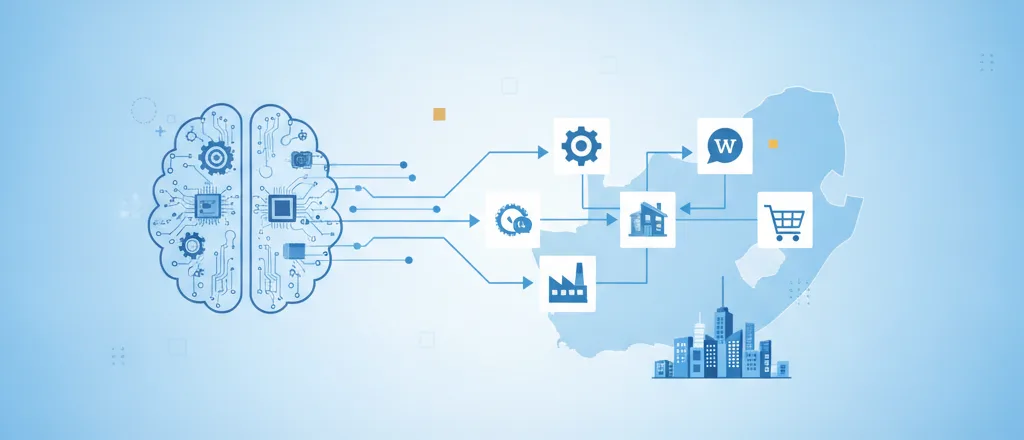
The short answerWhat you pay depends on complexity, integrations, and the number of processes being automated.
The short answer
What you pay depends on complexity, integrations, and the number of processes being automated.
How Much Does AI Automation Cost in South Africa?
Direct answer: Our AI automation plans start at R15,000 per month (Foundation Partner), with Growth Partner at R35,000 per month and Enterprise quoted on scope. What you pay depends on complexity, integrations, and the number of processes being automated.
Current as of 31 May 2026: This article has been reviewed for the 2026 South African AI, SEO, and automation market. Pricing, platform capabilities, Google rich-result rules, and AI model features change quickly, so verify live vendor documentation before procurement. For privacy and data handling, use the Protection of Personal Information Act as the baseline; for search and structured-data implementation, use Google Search Central.
This AI automation pricing South Africa guide shows what our plans cost and what drives the price, so you can plan your AI automation budget with confidence.
AI Automation Pricing Tiers (2026)
| Tier | Monthly Cost | What You Get |
|---|---|---|
| Foundation Partner | R15,000/month | 20 embedded developer hours per week, a core automation workflow, basic integrations, monthly review |
| Growth Partner | R35,000/month | 40 embedded developer hours per week, multiple automation workflows, full CRM/ERP integration, weekly strategy calls |
| Enterprise Partner | Custom quote | Multiple developers, scope set per engagement, complex system integrations, dedicated account management |
All Smart AI Solutions plans include no long-term contracts and weekly progress reports. View full details on the pricing page.
What Affects AI Automation Cost in South Africa
1. Number of Processes Being Automated
Each distinct workflow, lead qualification, invoice processing, customer support, stock replenishment, requires design, development, and testing time. Automating one process costs significantly less than automating five interdependent ones.
- One process: fits the entry plan
- Several processes: needs more developer hours each week
- Many processes (enterprise): custom pricing
2. Integration Complexity
Standalone automations (e.g., a WhatsApp chatbot on its own) cost less than automations that must connect to your CRM, ERP, accounting system, and fulfilment platform simultaneously.
- No integrations: base cost
- A few API integrations (for example Salesforce or Sage): more design and testing work
- Legacy system or custom database integration: the most work, because the data and access have to be mapped first
For deep technical integration work, see AI integration services.
3. Data Volume and Quality
AI models learn from your data. If your data is clean and well-structured, development is faster and cheaper. If your records are inconsistent, duplicated, or spread across spreadsheets, data preparation adds to the initial build cost.
4. POPIA Compliance Requirements
Businesses in financial services, healthcare, and legal industries operating under POPIA must implement additional data handling safeguards. This adds compliance architecture to the automation, with ongoing compliance monitoring billed as a monthly add-on.
5. Ongoing Maintenance and Retraining
AI models degrade over time as business conditions change. Budget for model retraining, performance monitoring, and system updates every year.
AI Automation Cost Comparison: Your Four Options
Option 1: Hire a Full-Time AI Developer
A full-time hire means salary and benefits, plus recruitment costs, hardware, software licences, and a ramp-up period before they deliver value. Check current salary surveys for your market and add all of those costs before comparing.
The risk: If they leave, you lose institutional knowledge. AI talent in South Africa can be hard to retain because demand is high.
Option 2: Smart AI Solutions Developer Rental
With the AI developer rental model, you pay a flat monthly rate and get immediate access to a developer with proven delivery experience:
- Foundation Partner (R15,000/month): 20 embedded developer hours per week, ideal for single-workflow automation
- Growth Partner (R35,000/month): 40 embedded developer hours per week, multi-system integration, strategy included
- Scale-up: Add developers or hours as your automation needs grow
Option 3: Offshore Development (India, Eastern Europe)
Offshore teams can look cheaper on paper. The trade-offs:
- Time zone misalignment slows iteration cycles
- No understanding of South African business context (POPIA, local payment gateways, SARS compliance)
- Difficult to verify credentials or references
- Quality can be inconsistent, a complaint we hear from businesses that have used offshore teams
Option 4: Freelancers
Freelancers can suit a small, one-off task, but they are not consistently available, cannot own a production system long-term, and provide no SLA or accountability structure.
Verdict: For anything mission-critical, freelancers introduce more risk than they save in cost.
ROI: How to Work Out What You Get Back
We do not publish an average ROI figure for our clients, because the return depends on the process you automate, your volumes and how well the baseline is measured. The only client figure we publish is NAPTOSA's 40 hours a week saved. For your own business, work it out like this:
- Measure the baseline. Record how many hours the process takes each week and what those hours cost you.
- Estimate the saving. Multiply the hours you expect to free up by the hourly cost. Be conservative.
- Compare with the plan cost. Set that saving against the monthly plan fee plus the costs on your side, such as staff time for testing.
- Check after launch. Compare the actual hours against the baseline after 60 to 90 days.
Our guide to calculating ROI on process automation gives a worked template.
Industry-Specific Pricing Guide
Financial Services
What drives cost: the highest compliance load of the common sectors.
Higher cost driven by POPIA compliance architecture, financial regulation requirements, and the complexity of integrating with banking APIs and compliance reporting systems. Loan processing, KYC verification and fraud detection are common automation candidates in this sector.
Retail and E-Commerce
What drives cost: the number of channels and systems integrated.
Strong use cases: inventory management, customer segmentation, personalised marketing, returns processing. Integrations typically involve Shopify, WooCommerce, or local POS systems. POPIA obligations exist but are more straightforward than financial services.
Manufacturing
What drives cost: legacy system integration and the number of production processes.
Primary automations: demand forecasting, predictive maintenance scheduling, quality control reporting, supplier communication. Legacy ERP integration (SAP, Syspro) adds to base cost but delivers large labour savings. See operations and logistics AI.
Healthcare
What drives cost: data protection design and careful scoping.
Highest compliance overhead in any sector. Patient data falls under POPIA's most stringent protections: every automation must be designed with data minimisation, access controls, and audit trails. Automations for appointment scheduling, billing, and clinical documentation have very high ROI but require careful scoping.
Professional Services (Legal, Accounting, HR)
What drives cost: document volume and how sensitive the client data is.
Document automation, contract generation, compliance reporting, and client onboarding are the primary use cases. Lower infrastructure complexity than manufacturing but higher sensitivity around data handling. Read the POPIA compliance guide for AI chatbots.
Hidden Costs to Watch For
Any reputable provider should be transparent about these. If they are not mentioned upfront, ask specifically:
Data Preparation
If your business data lives in spreadsheets, multiple disconnected systems, or is partially paper-based, you will need a data preparation phase before automation development can begin. Ask for this to be scoped and quoted separately from the monthly plan.
Staff Training
Automation only delivers ROI if your team uses it correctly. Budget for structured training, documentation, and internal champion coaching. Smart AI Solutions includes this in Growth Partner plans.
Change Management
Resistance to automation is real. Businesses that skip change management, communicating why automation is happening, what changes for each role, and how staff will be upskilled, often see adoption failures that negate the investment. Plan and budget for a structured change management process.
Cloud Infrastructure
Most AI automations run on cloud infrastructure (AWS, GCP, Azure). Depending on data volume and processing requirements, expect monthly infrastructure costs on top of development fees. Smart AI Solutions includes basic infrastructure within plan costs and is transparent when a project is likely to require additional infrastructure spend.
Ongoing Maintenance
AI models are not set-and-forget. Plan for retraining, performance monitoring, and updates every year. On monthly retainer plans, maintenance is typically included.
Smart AI Solutions Pricing Commitment
We built our pricing model specifically to address the frustrations South African businesses have with AI vendors:
- Transparent flat-rate plans: no hourly billing surprises
- No long-term contracts: month-to-month with 30-day cancellation
- Weekly strategy calls included on Growth Partner and Enterprise Partner plans
- Local team: based in Cape Town, understanding of South African business context, POPIA, and local system integrations
- No offshore handoff: the developer you meet is the developer who builds your automation
For a custom quote based on your specific processes and systems, book a free consultation.
Frequently Asked Questions
Is R15,000/month enough to see real results?
Yes: for a single, well-defined automation workflow. The Foundation Partner plan works best for businesses with one clear bottleneck: a lead qualification process, a repetitive data entry task, or a customer support FAQ workflow. It is not suited for businesses wanting to automate across multiple departments simultaneously. Start here, prove ROI, then scale.
Do I need to sign a long-term contract?
No. Smart AI Solutions operates on month-to-month agreements. You can cancel with 30 days notice. We earn your business every month: that is the model. You stay because the work is paying for itself, not because you are locked in.
How long before the automation is live?
For standard workflows on the Foundation Partner plan, the first live automation comes soon after kickoff, once the scope and access are agreed. Complex multi-system integrations on the Growth Partner or Enterprise Partner plan take longer for the initial build, with additional workflows added monthly thereafter. We confirm a timeline in the written quote.
What happens if the AI makes a mistake?
All automations include exception handling: when the AI is uncertain or encounters an edge case, the task is routed to a human for review rather than processed incorrectly. You define the confidence threshold. Over time, exceptions reduce as the model improves. Our SLA covers error rate targets.
How does your pricing compare to building an in-house AI team?
Building an in-house team capable of delivering the same output as our Growth Partner plan would require at minimum one senior AI developer and one data engineer, each on a full salary with benefits, plus recruitment, hardware, and training overhead. Compare current salary quotes for your market against the Growth Partner plan at R35,000/month.
Conclusion
AI automation in South Africa in 2026 is accessible at every business size. The Foundation Partner plan at R15,000/month is a real entry point with genuine ROI potential. The Growth Partner plan at R35,000/month is where most growing businesses find the sweet spot between cost and capability.
The most important question is not "How much does it cost?" but "What is the cost of not automating?" Businesses running manual processes in 2026 are losing ground to competitors who have already deployed AI across their operations.
The return depends on your process and volumes, so measure your baseline first and check the result after launch.
Next step: Book a free 45-minute consultation. We will scope your highest-value automation opportunity, give you a written quote, and tell you honestly whether we are the right fit.
Book your free consultation or explore our process automation services
Related Resources:
- AI Developer Rental: How It Works
- Calculate ROI for Process Automation
- POPIA Compliance for AI Systems
- AI Development Cost in South Africa: 2026 Pricing Guide
- Best WhatsApp Automation Providers in South Africa (2026): if WhatsApp automation is the channel you want to price up first