AI voice agent development for South African businesses handling inbound sales calls works best when we design around real sales tasks, clear caller choices and reliable human support. The goal is to turn suitable conversations into accurate, actionable follow-ups and to handle callers' personal information in line with POPIA. Answering more calls is only the start.
This guide is for sales and operations leaders planning an AI call centre agent or AI receptionist for inbound enquiries. It covers the call flow, lead qualification, human handoff, integrations, a POPIA checklist for recorded sales calls, piloting and measurement.
Key takeaways
| What to plan | Why it matters |
|---|---|
| Start with a narrow call flow and a defined sales use case. | A focused first release is easier to test and improve. |
| Collect only lead details the sales team will use. | Useful context supports follow-up without overloading the caller. |
| Set explicit handoff rules. | People can handle sensitive, unclear or high-judgment conversations. |
| Connect call routing, CRM and follow-up tools with clear recovery steps. | Call outcomes need to become reliable records and next actions. |
| Test accents and code-switching, plus interruptions and noisy calls. | Local speech patterns can affect recognition and caller understanding. |
| Tell callers about recording, limit what you collect and set retention rules. | POPIA applies to every recording, transcript and lead record the agent creates. |
| Measure qualified leads and downstream sales outcomes. | Handled calls alone do not show whether the agent helps sales. |
| Plan human escalation alongside automation. | For adjacent examples of lead capture and staff escalation, see AI Chatbots & Assistants. |
Design a call flow around the sales process
Start with the sales process your team already follows. Map why people call, what information staff need to respond and which outcomes a call can reach. Then build branches for common enquiries instead of relying on one generic script.
Keep qualification questions short and purposeful. Ask about the caller's need, product or service interest, fit, urgency and preferred next step only when that information will guide the sales team's response.
Write fallback language for unclear answers, objections and requests outside the agent's scope. Define exactly what the agent may say about prices, guarantees, availability and commitments so it does not make promises the business has not authorised.
Before expanding the agent's responsibilities, identify repetitive call tasks and bottlenecks, then choose a narrow use case that can be tested. A staged path from AI opportunity audit, prototype and pilot, full-scale integration, and continuous optimisation can help teams move from identifying a useful task to improving a live system.
Auditing repetitive tasks, data silos and communication bottlenecks can help a business focus its first voice-agent project on work where returns may arrive quickly. It suits this planning stage because it starts with the operating problem and leaves the technology choice for later. Our guide to what a business AI audit covers shows what that review looks at.
Qualify inbound leads for a useful sales follow-up
A good lead record gives a salesperson enough context to take the next step. Depending on the sales process, that can include the caller's name and contact details, reason for calling, relevant product or service interest, urgency and preferred follow-up method.
Use branching questions to distinguish a ready-to-buy prospect from someone seeking general information, an existing customer or a caller whose needs need specialist judgment. Each branch should lead to a clear next action, such as a sales callback, an information follow-up or a transfer to the right team.
Keep the questions proportionate to the conversation. Explain why you need a detail, avoid collecting personal information that does not support the sales purpose, and let callers correct an answer or decline to provide it.
CRM & Sales Automation audits sales pipelines and implements solutions such as lead scoring, automated follow-ups, pipeline intelligence and data enrichment. It suits this stage because qualified call details can feed a sales process that prioritises leads and prompts timely follow-up. Call volume isn't the result. For the scoring side, see AI-powered lead scoring.
Agree on how the team will use qualification data before launch. For example, define which answers indicate an urgent enquiry, which require a sales specialist and what makes a lead ready for a meeting, then make those definitions consistent between the call flow and CRM.
Set clear rules for transferring callers to people
Offer a route to a person when callers ask for one, show frustration, give ambiguous answers repeatedly or raise an issue outside the agent's permitted scope. A transfer rule gives the caller a clear alternative when the conversation stops being productive.
Route high-value or time-sensitive prospects to a salesperson when the call needs judgment or tailored advice. The agent should not try to resolve complex questions by improvising beyond the business's approved information.
Send the receiving salesperson a concise handoff summary with the caller's stated need, qualification answers, unresolved question and promised next step. That context helps the person continue the conversation without making the caller repeat everything.
If nobody is available, explain what will happen next and collect only the details needed to arrange a callback. If the transfer fails, say so plainly and record the call for follow-up. Never imply that the caller reached a person.
Did you know? Only 22% of users prefer chatbots over live human agents. Source: University of Pretoria
Connect telephony, CRM and follow-up tools reliably
Map how each call enters the phone system and where it can go, including transfer destinations and what should happen if call routing or connectivity fails. If the business uses VoIP, include its routing rules and failure paths in the design. A voice agent is not a standalone tool. It sits inside the phone system that an inbound call centre or front desk already runs on.
Decide which call details should create a CRM record and which should update an existing contact. Define how the system matches contacts, when a match is too uncertain to apply automatically and how staff will resolve that ambiguity.
Connect calendars and follow-up tools only for actions the agent is authorised to take. Check availability before confirming a meeting, and set an alternative next step if the calendar cannot be reached.
AI Integration Services investigates existing systems, plans an integration architecture and builds and deploys connections incrementally. It suits this part of a voice-agent project because the team needs to understand current data flows and systems before connecting calls to CRM and follow-up processes.
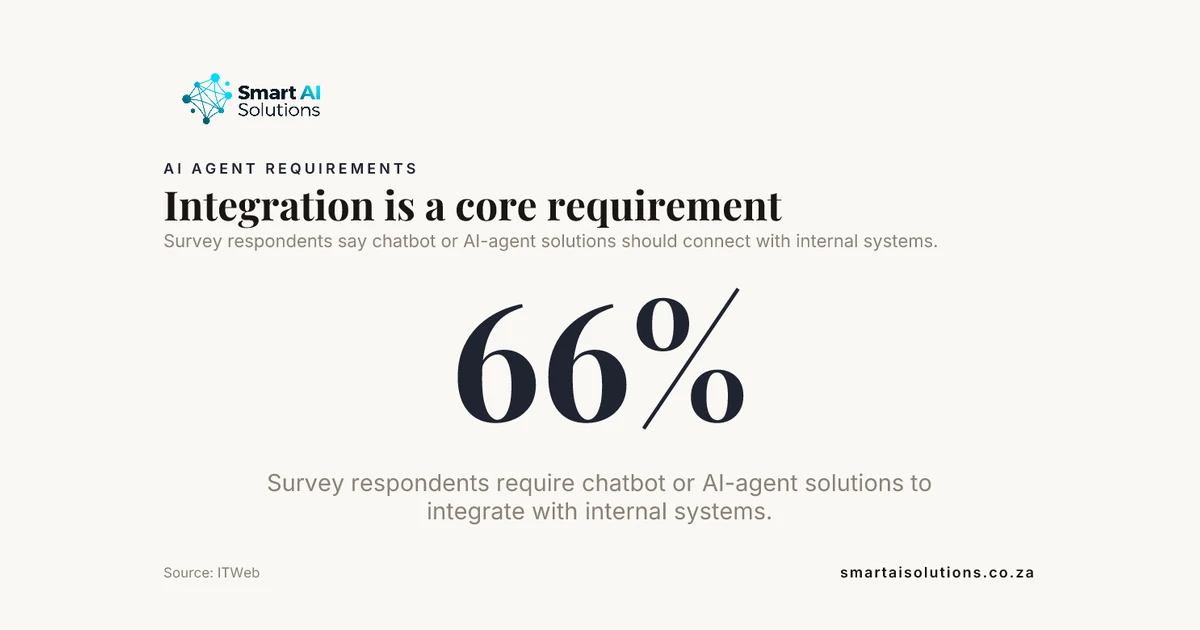
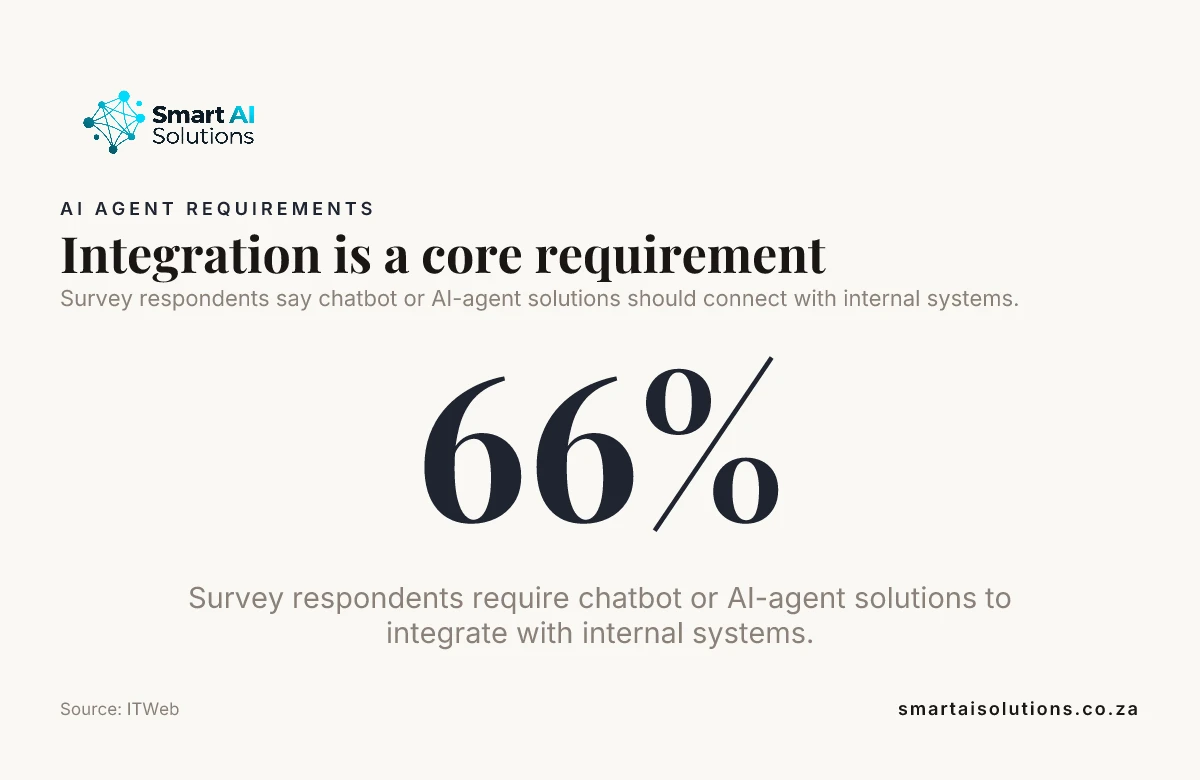
Keep lead fields, transcripts, recordings and consent preferences consistent across connected systems. ITWeb reported that 66% of survey respondents would require integration with internal systems (CRM, ERP, FIN) from a chatbot or AI agent solution.
Source: ITWeb
Set permissions for each connected system so people and services can access only the information they need. Agree on retention practices for call records and transcripts as part of the integration design, not as a clean-up task after launch.
Test South African speech patterns and handle personal information carefully
Test speech recognition with real examples of the accents, languages, business terms and place or person names callers use. Include code-switching within a conversation, such as a caller moving between English and isiZulu, isiXhosa or Afrikaans.
Include background noise, interruptions, fast speech and ambiguous answers in test calls. When the agent cannot confidently understand the caller, it should ask for clarification or transfer the conversation. A guess is not a confirmed lead detail.
Decide when recording or transcription is needed and explain its purpose to callers. Obtain consent where required, and provide a suitable route for people who do not consent to recording or transcription.
Limit personal information to what supports the sales purpose, control access to call records and define retention and deletion practices in line with POPIA obligations. The ITWeb report found that 52% identified security and compliance concerns as perceived challenges or barriers that may delay or prevent AI adoption.
A POPIA checklist for recorded inbound sales calls
The Protection of Personal Information Act 4 of 2013 (POPIA) applies to the recordings, transcripts and lead records a voice agent creates, because each one identifies a caller. The Information Regulator publishes the Act and its guidance. The table below maps the sections that matter most on an inbound sales line to a design decision. It is general guidance, not legal advice, so confirm the detail with your information officer or attorney.
| POPIA requirement | What it means for the voice agent |
|---|---|
| Minimality (section 10) | Ask only the qualification questions the sales team will use. |
| Purpose specification (section 13) | Record and transcribe for a defined purpose, such as following up a sales enquiry, and do not reuse the data for something unrelated. |
| Retention (section 14) | Set how long recordings, transcripts and lead records are kept, then delete or de-identify them. |
| Notification (section 18) | Tell callers at the start that they are speaking to an automated agent for your business, that the call is recorded and why. |
| Security safeguards (section 19) | Restrict who can open recordings and transcripts, and protect them in storage and in transit. |
| Operators (sections 20 and 21) | Sign written contracts with the telephony, speech and AI vendors that process caller data on your behalf. |
| Direct marketing (section 69) | Check consent or an existing customer relationship before any automated outbound follow-up call or message. |
| Cross-border transfers (section 72) | Check where speech and language providers process and store call data if it leaves South Africa. |
Our guide to POPIA compliance for AI chatbots covers the same conditions for text channels.
Pilot with realistic callers before expanding
Test realistic sales scenarios before a broad launch. Include unusual names, interruptions, background noise, code-switching, objections, silence and callers who change their answers partway through.
Set pass criteria for correct qualification, accurate summaries, appropriate transfers and safe handling of unclear or out-of-scope requests. These criteria help the team decide whether the agent is ready for its defined role.
A prototype and pilot tests a custom agent or single automation in a controlled environment before commitment. It fits this stage because a team can review the call flow and integrations on realistic scenarios before giving the agent wider responsibility.
Simulate dropped calls, unavailable calendars, failed CRM writes and uncertain contact matches. Define how each failure will be logged and who will follow up, so a technical issue does not leave a promising prospect without a next step.
Run a limited pilot with human review of call outcomes. Use what the team learns to revise the call flow and integration rules before increasing the agent's responsibilities.
Did you know? 58% experienced improved customer service through chatbots. Source: University of Pretoria
Measure sales outcomes and improve after launch
Track answered calls, completed qualifications, qualified-lead rate, successful handoffs, booked meetings and the sales outcomes that follow each handoff. That lets you judge the voice agent as part of the sales process. Call answering is only its first step.
Separate lead volume from lead quality. Attribute outcomes using consistent call and CRM records, and do not count a handled call as a conversion unless it leads to the sales outcome your team has defined.
Review failed or abandoned calls, caller correction requests, transfer outcomes and missed follow-ups. These patterns can show where a branch is unclear, where recognition fails or where a system connection needs adjustment.
Full-scale integration is an enterprise rollout wired into the CRM and existing internal data. Choose that stage when the tested call flow and system connections are ready to support a wider operation.
Continuous optimisation provides ongoing support and performance tuning after the AI system goes live. Use it to keep reviewing observed outcomes, improve the live call flow and retain human oversight for decisions that need sales judgment.
Frequently asked questions
How is an AI voice agent different from an interactive voice response (IVR) system?
An IVR usually guides callers through a fixed menu, often using keypad selections or short spoken commands. An AI voice agent can use speech recognition and a large language model to interpret natural phrasing, while its actions and answers should still follow business-defined limits. That is also what separates an AI receptionist from a virtual receptionist service staffed by people, or from an automated answering service that only takes messages.
Can an inbound sales voice agent also make outbound calls?
Yes, the same underlying technology can support outbound calling, but that requires a separate call purpose, script, permissions and contact-preference controls. Businesses should design outbound activity around the rules that apply to their audience and campaign, including POPIA's direct marketing rules, and should not simply reuse the inbound flow.
Does POPIA allow an AI voice agent to record inbound sales calls?
POPIA does not prohibit recording a sales call, but it sets conditions. Tell the caller the call is recorded and why, collect only what the sales purpose needs, secure the recording and transcript, and keep them no longer than necessary. Offer callers who object another route, such as a transfer to a person or an unrecorded callback.
Can an AI voice agent collect payment card details during a call?
A safer design avoids having the agent hear or store raw card details. Use a payment provider's secure payment flow, such as a protected keypad entry or payment link, and keep card data out of call transcripts and recordings.
How much does it cost to develop an AI voice agent for a South African business?
The budget depends on the call flow and telephony setup, the languages the agent must handle, the CRM and calendar connections, and how much testing and ongoing support you need. Scope those components separately so a proposal separates voice-agent development from related integration work.
How do we make an AI voice agent sound consistent with our brand?
Set an approved greeting, pronunciation guide for names and product terms, tone of voice and closing language before testing. Review recordings or test calls with sales staff so the agent sounds clear and respectful without making claims outside approved wording.
Conclusion
Strong AI voice agent development for South African businesses handling inbound sales calls starts with a bounded call flow, useful qualification, reliable integrations and clear human handoffs. Test with realistic callers, protect personal information and improve the system against sales outcomes so the agent supports the team without replacing the judgment only people can provide. To scope an AI call centre agent for your inbound sales line, contact our team.