The short answerMost AI pilots never reach the P&L. Here is what an AI consultant really does, a practical readiness framework, and how South African businesses get AI to pay off.
The short answer
Most AI pilots never reach the P&L. Here is what an AI consultant really does, a practical readiness framework, and how South African businesses get AI to pay off.
Current as of 31 May 2026.
What does an AI consultant actually do?
An AI consultant closes the gap between buying AI and getting value from it. The work runs in four stages: assess where AI fits, build a strategy tied to business outcomes, implement working systems, and enable your team to run them. The job is far less about models and far more about turning a promising pilot into something that moves revenue, cost, or risk.
That distinction matters because the failure rate is brutal. An MIT NANDA study found 95% of generative AI pilots fail to deliver measurable P&L impact (MIT, via Fortune, 2025). Adoption is not the problem. McKinsey reports 88% of organisations now use AI regularly, up from 78% a year earlier (McKinsey, 2025). The problem is the distance between a demo that impresses and a system that earns its keep. Bridging that distance is the entire point of hiring an AI consultant.
In our experience working with South African SMEs, the businesses that win are not the ones with the fanciest model. They are the ones who picked a real bottleneck, wired AI into the actual workflow, and trained the people who use it. A consultant exists to make that happen on purpose rather than by luck. The honest version of the role is part engineer, part change manager, and part translator between what the technology can do and what the business actually needs.
Why do so many AI projects fail?
Most AI projects fail because they are run as technology experiments, not business changes. The same MIT research that flagged the 95% failure rate also found something more useful: AI tools bought from specialised vendors and partners succeeded about 67% of the time, versus roughly one-third for internally built tools (MIT, via Fortune, 2025). How you implement matters more than which model you choose.
The pattern repeats at the agent level too. Gartner predicts more than 40% of agentic AI projects will be cancelled by the end of 2027, citing escalating costs, unclear value, and weak risk controls (Gartner, 2025). These are not model failures. They are scoping, integration, and governance failures. We see the same three causes repeatedly: a project with no owner, a goal nobody can measure, and an AI that was never connected to the systems where work actually happens.
The skills gap is the real ceiling
The single biggest barrier is people, not technology. IBM's Global AI Adoption Index found limited skills and expertise to be the top adoption barrier, cited by 33% of organisations (IBM, via TechRepublic, 2024/25). The World Economic Forum reports 63% of employers name skill gaps as the number-one barrier to transformation, with 77% planning to prioritise reskilling for AI by 2030 (WEF, 2025). A consultant who hands over a system without building internal capability has only deferred the failure.
This is why we treat enablement as core delivery rather than an optional extra. A tool nobody trusts gets quietly abandoned within a quarter, no matter how good it is. If you want the deeper version of why pilots stall, we wrote a full breakdown in why AI adoption fails and how change management fixes it.
What are the four stages of AI consulting?
Good AI consulting follows four stages: assess, strategise, implement, enable. Each stage has a clear output, and skipping any of them is where most projects quietly go wrong. The sequence is deliberate. You cannot strategise before you understand the business, and you cannot enable a team around a system that does not yet exist.
Stage 1: Assess
The assessment stage maps where AI can realistically create value in your specific operation. A consultant audits your processes, data, systems, and team capability, then ranks opportunities by value and feasibility. The output is a shortlist of two or three high-value, low-friction use cases rather than a wishlist of twenty.
What actually happens here is unglamorous and important. We sit with the people doing the work, watch how a task really flows, and find where time leaks. We check whether the data the use case needs exists and is accessible. We score each opportunity on two axes: how much value it would create and how hard it is to build. The deliverable is a short opportunity map with a recommended starting point and a rough effort estimate for each option.
Who is involved: a consultant or two on our side, plus your process owner and whoever controls the relevant data and systems. It usually takes one to three weeks. This stage is where ROI is won or lost. McKinsey estimates generative AI could add $2.6 trillion to $4.4 trillion annually across 63 use cases, but that value is concentrated in a handful of functions for any given business (McKinsey, 2025). Finding your handful is the assessment.
A realistic SA example: a Cape Town logistics firm came to us wanting a chatbot. The assessment showed the higher-value opportunity was automating their proof-of-delivery capture and reconciliation, which was eating two admin staff most of the week. We parked the chatbot and recommended the reconciliation work first.
Stage 2: Strategise
Strategy translates the shortlist into a sequenced plan with owners, budget, success metrics, and a governance approach. A strategy consultant decides what to build first, what to buy versus build, and what to leave alone. The plan should name the P&L line each project is meant to move.
The deliverables here are concrete: a phased roadmap, a target metric for each phase, a named owner, a budget range, and a one-page governance note covering data handling, human review points, and how you measure whether it worked. Governance belongs here, not bolted on later. The projects Gartner expects to be cancelled are usually the ones with no metric, no owner, and no risk plan from day one. A one-page strategy that a CFO can read in five minutes is worth more than a fifty-slide deck.
Who is involved: the consultant, an executive sponsor, and finance for the budget and metric sign-off. Continuing the logistics example, the strategy was a three-phase plan: automate proof-of-delivery reconciliation first (target: cut admin time by half within eight weeks), then route exceptions to a human, then revisit the customer chatbot once the team trusted the first system. The metric was admin hours per week, tracked from day one.
Stage 3: Implement
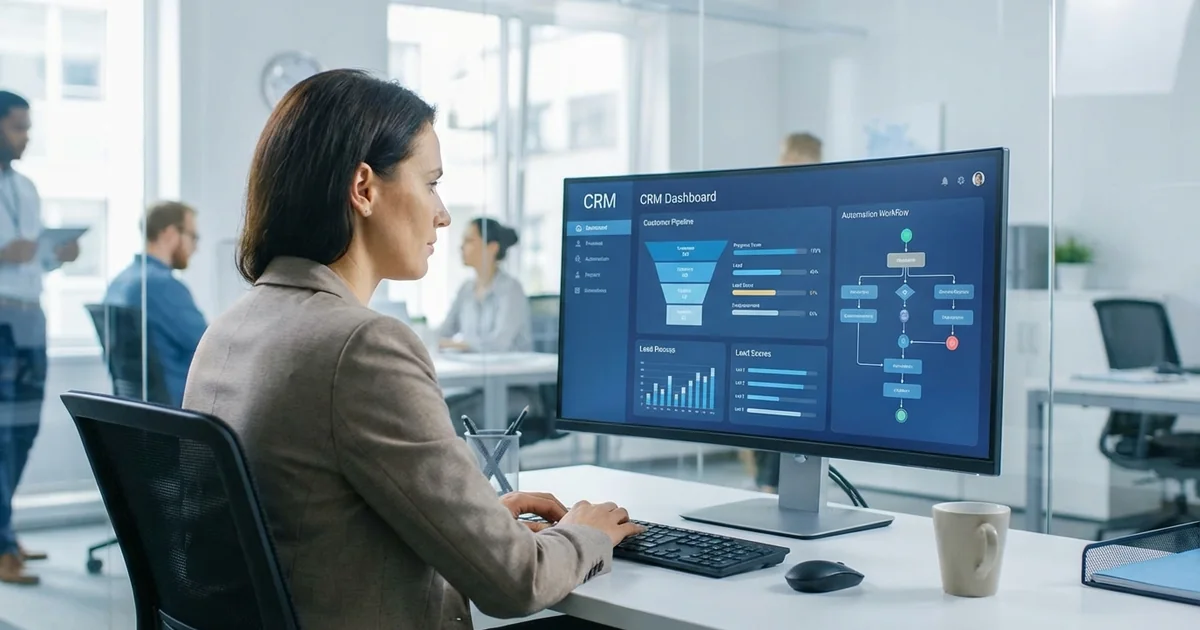
Implementation is where AI gets wired into the actual workflow your staff use every day. This means integration with your CRM, ERP, accounting, and communication tools, not a standalone demo running on someone's laptop. Done well, the AI disappears into the process.
The real work is connecting systems, handling the messy edge cases, and building in human review where the AI is uncertain. We ship a small working version first, run it alongside the existing manual process, and compare results before anyone relies on it. The deliverables are a working integration, an exception-handling path, and a monitoring dashboard so you can see error rates and volume in real terms.
The market is moving fast in this direction. Gartner predicts 40% of enterprise applications will feature task-specific AI agents by 2026, up from less than 5% in 2025 (Gartner, 2025). Integration work is the bulk of real implementation, which is why we treat AI integration services as its own discipline. In the logistics example, the build connected the AI to their existing fleet system and accounting package, with anything below a confidence threshold flagged for a human to check. Within six weeks reconciliation that took two people most of the week ran in under a day.
Stage 4: Enable
Enablement builds the internal capability to run, trust, and improve the system after the consultant leaves. This covers training, documentation, internal champions, and a clear escalation path for when the AI is uncertain. Without it, adoption stalls the moment external support ends.
The deliverables are practical: hands-on training for the people who use the system daily, a short written runbook, a named internal champion who becomes the first point of contact, and an agreed way to feed corrections back so the system improves. Who is involved: the consultant, the day-to-day users, and the champion. This is the stage most firms skimp on, and it is the stage that decides whether your investment survives.
The payoff for getting this right is large. Deloitte found roughly 74% of organisations report their most advanced generative AI initiative is meeting or exceeding ROI expectations (Deloitte, 2025), and the common thread among them is workforce capability rather than model sophistication. Our AI team enablement work exists precisely for this stage. With the logistics firm, the two admin staff were not made redundant. They were retrained to handle the exception queue and customer follow-ups, which was higher-value work they had never had time for.
How do I know if my business is ready for AI?
You are ready for AI when you have a clearly defined problem, usable data, an executive sponsor, and at least one process worth automating. Readiness is not about having a data science team. Stanford HAI found 78% of organisations used AI in 2024, up from 55% the year before, so the barrier to entry has collapsed (Stanford HAI, 2025). The question is no longer whether you can start, but whether you are set up to get value when you do.
Use this simple five-part readiness framework before you spend a cent on implementation.
The DATES readiness framework
- Data. Do you have the data the use case needs, and is it accessible? Messy is fine. Missing is not.
- Aim. Can you name the specific process and the metric it should improve? Vague goals produce vague results.
- Talent. Is there someone internal who will own and champion the system day to day?
- Executive sponsor. Does a decision-maker back this with budget and air cover?
- Systems. Can the AI connect to the tools where work actually happens?
If you can answer yes to three or more, you are ready to start small. If you answer no to data or aim, fix those first. Cost has stopped being the blocker: Stanford HAI reports the inference cost of a GPT-3.5-level system fell roughly 280-fold between late 2022 and late 2024 (Stanford HAI, 2025), so capability that was enterprise-only two years ago is now within SME reach.
For a more detailed self-assessment, work through our AI readiness checklist for South African SMEs before your first project.
What does an AI consultant cost, and what is the return?
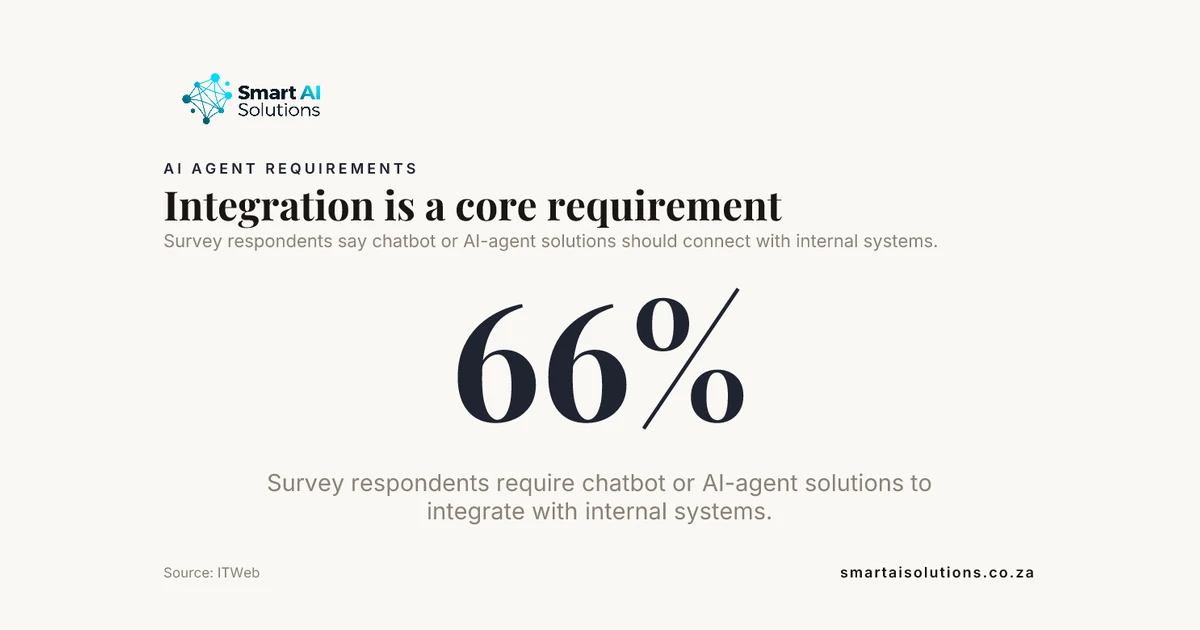
AI consulting is priced on scope, but the more useful number is the return. PwC found 66% of organisations adopting AI agents report increased productivity, and 88% plan to raise their AI budgets as a direct result (PwC, 2025). Spend is rising because the payback is showing up in the numbers, not because of hype.
What you are actually paying for
A consulting fee covers four things, and it helps to see them separately. You pay for diagnosis: the time spent finding the right problem instead of building the wrong one. You pay for engineering: the integration, exception handling, and testing that turn a model into a reliable system. You pay for change management: the training and documentation that get your team using it. And you pay for risk reduction: the governance and human-review design that keep a confident-but-wrong AI from making an expensive mistake.
The diagnosis and risk-reduction parts are the ones businesses underestimate, and they are exactly what separate the projects that work from the 95% that do not. Capital is flowing into the field for this reason. Stanford HAI recorded global corporate AI investment of $252.3 billion in 2024 (Stanford HAI, 2025), and the firms getting a return are spending on implementation discipline rather than on the model alone.
How to think about ROI and payback
The cleanest way to judge a project is to pick one metric before you start and track it from day one. Admin hours per week, cost per processed document, lead response time, error rate. If you cannot name the metric, you are not ready to spend. The productivity effect is real and measurable: PwC's Global AI Jobs Barometer found productivity growth in AI-exposed industries running about four times higher than in less-exposed ones, with a 56% wage premium for workers with AI skills (PwC, 2025). For a business that translates into faster cycle times, lower processing cost, and staff freed for higher-value work.
A quick word on the buy-versus-build maths, because it drives most consulting decisions. The MIT finding that partner-bought AI succeeds twice as often as internally built tools is not an argument against internal teams. It is an argument for buying the implementation expertise you lack while you build the internal capability you will keep. That is the logic behind the embedded AI partner model versus a traditional consultant, which suits SMEs that want momentum without a permanent payroll commitment. Start with one well-scoped project, prove the payback against your chosen metric, and expand from evidence rather than ambition.
How do I choose an AI consulting partner?
Choose a partner on evidence of delivered outcomes, depth of implementation skill, and a clear plan to leave you self-sufficient. Avoid anyone selling a model in search of a problem. Worker access to AI tools rose roughly 50% during 2025 according to Deloitte (Deloitte, 2025/26), so the field is crowded and the quality range is wide.
Three questions cut through most of the noise. Ask for a specific outcome they delivered and the metric it moved. Ask how they integrate with existing systems rather than replacing them. Ask what they do to make your team independent. A partner who cannot answer the third question is selling dependency.
We deliberately keep this section short because we have a full guide on exactly this. If you are evaluating firms, read how to choose the right AI consulting partner in South Africa, which covers due diligence, contracting, and red flags in depth.
What does AI adoption look like in South Africa?
South Africa leads Africa in generative AI adoption and the market is growing fast, but a real skills divide remains. Microsoft's global adoption data, reported by Business Day, puts SA AI usage at 23.1% of the working-age population in Q1 2026, ranking the country 46th of 147 worldwide (Microsoft, via Business Day, 2026). That is strong for the region, and it means local businesses are no longer early adopters experimenting at the edge. They are competing.
The market size confirms the momentum. Statista projects the South African AI market at US$537.31 million in 2025, growing to US$3.27 billion by 2031 at a 35.13% CAGR (Statista, 2025). A market growing more than sixfold in six years is not a fad, and the businesses moving now are setting the pace competitors will have to match. For context on where the broader picture is heading, McKinsey notes about one-third of organisations have already begun scaling AI beyond pilots (McKinsey, 2025).
What this means for an SA business
The practical takeaway is that the skills gap, not the technology, is the local constraint. The 23.1% adoption figure also exposes a digital divide: capability is concentrated in larger, better-resourced firms, which leaves a genuine opening for SMEs that move deliberately. You do not need to outspend a bank. You need to pick one real problem and execute it properly while competitors are still deciding.
A South African AI consultant earns their fee by understanding the local context: POPIA obligations on how you handle personal data, integrations with local payment and banking systems, SARS-facing processes, and the reality that most teams are learning AI on the job. The advantage of a local partner is not patriotism. It is that they have already solved the integration and compliance problems specific to operating here, so you are not paying an overseas firm to learn South African rules on your budget.
We are based in Cape Town and build AI systems for South African businesses every week. If you want a grounded view of where AI fits in your operation, book a free consultation and we will scope your highest-value opportunity honestly, including telling you when AI is not the answer.
The bottom line
An AI consultant exists to move you from the 95% who run pilots that go nowhere to the minority who get AI into the P&L. The work is methodical: assess the real opportunities, build a strategy tied to business metrics, implement into live workflows, and enable your team to run it without you. The data is consistent across MIT, McKinsey, Deloitte, and PwC. Implementation discipline and human capability decide the outcome, not the model.
For South African businesses in 2026, the timing is good and the gap is closing. Adoption is rising, costs have collapsed, and the market is growing at over 35% a year. The businesses that win will be the ones who start with one real problem, prove the return, and build the internal capability to compound it. If that is where you want to be, start with a readiness review and pick one process worth getting right.
Related reading:
- Best WhatsApp Automation Providers in South Africa (2026): comparison of WhatsApp-specific automation platforms once you have scoped your first use case
- AI Consulting Services in South Africa: how to evaluate and choose an AI partner
Frequently Asked Questions
What does an AI consultant do?
An AI consultant closes the gap between buying AI and getting value from it. The work runs in four stages: assess where AI fits your operation, build a strategy tied to business outcomes, implement working systems into live workflows, and enable your team to run them. It is far less about models and far more about turning a pilot into measurable P&L impact. MIT found 95% of generative AI pilots fail to deliver that impact, which is exactly the gap a consultant closes.
How much does an AI consultant cost?
AI consulting is priced on scope, but the more useful number is the return. PwC found 66% of organisations adopting AI agents report increased productivity, and 88% plan to raise AI budgets as a result. Smaller, well-scoped projects start low and scale as ROI is proven. The buy-versus-build maths usually favours buying implementation expertise, because MIT found partner-bought AI succeeds roughly twice as often as internally built tools.
How do I know if my business is ready for AI?
You are ready when you have a clearly defined problem, usable data, an executive sponsor, and at least one process worth automating. Use the DATES check: Data, Aim, Talent, Executive sponsor, Systems. If you can answer yes to three or more, start small. You do not need a data science team. Stanford HAI found 78% of organisations already used AI in 2024, and inference costs have fallen roughly 280-fold, so the barrier to entry has collapsed.
What is the difference between an AI strategy consultant and an AI implementation consultant?
A strategy consultant decides what to build, in what order, and how to measure success. An implementation consultant wires the chosen systems into your CRM, ERP, and daily tools so staff actually use them. Strong partners do both, because a strategy with no working delivery is a document, and an implementation with no strategy is the kind of project Gartner expects 40% of agentic AI efforts to cancel by 2027.
Why do most AI projects fail to deliver results?
Most AI projects fail because they are run as technology experiments rather than business changes. MIT found 95% of generative AI pilots deliver no measurable P&L impact, while partner-bought tools succeed about 67% of the time. The biggest barrier is people: IBM found limited skills and expertise to be the top adoption barrier at 33%. Projects without a clear metric, owner, integration plan, and enablement effort stall once the demo ends.
Do I need a South African AI consultant or can I use an offshore firm?
A local AI consultant earns their fee through context. South African AI usage reached 23.1% of the working-age population in Q1 2026, and the market is growing at over 35% a year, so the technology is mature here. The local advantage is practical: POPIA compliance, local banking and payment integrations, SARS-facing processes, and teams learning AI on the job. A local partner has already solved the integration and compliance problems specific to operating in South Africa.