
The short answerChoose a consultancy that finds candidate use cases in your own work, ranks them openly on value, effort, data readiness and risk, and proves the top one with a small paid pilot, so you only spend on the work that will pay back.
The short answer
Choose a consultancy that finds candidate use cases in your own work, ranks them openly on value, effort, data readiness and risk, and proves the top one with a small paid pilot, so you only spend on the work that will pay back.
Which South African AI consultancy can help us identify the best use cases before we invest in development? Choose one that starts with your own workflows, ranks every candidate use case against the same clear criteria, and proves the top one with a small paid pilot before anyone quotes you for a full build.
The relief is simple. You spend money only on the piece of work most likely to pay back, instead of paying for a system your team never opens. Smart AI Solutions runs that process with you: we find the candidates in your day-to-day work, score them openly, set up the first pilot for you and stay with your team while it runs.
This guide covers the part before development: where to find AI use cases in your own work, how to score and rank them, how to pick the first one, how to prove it, and what a good discovery engagement should hand you. If you want the wider picture of consulting models and fees, read our guide to choosing an AI consulting partner in South Africa. If you are not sure your business is ready at all, start with the AI readiness checklist for South African SMEs.
Key takeaways
These are the questions that separate a useful discovery engagement from a sales pitch for a build.
| Question | What to look for |
|---|---|
| How do we know a consultancy understands our work? | It maps real tasks, handoffs and exceptions before it proposes any technology. |
| How should we compare AI use cases? | One scorecard for every idea: business value, effort, data readiness and risk. |
| Which one goes first? | The use case with clear value, data you already have, low risk and a small first step, not the most impressive idea. |
| How do we avoid funding the wrong solution? | Compare AI with a process fix and simple rules-based automation, then test one narrow use case against a baseline. |
| What should discovery deliver? | A ranked list with the reasons behind each score, visible assumptions, a defined first project and agreed pilot measures. |
| How do we prepare employees? | Involve the people who do the work in scoring and testing, with support such as AI team enablement. |
Start with your own work, not a tool someone wants to sell
The best AI use cases are hiding in the work your team already finds slow, repetitive or easy to get wrong. A useful discovery engagement starts with a real workflow, not a software demonstration. Ask the consultancy to map the steps, handoffs, exceptions and bottlenecks, because those details show where time or service quality is lost and whether AI is relevant at all.
Smart AI Solutions works this way through Loxly Atkinson's hands-on AI consulting. The work maps your workflows, the path your customers take and the bottlenecks first, and only then agrees on the problem worth solving and the improvement to pursue.

Good discovery separates the stated problem from its cause, then sets an outcome you can observe, such as fewer manual hours, faster replies or fewer errors. A request for "an AI chatbot", for example, may point to unclear ownership of customer questions or answers scattered across inboxes, which a process change could fix on its own.
Before the first conversation, bring a short description of one troublesome workflow: who owns it, which systems it touches and a few recent examples of where work got delayed. Then watch what the consultancy does with it. You'll learn more from that than from any brochure. A good one asks about your constraints and proposes a practical first step. A weak one moves straight to a build.
One question keeps the conversation on track: which specific business outcome should improve, and what in the current workflow stops it?
Build a long list of candidate use cases from where time leaks
A long list comes from the people doing the work, not from a list of trending AI applications. In a short workshop or a few interviews, the consultancy should collect every place where the team re-types information, chases replies, searches for answers, copies data between systems or waits on someone else.
Practical candidates usually come from a handful of areas:
- Sales follow-up: enquiries that wait too long for a reply, quotes nobody chases, leads that go cold in the CRM.
- Customer requests: the same questions answered by hand every day, requests that bounce between people.
- Document handling: invoices, forms, contracts or reports read and re-keyed by hand.
- Scheduling and admin: bookings, reminders, reschedules and the late-evening catch-up.
- Operational planning: stock, staffing or routes planned from spreadsheets and memory.

Each item on the list needs four things written next to it: the workflow it belongs to, the person who owns that workflow, how often the task happens and what goes wrong today. Without those, an idea is still only a wish. Sales pipeline work is a common candidate, and our sales-pipeline audit and automation service shows the kind of workflow worth examining.
Examples only become credible opportunities when they fit your own work. A use case that saves a large retailer hours every week may be irrelevant to a ten-person practice. The long list should be yours, in your language.
Score every candidate on the same four questions
Ranking only works if every idea is judged by the same rules. Otherwise the most impressive-sounding idea wins by default. Score each candidate from 1 (poor) to 5 (strong) on four criteria, and write one line of evidence next to each score.
| Criterion | What to assess | A 5 looks like |
|---|---|---|
| Business value | The effect on a measured problem: staff hours, turnaround time, missed revenue or service quality. | A frequent, costly task with a baseline you can already measure. |
| Effort | Build, integration, change management and ongoing support. Score it so that less effort earns more points. | A small first step that uses systems you already have. |
| Data readiness | Whether the information the task needs exists, is accurate enough and can be reached when the workflow needs it. | Clean, accessible records in a system with an export or API. |
| Risk | Privacy, confidentiality, accuracy and operational harm if the output is wrong. Score it so that lower risk earns more points. | Internal drafts that a person reviews before anything goes out. |
Add the four scores for a total out of 20, and treat business value as the tie-breaker. Some teams weight value double; that is fine, as long as the weighting is agreed before anyone scores.
Here is how a ranked shortlist might look for a small services business. The scores are illustrative, not data from a client:
| Score | Enquiry replies drafted for staff to approve | Reminders about unpaid quotes | Monthly stock forecast | Chatbot giving pricing advice |
|---|---|---|---|---|
| Value | 4 | 3 | 4 | 3 |
| Effort | 4 | 5 | 2 | 3 |
| Data readiness | 4 | 4 | 2 | 2 |
| Risk | 4 | 4 | 3 | 1 |
| Total out of 20 | 16 | 16 | 11 | 9 |
| Verdict | Pilot first | Next on the list | Fix the data first | Not yet |
Ask for this as an opportunity register: a ranked list that explains why each idea sits where it does, the assumptions behind every score and the evidence still needed. If a consultancy can't show its scoring, you can't check its recommendation.
Two free tools are a good place to prepare. The Free assessment gives you an AI readiness score, an opportunity map and recommended next services through a short questionnaire, with no call required. The AI savings calculator gives personalised recommendations based on your company's numbers, size and industry, with a free 30-minute strategy session that works from your actual workflows. Either one gives the scoring conversation real inputs to work with.
Check data and systems before a candidate makes the shortlist
A promising use case can stall on a simple data problem, so check the data before you trust a high score. For each shortlisted workflow, confirm that the required information is accurate, complete enough, accessible for its intended purpose and available in a usable format. Inconsistent records, missing fields or data that staff cannot reach at the right moment will all stop a pilot.
For a broader view of your organisation, the AI Readiness Assessment is free, takes about three minutes and gives personalised recommendations, an implementation roadmap and a suggested service tier. These assessments help you spot broad gaps, but they do not replace a check of the selected workflow's own data and integration needs.
Map the systems the use case must connect to, the dependencies between them and who will maintain the data and the solution after a pilot goes live. When several systems need to exchange information, AI integration services belong in the discussion. Discovery questions should cover data flows, error handling, access controls, monitoring, rollback and the internal owner who will run it day to day. Our guide to what a business AI audit covers goes deeper into SOPs, ERP, CRM and POS data.

Compare AI with a process fix and simple rules
Sometimes the cheapest win is to remove a step and add nothing. Before you invest in AI, ask whether cutting an unnecessary step, standardising inputs or clarifying ownership would fix the bottleneck. Process improvement can cost less and be easier to maintain than another tool bolted onto a poorly defined workflow.
Conventional workflow automation suits predictable tasks with clear rules, such as moving an approved record between systems or sending a notification when a condition is met. AI earns its place when the task depends on reading variable text, images or language, and the consequences of a mistake stay manageable.
Ask the consultancy to compare three options for every top-ranked use case: no build, rules-based automation and AI. The recommendation should spell out what each option costs, how reliable it is, how it connects to your systems and who supports it afterwards. AI is not the default answer. For a process-focused comparison, look at workflow automation for South African businesses alongside business process automation.
Widespread use of AI does not, by itself, show that a particular task needs it. The figures below give context on AI use in South Africa; your own decision should still rest on the workflow and the outcome under review.
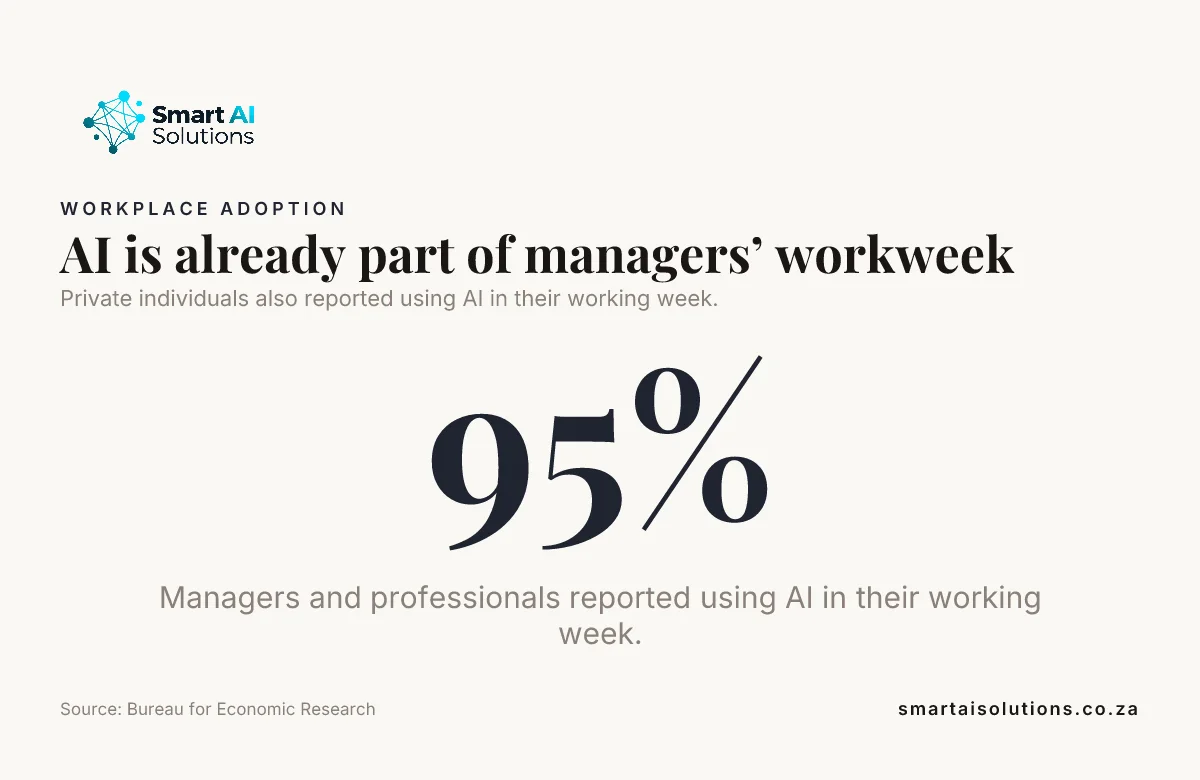
Did you know? In the Bureau for Economic Research's 2026Q1 outlook survey, 95 per cent of managers and professionals and 91 per cent of private individuals reported using AI in their working week. Among managers, 5 per cent reported no AI use, 18 per cent used it for up to one hour a week, 37 per cent for one to five hours and 41 per cent for more than five hours. Source: Bureau for Economic Research research note, April 2026
Pick the first use case: the one most likely to pay back
The first use case should give your team relief quickly and safely. It is rarely the most ambitious idea on the list. Take the top two or three candidates from the scorecard and choose the one that meets all of these tests:
- A named owner who wants the problem solved and will make decisions during the pilot.
- A baseline you can measure today, such as hours spent, response time, error rate or enquiries lost.
- Data that already exists and passed the readiness check above.
- A narrow first step that touches one workflow and one team.
- A mistake you can catch, because a person reviews the output before it reaches a customer.
A high-value idea that fails two of these tests goes on the roadmap for later, not first. Starting with a smaller win builds trust with your team and gives you real evidence for the next decision, which is worth more than a bigger promise. Our guide on why buying AI software keeps failing South African businesses shows what happens when the order is reversed.
Did you know? The same Bureau for Economic Research note reports that 35 per cent of managers and professionals said AI had added five per cent or more to their productivity over the past three years, while 82 per cent expect it to add five per cent or more over the next three. Among private individuals the shares were 27 and 57 per cent. More than twice as many managers expect that gain as say they have already seen it. Source: Bureau for Economic Research research note, April 2026
Prove it with a small paid pilot before full development
A pilot answers one question: does this use case improve the measured problem in your real work? It should test a defined business hypothesis. Showing that a model can produce an output proves very little. Before it starts, record the baseline, then choose a small set of measures tied to the problem.
This is where the AI business case gets real numbers instead of estimates. Agree in advance, with the outcome owner, what evidence would justify scaling, what would trigger a change and what result would mean stopping. Include running and maintenance effort in that decision, so a technically successful test does not hide an impractical support burden.
The most common unspoken fear is looking bad in front of customers. A well-run pilot removes that risk by moving in three stages:
- Everything is drafted and you approve it. Nothing reaches your customers without your approval.
- Routine tasks run on their own while you stay informed, once the drafts have proved reliable.
- Hands-off, only when you choose, and only for the parts that have earned it.
With Smart AI Solutions the setup is done for you, you should see a first real result within 48 hours of go-live, and a named person checks in during the first weeks and answers quickly.
Keep the test narrow enough to judge the workflow and its risks, with human review and staff feedback in place. A proof of concept should also state what it does not test, such as performance across other teams, unusual cases or a production-scale workload.

Make privacy and human review specific to each use case
Privacy checks belong to each use case. A general promise that a tool is secure doesn't cover them. For every candidate, identify whether the workflow uses personal or confidential information, why that information is needed and who may access it. Assess the proposed use against your POPIA obligations with your privacy or legal lead.
Set specific safeguards for handling and access, and decide whether the pilot can use less information through minimisation or anonymisation. Document who can see inputs and outputs, where staff should report a concern and how the team will respond to an unexpected result.
When an output could affect a customer, an employee or an important decision, define the human review point before testing begins: who checks the output, how errors are escalated and who stays accountable for the final action. A low-risk internal draft needs different controls from a recommendation that could change how a customer is treated.
What a good discovery engagement should hand you
At the end of discovery you should be holding a decision. A slide deck of possibilities doesn't count. Expect these outputs in writing:
- An opportunity register: every candidate use case with its four scores, the evidence behind each and the assumptions still to test.
- A ranked AI roadmap: the first use case, the next one or two, and what has to be true before each starts.
- A three-way comparison for the top candidate: no build, rules-based automation and AI, with the trade-offs.
- A defined first-project scope: the workflow, the team, the systems, what is in and out, and the human review points.
- Pilot measures and a decision rule: the baseline, the measures, the date of the review, and what counts as scale, change or stop.
- A data and privacy note: what information the pilot uses, who can access it and how it is protected.
- Named owners on your side for the outcome, the data and day-to-day operation.
If an engagement ends with a list of "AI opportunities" and a quote for building all of them, the ranking work has not been done. Our article on what an AI audit is and what to expect explains how an audit fits around this.
How to judge a South African AI consultancy for discovery
There is no universal shortlist of top AI agencies for every organisation. The right South African AI consultancy is the one that can explain how its recommendations follow from your workflows, constraints and evidence, including when the best recommendation is not to build.
Ask each consultancy you speak to:
- How will you find use cases in our work, and who on our team will you talk to?
- Can we see the scorecard you will use, and an example of a ranked opportunity register?
- Tell us about a use case you advised a client not to build. Why?
- How do you compare AI with process change and rules-based automation?
- What exactly will the pilot measure, and who decides whether we scale or stop?
- Who will check in with us after go-live, and how quickly do they answer?
- How do you handle personal information under POPIA during a pilot?
Watch for warning signs: a recommendation before anyone has looked at your workflow, scores with no evidence, a pilot without a baseline, or a full build priced before the first use case is proved. Also ask whether the consultancy stays to run the work or hands over a report and leaves; our piece on an embedded AI partner versus a consultant covers that difference.
What it costs to start
The first steps are free, and you only pay once there is a ranked use case worth testing. The Free assessment, the AI Readiness Assessment and the strategy session in the AI savings calculator cost nothing. Deep Readiness, the paid next step on the same page, is a working session with a data and tooling review, a prioritised roadmap, a business case and a first-project scope.
The paid pilot is priced from the service the first use case needs. Business process automation starts from R30,000 per workflow. A customer-facing assistant starts from R15,000 once-off setup. CRM Lite is R15,000 once-off setup plus R2,999 per month SLA. If you would rather have a developer build and adjust the pilot alongside your team, AI developer rental starts from R15,000 per month. All prices exclude VAT; see pricing for the full list.
Frequently asked questions
How long should an AI pilot run before a scale-or-stop decision?
Long enough to cover a representative cycle of work, including the normal variations that affect the task. Set the review date around that evidence, and extend the test only when a specific unanswered question needs more observation.
Can we use synthetic or anonymised information for an early AI test?
Yes. Synthetic information can test system flow and output formatting, while anonymised records can show how the tool performs on realistic patterns. Keep the test data fit for its purpose, and check whether the anonymisation leaves any practical route to identifying individuals.
What should we do if a pilot works technically but employees do not use it?
Pause expansion and find out where the tool clashes with how the work is actually done, including access, timing and handoffs. Involve the people who are not using it in redesigning the task, and agree how responsibilities change before restarting.
How often should we revisit our AI use-case ranking?
During regular business planning, and whenever a material change affects the process, systems, data or ownership behind a shortlisted use case. That keeps priorities tied to how the business runs now.
What should we prepare before speaking with an AI consultancy?
A one-page outline of one troublesome workflow: who owns it, the systems involved, recent examples of delays, and any information that cannot be shared.
Who should attend an AI use case discovery meeting?
The workflow owner, someone who does the task every day and a representative from IT or data. Add a privacy, legal or risk lead when the process handles sensitive information or could affect important decisions.
Conclusion
Which South African AI consultancy can help us identify the best use cases before we invest in development? Choose a partner that maps your real work, scores every candidate openly, checks data and systems, recommends a process fix when it is the better answer, and proves the first use case with a small paid pilot before quoting a full build.
That way you spend only on the work that will pay back, and your team gets relief instead of another system to ignore. Start with one problem, usually the slow reply to new enquiries or the quote nobody chases, and prove it. Once it works, add the next one from your ranked list, such as business process automation for the paperwork behind it. To begin, take the Free assessment or book a strategy session through the AI savings calculator.