
The short answerChoose the programme that leaves your team confident with the new tools, so people stop working around them and the gains stay after the trainer leaves. It should start from your own workflows, train each role on its real work, support the first live use and measure whether the work got better.
The short answer
Choose the programme that leaves your team confident with the new tools, so people stop working around them and the gains stay after the trainer leaves. It should start from your own workflows, train each role on its real work, support the first live use and measure whether the work got better.
How do you choose an AI team enablement programme for a business adopting AI across departments? Choose the one that leaves you with a team that is confident using the new tools, where people stop working around them and the gains stay after the trainer leaves.
That means a programme built on your own workflows, not a generic course. It should check readiness, train each role on the work it actually does, support the first live use and measure whether the work got better.
Disclosure: Smart AI Solutions wrote this guide and sells the team enablement, readiness and integration services linked in it. No other provider is ranked here.
Key takeaways
A good programme answers six questions before anyone books a workshop.
| Question | Practical answer |
|---|---|
| How should we begin? | Map everyday tasks with the people who do them, then assess readiness and rank opportunities before choosing a pilot. |
| What makes enablement different from buying tools or AI training courses? | It combines readiness, role-based practice, supported implementation and measurement, instead of treating tool access or a once-off course as the goal. |
| How can we check AI readiness? | Review workflows, skills, data, approved tools and time to practise. Our AI Readiness Assessment can structure that first look. |
| How do we make training useful across departments? | Teach shared AI literacy first, then let each team practise on its own tasks and approved tools. |
| What should we measure? | Adoption alongside quality, errors, rework, time, confidence and risk, compared with the original workflow. |
| Who keeps the programme moving? | Leaders set priorities, managers adapt workflows, champions share practice, and accountable reviewers check outputs that matter. |
What a good AI enablement programme should do
The relief you are buying is simple: a team that uses the new tools without being chased. AI enablement is a continuing cycle of readiness, role-based practice, supported implementation and measurement. Buying licences or running a single course may introduce the tools, but it does not build the judgement and habits people need every day.
Set outcomes around better work, such as clearer first drafts, fewer repetitive hand-offs or more consistent information processing. Account creation and prompt counts show activity. They don't show whether a task became faster, more accurate or safer.
Give people clear responsibilities. Leaders set priorities and acceptable risk. Managers adapt team workflows. Departmental champions share working examples and raise issues early. IT and security staff manage the approved tools and who can access them. Legal and privacy specialists check how data is used before a team brings AI into a business process. Write these decision rights down before everyday use begins, so staff know who approves a use case and who owns an error. Our AI Team Enablement service is built around one outcome: your team confident with the new tools. Your people learn to use the tools safely, so the gains stay. Each programme is built around the tools your team already uses and the way your industry works. It runs in three steps: a readiness assessment, role-specific training, then capability measurement.
Use adoption figures as context, not as a target.
Did you know? Among UK businesses already using AI, on average 30% of staff currently use it. Source: UK government AI adoption research (DSIT)
A strong programme also plans for change management. Managers need time to explain why a workflow is changing, invite questions and make it easy for anyone to report an error or a use that feels wrong. Our guide to change management for AI adoption covers that side in more depth.
How to compare AI training courses and enablement providers
The right provider is the one whose work is still visible in your team's week three months later. Most AI training courses, including the many AI courses South Africa offers to individuals, teach a person to use a tool. A business adopting AI across departments needs shared standards, practice on real work in every team, and someone who stays to help once the training ends.
Whichever providers you shortlist for AI training in South Africa, ask each one the same questions, and compare the answers side by side.
| Ask the provider | A strong answer (and the weak one to avoid) |
|---|---|
| Where do you start? | A look at how your team works today and at the tools you have approved, before any syllabus. Weak: a fixed syllabus, the same for every client. |
| What will my team practise on? | Their own tasks, in the tools you have approved. Weak: generic examples and demo prompts. |
| How do you handle different departments? | Shared basics, then role-specific practice per department. Weak: one session for everyone. |
| What happens after the AI workshops? | Coaching, playbooks and a named contact during the first weeks. Weak: a certificate and a recording. |
| How will we know it worked? | Quality, errors, rework, time saved and confidence against a baseline. Weak: attendance and satisfaction scores. |
| Who owns the safeguards? | Shared rules for tools, data and review, built with your process owners. Weak: "That's your IT team's job". |
Treat the last two rows as deal-breakers. If a provider can't tell you how it will measure the result, it's selling a course. That may be fine for an individual. It is too thin for a business changing work across departments. For the people side of the decision, our manager's guide to upskilling your team for AI sets out how to build buy-in before the programme starts.
Assess readiness and rank opportunities before scaling
A short readiness check saves your team from learning tools for work that never changes. Start with the work itself. Ask employees where they repeat the same steps, hand information between people or systems, or wait for details they need. A specific workflow is a far better starting point than a wish list of AI ideas.
Rank candidate use cases on four practical points: the business value you expect, the risk, how ready the data and tools are, and the effort needed to change the workflow. Prioritise worthwhile tasks with manageable risk, reliable information, approved tools, time for practice and a named owner.
Security, expertise and integration need early attention.
Did you know? In the Incasu-ITWeb AI Adoption Survey, South African respondents named security and compliance concerns (52%), lack of internal expertise (47%) and integration with existing systems (42%) as the three biggest barriers to AI adoption. Source: ITWeb
Our AI Readiness Assessment and Roadmap includes a readiness score and opportunity map. Its Deep Readiness option adds a working session, a data and tooling review, a prioritised roadmap, a business case and a first-project scope. It suits leaders who need to turn a broad list of ideas into a reasoned order of work. Our AI readiness checklist for South African SMEs is a lighter place to start.
The AI Team Enablement programme starts with the same kind of readiness assessment, so the opportunity map leads straight into team capability instead of sitting in a report.
Before any trial, set a decision gate. Name the accountable owner, the intended outcome, the acceptable error level and the conditions for pausing or going ahead. That gives the team a clear way to settle uncertainty before a pilot begins.
Roll it out department by department
Nobody has to look foolish in front of a customer while they learn. Start with one bounded workflow in one department, use representative tasks, and assign a human reviewer who understands the work. Compare the AI-assisted results with the current process before extending the trial, so the team can see what changed in quality, effort and risk.

We roll out every pilot in the same three stages:
- Everything is drafted and you approve it. Nothing reaches your customers without your approval, so a mistake made while people learn stays inside the team.
- Routine tasks run on their own while you stay informed. Once a workflow has proved itself, the repeatable parts carry on and you see a short note of anything unusual.
- Hands-off, only when you choose. No department moves up a stage on its own.
The setup is done for you, you should see a first real result within 48 hours of go-live, and a named person checks in during the first weeks and answers quickly.
At the pilot gate, review output quality, errors, rework, time saved, user confidence and relevant risks, alongside whether people used the tool at all. Move to the next department only when there is a named workflow owner, agreed data rules, reliable review steps and evidence that the pilot met its intended outcome. If a pilot misses those thresholds or adds risk the team can't accept, pause it, redesign it or retire it.
Did you know? Just over half of UK organisations already using AI (54%) feel ready to scale their use. Source: UK government AI adoption research (DSIT)
The Sandton AI Team Enablement programme combines a capability audit, tailored workshops, custom industry playbooks, implementation coaching and ongoing support. Those pieces suit a staged rollout, because each department can use the playbooks and coaching to carry agreed practices from a contained trial into daily work.

After each expansion, schedule reviews so teams can revise prompts, guidance and workflow steps when tools, risks or business needs change. Our AI as a Service guide describes the same progression: opportunity audit, controlled prototype and pilot, then integration and ongoing improvement. Where a department needs hands-on build capacity rather than training, AI developer rental puts a developer inside the team.
Tailor practical training to each department
People keep using a tool when the practice looks like their own Monday morning. Teach transferable AI literacy first: give context, state the task, check the answer and improve the prompt when the result misses. Then practise those skills on work employees recognise, because generic examples do not prepare each role for its own quality checks.
Use role-based AI training. Marketing staff can draft and verify content. Operations teams can structure routine information. IT teams can assess technical outputs. Each exercise should teach people what to check before they use the result.
Staff who are new to business AI need the basics before product shortcuts. Generative AI produces responses from patterns in its training and the information in a prompt. That makes it useful for drafting and summarising, but it does not make an answer true. Outputs can leave out important information, reflect bias or sound certain while being wrong. For the prompt itself, a simple structure helps beginners: the goal, the audience, the context and the format. A first exercise might look like this:
Practice prompt: Summarise the following meeting notes for a project manager. Focus on decisions and open actions, use only the information in the notes, and return the result as a table with an owner and next step for each action.
Learners then check the table against the notes, refine the prompt and try it on a different set of notes. Repeating that loop teaches a method they can adapt, rather than one prompt to memorise.
Source: UK government AI adoption research (DSIT)
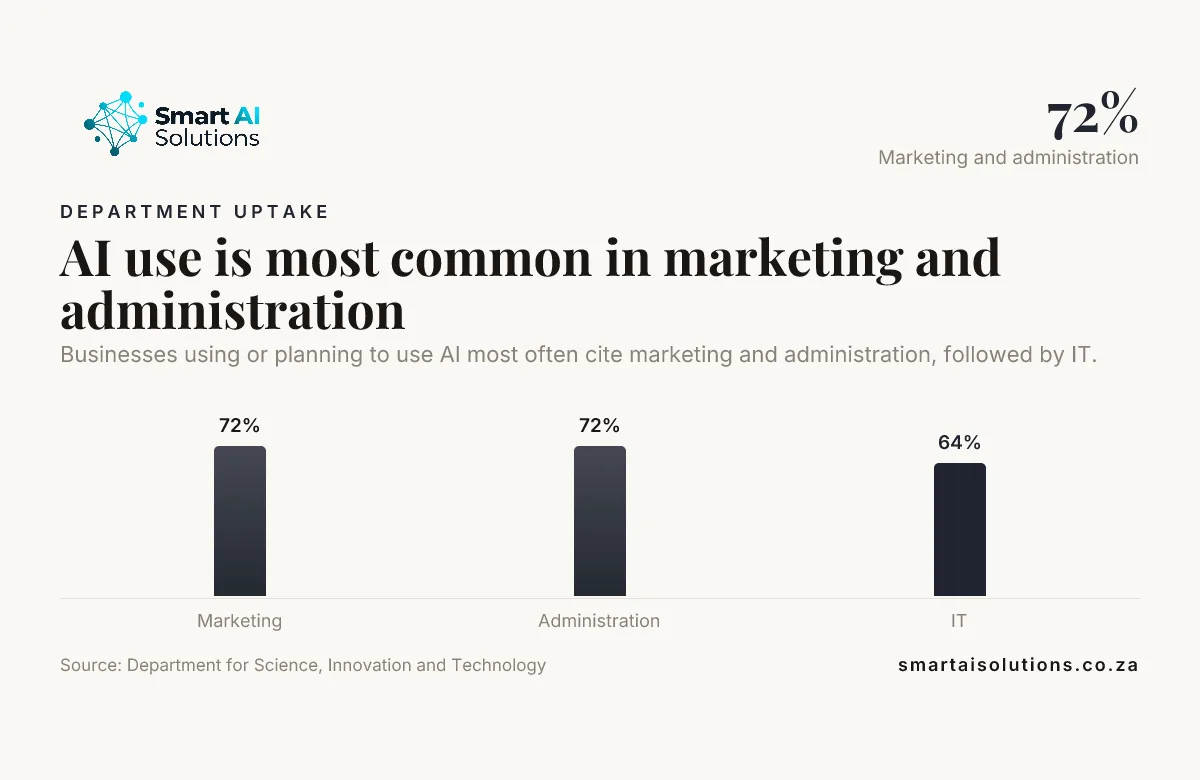
Marketing and administration are the most common areas of AI use or planned use among UK businesses that use AI or plan to (72% each), followed by IT (64%), according to the UK government's AI adoption research (DSIT). Those are sensible first departments. Ask learners to complete a realistic task and explain how they checked the result; attendance alone does not show capability.
The Johannesburg CBD AI Team Enablement programme pairs a capability audit with hands-on workshops, custom industry playbooks, implementation coaching and ongoing support. It suits teams that need learning materials tied to their roles and continued help applying them.

For accessibility, use plain-language guidance, reusable examples and supported practice in approved tools. Offer other formats or languages where needed, and allow for differences in digital confidence and access to devices or systems.
Check the programme sets shared safeguards and ownership
A programme with clear rules lets people use the tools without second-guessing every click. Look for organisation-wide rules on approved tools, permitted data, sensitive use cases, disclosure and escalation, with role-specific examples. That way, each department applies the same principles instead of inventing its own data practices.
Under POPIA, the business stays accountable for lawful processing and appropriate security safeguards. A good programme limits the personal information entered into AI tools to what an authorised purpose needs, and keeps personal or special personal information out of unapproved tools.
Before a tool is approved for personal information, someone should assess provider access, retention, security and any cross-border processing. Each workflow also needs a human reviewer with the expertise and authority to verify outputs that matter, correct errors and escalate uncertain or harmful results.
Did you know? 84% of UK businesses currently using AI report at least some human input or checking of AI outputs or decisions. Source: UK government AI adoption research (DSIT)
A reviewer should know exactly what they are accountable for and when a result must go back for correction. Human review is a working step. A rubber stamp at the end doesn't count.
Match the depth of review to the consequences of an error. High-impact decisions and anything sent outside the business need accountable human approval, while lower-risk drafts and routine internal tasks can use lighter checks. List the tasks where AI should not be used at all, such as decisions that need authorised human judgement or work that relies on an unapproved tool or data source.
Training should also cover what to do when something goes wrong. Give employees one route for reporting suspected data exposure, a questionable output or another AI-related incident, and name the team that assesses each report.
For businesses that want continued support, AI Team Enablement in Cape Town CBD brings together a capability audit, hands-on workshops, custom industry playbooks, implementation coaching and ongoing support to build internal AI capability.
Connect AI practice to existing workflows
The new habits stick when they fit into the systems your team already opens every day. Map where information enters and leaves a workflow, which systems hold the source of truth, and where a human decision must stay. That map separates useful assistance from a side experiment that creates extra work or conflicting records.
Turn each approved workflow into a short playbook. It should state the purpose, the permitted inputs, the steps, the output checks, the human decision points, the escalation route and the owner. Keep reusable prompts, examples and checklists next to it, along with clear notes on when not to use AI.
Begin with the least disruptive approach that works. Pursue deeper integration only when a tested use case shows that manual hand-offs or repeated data entry are limiting its value.
With a capability audit, hands-on workshops, custom industry playbooks, implementation coaching and ongoing support, the Cape Town CBD AI Team Enablement programme builds internal capability while teams work out how new practices connect with the work they already do. Our article on AI copilots for every employee shows what that looks like department by department.
Before connecting an AI tool to business systems, test access controls, data flow, failure handling and fallback steps. Bring process owners together with IT or security staff during design and testing, so one department's improvement does not create conflicting tools or data practices elsewhere.
Our AI Integration Services investigate your existing systems first and use step-by-step implementation and testing before a connection goes live. That fits when a proven use case needs closer workflow integration rather than another manual hand-off.
Did you know? In a once-off Bureau for Economic Research survey in 2026Q1, 95 per cent of managers and 91 per cent of private individuals reported using AI in their working week. Source: Bureau for Economic Research, Stellenbosch University
Measure results and reinforce capability
You know the programme worked when the work is better, not when the attendance sheet is full. Set a baseline before a pilot, then track adoption alongside output quality, error rates, rework, time or productivity, user confidence and relevant risks. Compare the results with the original workflow and intended outcome; usage counts alone cannot show whether work improved. Measure responsible use too: whether the required reviews happened, which errors keep recurring, any privacy incidents, and whether people followed the playbook. Note other process or staffing changes that could also explain a result.
Efficiency or productivity was the most commonly cited reason for adopting or expanding AI among current and prospective AI users in the UK (65% of this group), according to the UK government's AI adoption research (DSIT). Use the business outcome behind a trial to decide whether to repeat it, revise the process or stop.
Reinforce proven practices through coaching, shared playbooks and short review sessions. Let departments adapt the examples to their roles. Review the measures with departmental owners at agreed intervals, then revise training or safeguards when results show recurring errors, low confidence or uneven access.
Our AI Team Enablement programme closes with exactly this step: we track adoption, provide coaching and report on how your team's capability has grown. Pricing starts from R85,000 per programme, scoped after the readiness assessment so you know what each department will practise before you commit.
Frequently asked questions
What is an AI enablement team?
An AI enablement team coordinates practical adoption across the business, often bringing together business leaders, department representatives, IT, security and the people responsible for learning. Its value lies in connecting business priorities with shared standards, while giving departments a clear route to raise questions or ask for support.
Is there a fixed 30% adoption rule for AI?
No. There is no fixed adoption rule; set targets around your own roles and approved use cases.
What are the four pillars of successful AI adoption?
A useful way to organise AI adoption is around people, processes, technology and governance. Looking at all four helps leaders spot when a promising tool lacks an owner, a workable process or clear accountability.
What does the 10/20/70 rule for AI mean?
It is a planning heuristic: account for people and process change alongside algorithms, technology and data. It is a reminder to plan for organisational change as well as technical delivery.
How often should a business refresh its AI training and usage guidance?
Review guidance at least quarterly, and sooner after a material change to approved tools, data practices, regulation or workflow risk. Refresh training when reviews reveal repeated errors or when employees take on new AI-assisted responsibilities.
How can a business respond when employees worry that AI will replace their jobs?
Invite employees to name the repetitive or frustrating tasks they would hand over, and involve them in designing how AI supports that work. Explain how decisions about roles will be made and leave room for questions. Share practical examples of work that still needs human judgement.
Should contractors and temporary staff receive AI training too?
Yes, when their duties involve AI tools, business information or AI-assisted work. Scope the training to their access and responsibilities, and record completion before granting access to the relevant tools.
How should we document an AI enablement programme for audit purposes?
Keep versioned records of approved tools, usage guidance, training materials and assessment criteria, with evidence of who completed which training. Recording policy changes and how reported incidents were resolved helps the business explain how its approach developed.
Conclusion
The best AI team enablement programme for a business adopting AI across departments is the one that leaves your people confident with the new tools, using them in their real work, with the gains still there after the trainer leaves. It connects real workflows with role-based learning, clear safeguards, accountable review and measured outcomes. Start with one manageable use case, support the people doing the work and expand only when the evidence shows the process is useful and responsible.
Start with one problem: the department where people are already working around the new tools, through our AI Team Enablement service. Once that team is confident, add the next one: hand its most repetitive tasks to process automation, so fewer repetitive tasks land on your team. To talk through where your departments stand today, contact us.