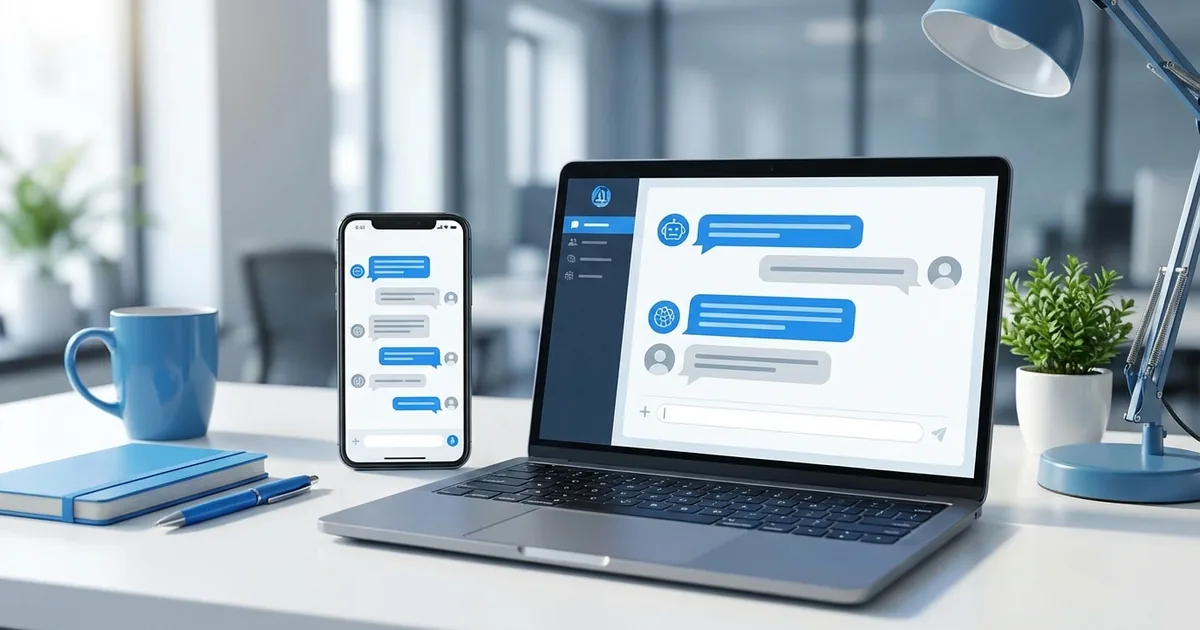
The short answerFor South African businesses specifically, chatbots solve a challenge that generic global platforms often overlook: South Africa's communications landscape is dominated by WhatsApp, not web chat or email.
The short answer
For South African businesses specifically, chatbots solve a challenge that generic global platforms often overlook: South Africa's communications landscape is dominated by WhatsApp, not web chat or email.
Why AI Chatbots Matter for SA Businesses in 2026
Direct answer: In 2026, customers expect instant responses. Not within an hour. Not within 30 minutes. Instantly. AI chatbots make 24/7 instant response possible at a fraction of the cost of staffing for it.
Current as of 31 May 2026: This article has been reviewed for the 2026 South African AI, SEO, and automation market. Pricing, platform capabilities, Google rich-result rules, and AI model features change quickly, so verify live vendor documentation before procurement. For privacy and data handling, use the Protection of Personal Information Act as the baseline; for search and structured-data implementation, use Google Search Central.
For South African businesses specifically, chatbots solve a challenge that generic global platforms often overlook: South Africa's communications landscape is dominated by WhatsApp, not web chat or email. Any chatbot strategy that doesn't include WhatsApp Business API integration is missing the channel where your customers actually are.
This guide covers everything you need to know to implement an AI chatbot in your SA business: the types available, platform comparisons, costs, POPIA compliance requirements, ROI benchmarks, and the implementation steps that separate successful deployments from failed ones.
For industry-specific chatbot deployments, explore AI chatbots for healthcare patient communication and chatbot automation for e-commerce customer support.
Types of AI Chatbots
Rule-Based Chatbots
Rule-based chatbots follow decision trees and predefined scripts. They are deterministic - given input X, they always produce output Y.
Best for:
- FAQ responses with clearly defined, stable answers
- Simple form collection (contact details, booking requests)
- Basic navigation help and menu-driven interactions
- Businesses with very defined, limited query categories
Limitations:
- Cannot handle unexpected queries or novel phrasing
- Require manual updates when policies or products change
- Frustrate users who phrase questions in unexpected ways
Cost: R5,000-R20,000 setup; R1,000-R5,000/month
AI-Powered Chatbots (NLP)
NLP (natural language processing) chatbots use machine learning to understand intent rather than exact phrasing. They can handle the same question asked 50 different ways and continuously improve from interactions.
Best for:
- Complex customer service across varied query categories
- Personalised product or service recommendations
- Sales assistance and lead qualification
- Any scenario where customers phrase questions unpredictably
Limitations:
- Require training data and an initial setup period
- Can occasionally misunderstand unusual queries (hallucination risk)
- Require ongoing monitoring and improvement
Cost: R20,000-R150,000 setup; R5,000-R25,000/month
Hybrid Chatbots
Hybrid chatbots combine rule-based logic for structured workflows (booking forms, payment confirmations) with AI/NLP for open-ended conversation. This is the architecture used by most professional implementations because it delivers consistency where consistency is needed and flexibility where flexibility is needed.
Best for: Most serious business deployments
Cost: R30,000-R200,000 setup; R8,000-R30,000/month
AI Agent Chatbots (2026 frontier)
The latest generation goes beyond conversation to action. AI agent chatbots can query databases, update CRM records, process payments, schedule appointments, and complete multi-step workflows - not just answer questions.
Best for:
- Lead-to-appointment booking automation
- E-commerce order management and returns
- Financial services account queries requiring real-time data
Cost: R80,000-R500,000 setup; R15,000-R50,000/month
Platform Comparison for SA Businesses
| Platform | Best For | SA Support | Starting Cost | |
|---|---|---|---|---|
| Tidio | Small e-commerce | Via API | Limited | R2,500/month |
| Intercom | B2B SaaS | Via API | Limited | R8,000/month |
| Freshchat | Mid-market retail | Via API | Basic | R4,000/month |
| Manychat | Social commerce | Yes | Limited | R2,000/month |
| Landbot | No-code WhatsApp | Yes | None | R3,500/month |
| Custom (local dev) | Complex SA use cases | Yes | Full | R15,000-50,000/month |
For most SA businesses, custom development with a local AI provider delivers the best results because it enables full WhatsApp Business API integration with SA-specific features (multilingual support, load-shedding resilience, POPIA-compliant data handling) that off-the-shelf platforms do not natively support.
WhatsApp vs Web Chat vs Other Channels
WhatsApp Business API: The SA Default
WhatsApp has 92% smartphone penetration in South Africa. It is the primary communication channel for an enormous proportion of your potential customers - particularly outside the major metros and across all age groups above 25.
WhatsApp chatbot advantages for SA businesses:
- No app download required - customers already have WhatsApp
- Works on 2G/3G connections (critical for load-shedding resilience)
- High message open rates (95%+ vs 20-30% for email)
- Native voice note support for customers who prefer to speak rather than type
- End-to-end encryption for POPIA compliance confidence
WhatsApp chatbot limitations:
- WhatsApp Business API requires an approved BSP (Business Solution Provider) - adds cost and setup complexity
- Template messages (proactive outreach) require pre-approval from Meta
- You cannot initiate contact outside an active 24-hour window without using paid template messages
Web Chat
Web chat is appropriate for desktop-heavy B2B environments where customers are on your website in a work context. In B2C and mobile-heavy contexts, WhatsApp almost always outperforms web chat for SA audiences.
Email Automation
Email is not a chatbot channel per se, but it is a critical complement. Chatbots capture leads, email sequences nurture them. The highest-performing SA implementations combine WhatsApp chatbot (real-time engagement) with automated email sequences (longer-term nurture).
Implementation Steps
Step 1: Define Your Goals and Use Cases (Week 1)
Before choosing a platform or writing a single conversation script, answer:
- What are the top 10 questions your customers ask most often?
- What percentage of your support/sales queries would be answerable by a bot with the right information?
- What is the most expensive manual process the chatbot could replace or reduce?
- What does success look like at 3 months? (Specific metrics, not just "better customer service")
Step 2: Map Customer Journeys (Week 1-2)
Document the actual paths customers take - not the ideal paths you wish they'd take. Interview 5-10 recent customers about how they found you, what information they needed, and what friction they experienced. This data directly informs conversation design.
Step 3: Choose Your Platform and Architecture (Week 2)
Based on your use cases, customer journey mapping, and budget, select whether you need rule-based, NLP, hybrid, or agentic architecture. For most SA B2C businesses, a hybrid chatbot with WhatsApp as the primary channel is the right starting point.
Step 4: Build and Train Your AI (Weeks 3-6)
Knowledge base preparation: Compile all the information your chatbot needs - product/service details, pricing, policies, FAQs, escalation procedures. Accuracy of the knowledge base determines chatbot performance more than any other single factor.
Conversation design: Write conversation flows for your top 20 use cases. Design for how customers actually talk, not how you'd like them to. Include failure states (what happens when the bot doesn't understand).
Integration: Connect to your CRM, booking system, or e-commerce platform so the chatbot can access real-time data and take actions (not just answer questions).
Step 5: Test Thoroughly (Week 7)
Test every conversation path with real users - not just staff. Common failure modes:
- Users who type single words rather than full sentences
- Users who answer a bot question with a new, unrelated question
- Users who try to "break" the bot with nonsense inputs
- Mobile users who make typos
Step 6: Monitor and Improve (Ongoing)
The first version of any chatbot is never the best version. Review weekly:
- Fall-through rate (queries the bot couldn't handle)
- Common failed intents (patterns in what the bot got wrong)
- Human escalation rate and reasons
- User satisfaction scores (add a simple 1-5 rating at conversation end)
Common Mistakes to Avoid
No human handoff option: Every chatbot must offer a clear, accessible path to a human agent. Customers who can't reach a human when they need one will leave and not return.
Over-promising capabilities: If your chatbot can only handle 15 use cases but your marketing implies it can handle anything, the gap destroys trust faster than having no chatbot at all.
Ignoring analytics: A chatbot you don't monitor will degrade over time. Products change, policies change, new query types emerge. Only regular review keeps performance improving.
Stale knowledge base: A chatbot trained on last year's pricing or a discontinued product is worse than no chatbot - it actively misleads customers.
English-only deployment: In South Africa, deploying in only English excludes a significant portion of your market. At minimum, support Afrikaans. For consumer brands, adding isiZulu capability dramatically expands reach.
POPIA Compliance for AI Chatbots
POPIA (the Protection of Personal Information Act) applies directly to AI chatbots that collect, store, or process personal information. Key requirements:
- Inform users at session start that they are interacting with an automated system and that their information will be processed.
- Obtain explicit consent before collecting personal information (name, contact details, financial information). 3. Data minimisation: Only collect what you actually need for the stated purpose.
- Secure storage: Conversation logs containing personal information must be stored on POPIA-compliant infrastructure (SA-hosted preferred for sensitive data).
- Right of access and deletion: Users can request their data or request deletion. Your system must be able to comply.
SA-Specific Cost Breakdown (2026)
| Business Size | Recommended Solution | Setup Cost | Monthly Cost | Typical Annual Saving |
|---|---|---|---|---|
| Small (1-10 staff) | Rule-based WhatsApp bot | R8,000-R20,000 | R2,000-R5,000 | R60,000-R180,000 |
| Medium (11-50 staff) | Hybrid NLP + WhatsApp | R30,000-R80,000 | R8,000-R20,000 | R200,000-R600,000 |
| Large (51-200 staff) | Custom AI + multi-channel | R80,000-R200,000 | R15,000-R40,000 | R500,000-R2,000,000 |
| Enterprise (200+ staff) | Full AI agent platform | R200,000-R600,000 | R40,000-R100,000 | R1,000,000-R5,000,000 |
How to Measure Chatbot ROI
Four metrics to track from day one:
Deflection rate: What percentage of queries the chatbot resolves without human involvement. Target: 60-75% for most SA business use cases.
First response time: How quickly customers receive an initial response. Any response (even "Hello, I'm looking that up for you") dramatically reduces frustration.
Human escalation rate: What percentage of conversations require a human agent. A 20-30% escalation rate is normal and healthy. Below 10% may indicate the chatbot is not correctly identifying when to escalate.
Cost per resolved query: Total monthly chatbot cost ÷ queries resolved. Compare this to your fully loaded human agent cost per query.
Getting Started
Ready to implement an AI chatbot? Smart AI Solutions offers free consultations to assess your needs, recommend the appropriate architecture, and provide a detailed ROI projection based on your actual query volumes and current support costs.
Book your free chatbot consultation or explore our AI chatbot services
Related Resources:
- AI Chatbots and Assistants
- How to Build a WhatsApp Business Chatbot in SA
- POPIA Compliance for AI Chatbots
- AI Chatbot vs Live Chat: Which Is Right for SA Businesses?
- Best AI Chatbot Companies in South Africa (2026): ready to shortlist providers? This comparison covers the 10 leading SA chatbot companies
Further Reading:
Frequently Asked Questions
How much does an AI chatbot cost for a South African business?
Setup costs range from R8,000 for a basic rule-based WhatsApp bot to R200,000+ for a custom enterprise AI chatbot. Monthly operating costs range from R2,000 to R40,000. Most SA SMEs see full payback within 2-4 months from reduced support staff costs alone.
Is WhatsApp the best chatbot channel for SA businesses?
For B2C businesses, yes - WhatsApp has 92% smartphone penetration in SA and dramatically higher open rates than email or web chat. For B2B businesses with primarily desktop users, web chat can be equally effective. Most successful SA implementations use both.
Do AI chatbots need to comply with POPIA?
Yes. POPIA applies to any AI chatbot that collects personal information. Requirements include informing users they are interacting with a bot, obtaining explicit consent for data collection, data minimisation, secure South African hosting for sensitive data, and the ability to delete user data on request.
How long does chatbot implementation take?
A basic rule-based WhatsApp bot can be deployed in 2-3 weeks. A hybrid NLP chatbot with CRM integration typically takes 6-8 weeks. A full agentic AI chatbot capable of taking actions (booking, payment) typically takes 10-16 weeks.
What is a realistic deflection rate for a South African chatbot?
Most well-implemented SA chatbots achieve 60-75% deflection (queries resolved without a human agent) within 3 months. High-volume, repetitive query environments (e-commerce support, banking FAQs) can reach 80-85% with sufficient training data.
Can an AI chatbot work in Afrikaans and Zulu?
Yes. Modern NLP models support all 11 South African official languages with varying accuracy. Afrikaans accuracy is highest (close to English). isiZulu and isiXhosa capabilities have improved significantly in 2025-2026. For critical customer-facing applications, we recommend testing accuracy with native speakers before deployment.