Current as of 9 September 2026: The search-demand figures in this article were pulled live from the DataForSEO Google Ads API for South Africa on 9 September 2026. The figures are dated on purpose, because a statistic without a date is a claim, not a measurement.
Direct answer: Business Intelligence and Process Automation is no longer a "nice to have" for 2026, because only 12% of CEOs report that AI has delivered both cost reductions and revenue benefits at the same time. The gap is usually not the tools. It is the workflow, the data quality, and the boring process details that decide whether automation sticks.
Key Takeaways
| Question | Short answer |
|---|---|
| What to automate first | Stop losing money to manual work by mapping your real processes, then automating only the steps that qualify. |
| Where BI fits | BI turns automation outcomes into dashboards and alerts built from actual KPIs, not guesses. |
| Best next step | Book an AI audit, then we build predictive analytics and process automation with error handling and monitoring. |
| Nationwide delivery | Nationwide service across South Africa, Cape Town headquarters, and coverage for Johannesburg, Pretoria, Centurion, and Midrand. |
| Local proof | Verifiable results in SA operations, including the Naptosa case study, and measurable time savings from process investigation and automation design. |
- Process automation starts with investigation, not apps, see Process Automation.
- Dashboards that matter come after data investigation and model development, see Predictive Analytics.
- For South African subsidiaries, we focus on governance, scalability, and cross-functional AI deployments.
- Need predictable rollout? Our approach is deploy and monitor, not "set and forget", see Pricing.
- Want to compare options? Use our comparison hub before you commit.
Why Business Intelligence & Process Automation keeps winning in 2026
In 2026, the companies doing Business Intelligence and Process Automation properly stop treating dashboards and bots as separate projects. They connect the workflow logic to the reporting logic, so when something changes operationally, the BI layer updates, and the automation layer reacts.
Most "we tried it" stories fail for the same reason. Either the automation runs on broken assumptions, or the dashboards look impressive but do not tie to the decisions people actually make. Our job is to audit, map, and deploy workflows that match your business logic, then investigate the data that powers your operational decisions.
Better vs worse: BI and automation that actually connects
- Worse: A dashboard built from whatever data is available, then automation attempted later. You get misleading KPIs and churn because decisions are made on the wrong signals.
- Better: Process investigation first, then automation design with error handling, then BI dashboards and alerts based on your actual KPIs.
We build dashboards from your actual KPIs. We investigate what matters before we build.
That is why we treat process automation and predictive analytics as one operating system for 2026, not two disconnected workstreams.
What South Africa is actually searching for, measured on 9 September 2026
Most articles on this topic assert that demand exists. We measured it. These are live monthly search volumes for South Africa, pulled from the DataForSEO Google Ads API on 9 September 2026:
| Search term (South Africa) | Monthly searches | Advertiser CPC | Competition |
|---|---|---|---|
| business intelligence | 720 | $1.35 | Low |
| process automation | 720 | $0.39 | Low |
| predictive analytics | 260 | $1.27 | Low |
| workflow automation | 140 | $7.34 | Medium |
| business process automation | 50 | $4.45 | Medium |
| ai automation south africa | 50 | $4.33 | Medium |
| business intelligence south africa | 10 | — | Low |
| predictive analytics south africa | 10 | — | — |
Two things in that table are worth more than the headline numbers.
"Workflow automation" carries a $7.34 CPC on only 140 searches a month. Advertisers do not bid seven dollars a click on idle curiosity. That is the highest commercial intent on the list by a wide margin, and it is the exact phrase describing what actually breaks in most implementations. Low volume, high commercial value: the combination worth building content around.
One caveat we will state rather than gloss, because the whole article is about not misreading your own data. The Competition column is Google Ads competition, meaning how hard advertisers compete to BID on the term. It is not organic ranking difficulty. They often correlate; they are not the same number, and this dataset cannot tell you the second one. On that measure the two 720-a-month generic terms sit at Low and "workflow automation" sits at Medium, so the cheapest paid entry and the highest-intent term are not the same keyword.
Process automation foundation: map the workflow, then automate the steps
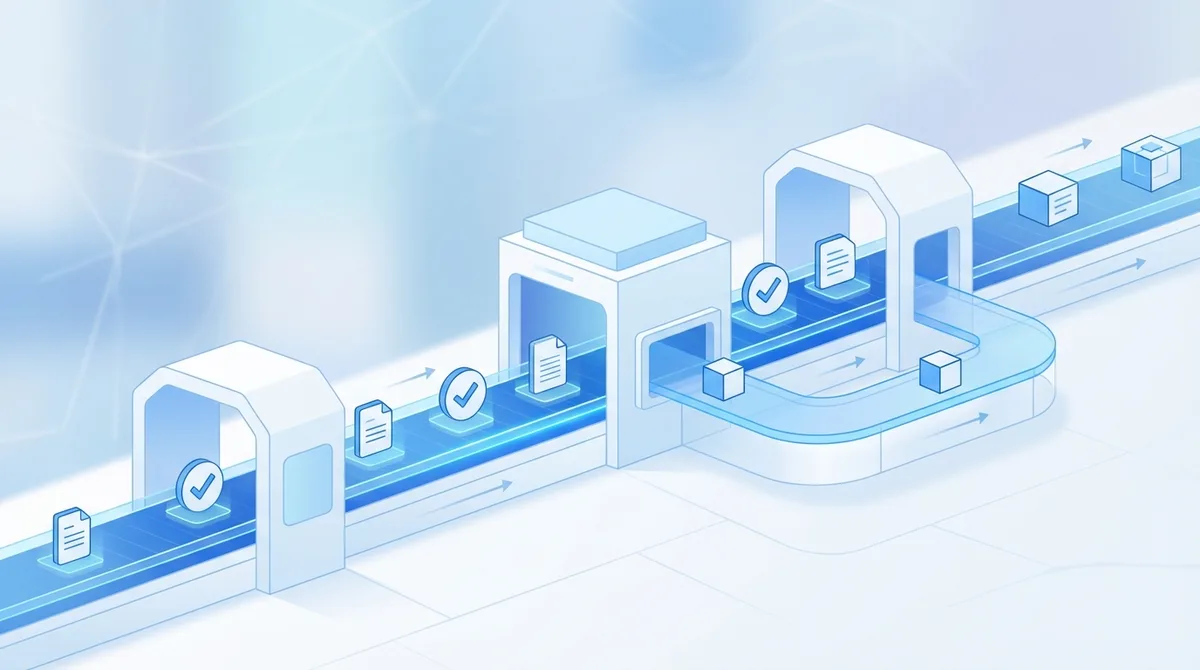
If you want process automation that holds up in the real world, you start with workflow mapping, not "plug in an AI agent" and hope. We map your operational workflow, identify automatable steps, and design automation with monitoring and guardrails.
On our Process Automation service, we run three phases: Process Investigation, Automation Design, and Deploy & Monitor. We do this for South African companies across Johannesburg, Pretoria, Centurion, and Midrand, and we have implemented over 2,000 individual workflows to date.
What we automate (common use cases)
- Inbound workflow triage, so work goes to the right person the first time.
- CRM-driven sales task automation that keeps pipeline stages accurate.
- Operational handoffs with automated checks and error handling.
- Exception workflows, so failures do not silently become backlog.
What "good" looks like for your team
Our typical client results are in the region of 40-70 hours saved per month, with a sharp reduction in process-related errors. That is the kind of outcome Business Intelligence and Process Automation needs to deliver to stay credible in 2026.
BI that drives decisions: dashboards, alerts, and the data behind the numbers
Business Intelligence and Process Automation works when the BI layer is built to answer a business question. In 2026, you cannot just "visualise data". You need to connect the KPI to the workflow action, then measure whether the action improved the outcome.
That is where dashboards and alerts stop being decorative and start becoming operational. We design reporting that reflects the workflow reality, then we deploy the automation that feeds it.
A statistic we deliberately did NOT use. The usual line here is that the brain processes visuals "60,000 times faster than text". We left it out: it is a marketing myth with no traceable study behind it, attributed variously to 3M and the University of Minnesota, neither of which can produce the research. An article arguing that you should measure rather than assert has no business opening its BI section with the most famous unsourced number in data visualisation.
How we keep BI tied to process reality
- Investigate data sources and quality before you promise forecasts or alerts.
- Define the KPI and the trigger, what starts an action, and what stops it.
- Build feedback loops, because automation must improve over time, not just report.
- Monitor failures, so BI does not show "success" while work breaks quietly.
If you need CRM-driven automation as well, we also focus on CRM sales automation, so pipeline data stays clean and decisions stay accurate.
Predictive analytics that fits your data reality, not a theoretical ideal
Business Intelligence and Process Automation becomes a competitive advantage when you can forecast and prevent problems, not just track them. That is what our Predictive Analytics service is for, and it starts with Data Investigation before any model work.
In 2026, most teams have data, but they do not have the right quality, the right joins, or the right volume to build reliable forecasts. We assess your existing data sources, quality, and volume before recommending a model. Then we build predictive solutions that fit your actual data reality.

Common predictive use cases
- Sales forecasting: forecast revenue, pipeline velocity, and deal probability with high accuracy.
- Customer churn prevention: identify at-risk customers and trigger retention campaigns.
- Demand prediction: forecast demand weeks in advance to optimise inventory and staffing.
Then we deploy dashboards and alerts so the forecasts trigger actions inside your workflows. That is the bridge between Business Intelligence and Process Automation and real operational outcomes.
Dashboards are useless without action
We see it every time. People view a chart, then nothing changes operationally. We design predictive analytics so it plugs into workflow automation, because investigation, model development, and dashboard deployment only matter if the outputs create decisions.
When automation breaks, it breaks on complex workflows, not simple tasks
We are direct about this. "Handles any complexity" versus "breaks on complex workflows" is how many generic automation attempts feel in practice. The reason is usually not intelligence, it is business logic. If your workflow has exceptions, approvals, and data quality edge cases, you need automation that was built with error handling and monitoring from day one.
What to look for in 2026 implementations
- Workflow mapping that includes exceptions, not just happy paths.
- Clear monitoring, so failures become visible, not mysterious.
- Dashboards that match operational KPIs, not vanity metrics.
- Integration discipline, so BI reports and automation triggers use the same definitions.
We audit your process, investigate your data, and then deploy and monitor. That is how we plug the leaks and keep automation from becoming extra work.
We audit your sales pipeline, find the leaks, and plug them with AI. That same approach applies to operational workflows, not only sales.
Choosing the right path in 2026: DIY tools, agencies, or an AI Developer Rental
In 2026, teams have options, DIY tools, agencies in Joburg, offshore teams, and developer rentals. The best choice depends on whether you need reliable process and automation logic, or you just want something working quickly.
Here is the honest comparison. DIY can be a good starting point if your workflow is simple and your data definitions are stable. Agencies often deliver work that looks good, but they struggle when you need ongoing iteration, monitoring, and process-level fixes. Offshore can be cheaper, then you lose time to rework and correction cycles.
The smarter alternative for serious Business Intelligence & Process Automation
We offer an AI Developer Rental model starting from R15,000/month when you need hands-on development capacity with our process automation and BI approach. You stop paying for one-off deliverables, and you start managing a builder team that can investigate, map, deploy, and improve.
Did you know? Only a small minority of CEOs, 12%, say AI delivered both cost reductions and revenue benefits simultaneously. Source: AYAutomate
Where our approach avoids common value traps
- Actually follow instructions, so automation uses the correct business logic and not generic prompts.
- Eliminating offshoring review and reducing correction cycles by building and monitoring locally with clear feedback loops.
- Coded to match your processes, we assess what you have and build from there.
Nationwide reach in South Africa, with an enterprise-ready delivery model
Business Intelligence and Process Automation needs consistency across teams, branches, and subsidiaries. Our marketplace approach supports remote and on-site options across South Africa, with nationwide service and coverage across multiple industries.
For enterprise rollouts, we add governance and scalability
If you are rolling Business Intelligence and Process Automation across multiple business units, our Enterprise offering focuses on governance, scalability, and cross-functional AI deployments. That matters in 2026 when auditability and integration discipline are non-negotiable.
For that enterprise path, see Smart AI Solutions Enterprise.
Local proof points that keep it real
We show outcomes through case studies, not just claims. If you want a concrete example, start with the Naptosa case study and then compare how the workflow logic and BI outputs connect.
Conclusion
Business Intelligence and Process Automation in 2026 is about one thing: connecting decision data to the workflow actions that fix problems. We audit your sales pipeline and operational processes, map the workflows, deploy automation with monitoring, and build dashboards from your actual KPIs so you get verifiable results.
The search data says South African demand for exactly this is real and still cheap to reach, and that the highest commercial intent sits on one of the lowest-volume phrases in the table. That conclusion came from measuring rather than assuming, which is the whole discipline in one sentence.
If you want a practical starting point, book an AI audit, then decide whether you need process automation, predictive analytics, or both. We deliver nationwide, we build with your business logic, and we keep iterating until the automation stops creating work and starts removing it. That is how we plug the leaks in 2026.
Frequently Asked Questions
What does Business Intelligence & Process Automation mean in plain English?
It means you use BI data (dashboards, alerts, KPIs) to drive decisions, and you automate the workflows that execute those decisions. In practice, it is mapping your process, building automation with monitoring, and connecting it to reporting based on your real KPIs in 2026.
Is process automation worth it in 2026 for mid-sized South African businesses?
Yes, when you start with process investigation and automate the steps that create leakage and rework. Our approach targets manual work first, because it is where time loss and errors pile up, and it supports accurate KPI reporting. Live DataForSEO figures for September 2026 show 720 monthly searches in South Africa for both 'business intelligence' and 'process automation' at low competition, so buyer demand is real and still inexpensive to reach.
How do we automate the process without breaking our workflow exceptions?
We map your workflow including exceptions, then design automation with error handling and monitoring so failures are visible and recoverable. That is the difference between automation that works on the happy path and automation that holds up in real operations in 2026.
What is the difference between business automation and enterprise process automation?
Business automation usually focuses on specific departments or workflows, while enterprise process automation adds governance, scalability, and cross-functional integration. At enterprise scale you also need consistent KPI definitions and reliable reporting across teams.
Which is better for forecasting, predictive analytics dashboards or full process automation?
Dashboards alone tell you what happened, predictive analytics forecasts what is likely to happen. Full Business Intelligence and Process Automation connects those forecasts to automated workflow actions, like churn prevention triggers or sales forecasting follow-ups, so the forecast becomes an operational change.
Can DIY tools replace a full-stack AI partner for Business Intelligence & Process Automation?
DIY tools can help with simple, stable workflows, but most teams struggle when data definitions and exception handling become complex. A full-stack partner approach, including process automation plus BI and predictive analytics, is usually the safer path for reliable outcomes in 2026.
How long does it take to deploy Business Intelligence & Process Automation?
It depends on how ready your data and workflows are, but the key is doing investigation first so you do not waste cycles building the wrong thing. We plan around process investigation, automation design, then deploy and monitor, and we keep the rollout tied to your actual KPIs.