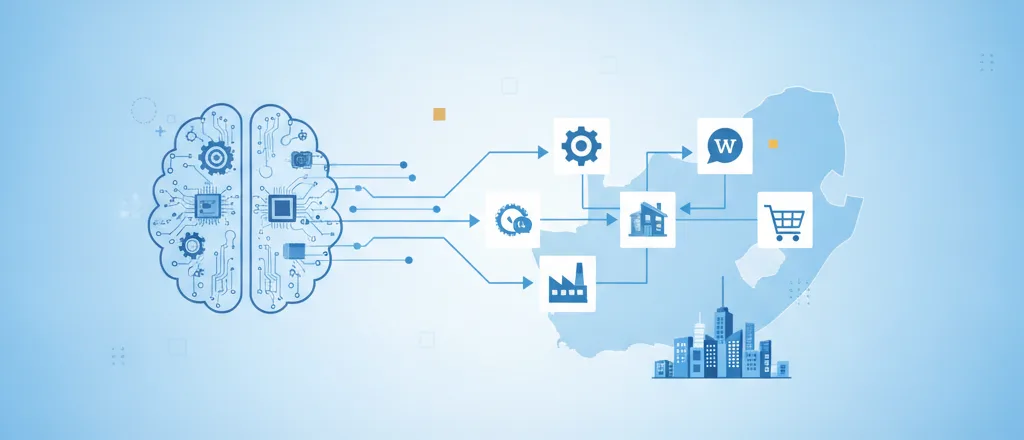
The short answerAI lead scoring helps South African sales teams spot high-value prospects, so your people spend their time on the deals most likely to close.
The short answer
AI lead scoring helps South African sales teams spot high-value prospects, so your people spend their time on the deals most likely to close.
The Lead Prioritization Problem
Direct answer: Every sales team faces the same challenge: too many leads, too little time. Which prospects should you call first? Which deals deserve your best resources? Which opportunities will actually close?
Current as of 31 May 2026: This article has been reviewed for the 2026 South African AI, SEO, and automation market. Pricing, platform capabilities, Google rich-result rules, and AI model features change quickly, so verify live vendor documentation before procurement. For privacy and data handling, use the Protection of Personal Information Act as the baseline; for search and structured-data implementation, use Google Search Central.
About the figures in this article: The scoring bands in this article (such as 80 to 100) are example thresholds you can adjust, not published statistics or measured client results.
Traditional lead scoring uses simple rules: add points for company size, industry fit, website visits, and engagement. Subtract points for missing information or slow response. This basic math misses subtle patterns that predict conversion.
Real estate agencies use lead scoring to automate lead follow-up, while financial advisors apply it to qualify leads faster.
AI lead scoring analyzes hundreds of signals simultaneously, identifying patterns human analysis would never discover. The result is a ranking of leads that reflects how your past customers actually behaved, rather than points someone guessed at, so reps spend less time on leads that were never going to close.
How AI Lead Scoring Works
Data Collection
AI analyzes all available lead information:
Firmographic Data: Company size, industry, location, revenue, growth stage, employee count, technology stack
Behavioral Signals: Website visits, pages viewed, time spent, content downloaded, email opens, event attendance, social media engagement
Engagement Patterns: Response speed, communication frequency, meeting acceptance rates, decision-maker involvement
Historical Context: Previous deals with similar profiles, industry trends, seasonal patterns, economic indicators
Pattern Recognition
Machine learning algorithms analyze thousands of historical deals, identifying patterns that distinguish winners from losers. These patterns are often counterintuitive.
Example Discoveries:
- Leads who visit the pricing page a couple of times may convert better than those who never look or who keep returning without acting
- Mid-sized companies may convert better than larger ones in specific industries
- Leads who reply quickly to first outreach may close faster
- A decision-maker joining the first meeting may raise close probability
These are the kinds of patterns a model can test against your own history. For instance, it might show that leads who download case studies convert better than those who download product sheets, which would change what content you promote. Whether that holds depends entirely on your data.
Learn more about CRM AI capabilities.
Predictive Scoring
For each new lead, AI calculates conversion probability based on learned patterns. Scores typically range from 0-100 or A-F grades.
High Scores (80-100, Grade A): Strong fit, high engagement, patterns match successful deals. Priority for immediate follow-up by senior sales representatives.
Medium Scores (50-79, Grade B-C): Decent fit but missing some positive signals. Appropriate for standard sales process.
Low Scores (0-49, Grade D-F): Weak fit or negative signals. Consider nurturing campaigns rather than direct sales attention.
Continuous Learning
As leads progress through your funnel, AI tracks outcomes. Did high-scored leads actually convert? Did any low-scored leads surprise by closing? The system learns from these results, continuously improving accuracy.
| Automation Type | Best For | Complexity |
|---|---|---|
| Rule-Based (RPA) | Repetitive, structured tasks | Low |
| AI-Powered | Pattern recognition, decisions | Medium |
| Cognitive AI | Unstructured data, NLP | High |
| Agentic AI | Multi-step workflows | Very High |
Implementation Approaches
Native CRM AI
Major CRMs include AI lead scoring:
Salesforce Einstein: Analyzes historical Salesforce data to score leads and opportunities. Works well for Salesforce-centric organizations.
HubSpot Predictive Lead Scoring: Available in Professional/Enterprise plans. Simpler than Salesforce Einstein but effective for SMBs.
Microsoft Dynamics AI: Powered by Azure AI services. Strong for Microsoft ecosystem users.
Pros: Seamless integration, easier implementation, included in many licenses
Cons: Limited customization, constrained to CRM data, less sophisticated than specialized solutions
Third-Party AI Platforms
Specialized platforms offer advanced capabilities:
Platforms: 6sense, Clari, InsideSales.com, Conversica
Pros: More sophisticated algorithms, broader data sources, specialized features, often better accuracy
Cons: Additional licence cost per user, integration complexity, vendor management
Custom AI Models
Build proprietary AI tailored precisely to your business:
Pros: Complete customization, competitive advantage, integration with any data sources
Cons: Requires AI expertise, longer implementation, ongoing maintenance
Best For: Large enterprises with unique requirements and internal AI capabilities
Our AI development services build custom lead scoring models.
Where the Gains Show Up for Different Teams
These are hypothetical profiles, not client case studies.
B2B software team using a CRM's built-in scoring: The main gains are a better conversion rate and a shorter sales cycle, because reps call the right leads first.
Manufacturer with a custom model: The main gains are a better win rate, less wasted effort on unqualified leads, and a more reliable sales forecast.
Professional services firm using a specialist platform: The main gains are a better conversion rate, larger average deals, and a lower cost of acquiring each customer.
Best Practices
Start with Clean Data
AI accuracy depends on data quality. Before implementing AI scoring:
- Remove duplicate leads
- Standardize data formats
- Fill critical missing fields
- Verify data accuracy
Define Success Clearly
What does "conversion" mean for your business? Signed contract? Qualified opportunity? First purchase? Clear definitions enable accurate AI training.
Balance Speed and Accuracy
AI can score leads instantly but accuracy improves with more data. Collect enough signals before scoring rather than immediate scoring on minimal information.
Don't Ignore Low-Scored Leads Completely
Some low-scored leads will convert. Implement nurturing campaigns to stay engaged while focusing active sales effort on high-scored prospects.
Combine AI with Human Judgment
Sales reps should be able to override AI scores when their judgment differs. Track these overrides to improve AI and catch edge cases.
Monitor and Refine Continuously
Review AI accuracy monthly. Are high-scored leads actually converting? Are any patterns emerging that AI misses? Continuous refinement maximizes value.
Discover sales optimization strategies.
Common Challenges
Challenge: Not enough historical data for AI training Solution: You need a meaningful history of won and lost deals. Start with simpler rule-based scoring while collecting data, then migrate to AI.
Challenge: Sales team doesn't trust AI scores Solution: Show the data. Demonstrate that high-scored leads convert at higher rates. Let reps override initially but track results.
Challenge: AI scores change frequently Solution: Normal as leads gain new signals. Educate team on how scores evolve. Focus on score trends, not momentary values.
Challenge: Integration with existing sales process Solution: Start with just prioritizing outreach based on scores. Gradually integrate deeper into process as adoption increases.
The safest way to begin is a focused pilot on one workflow, measured against your own baseline, before you scale further.
Frequently Asked Questions
How much historical data does AI scoring need?
You need a meaningful history of both won and lost deals, because the model learns from the contrast between them. More data and deals improve accuracy. Organizations with limited history can start with simpler models and enhance over time.
What's typical AI scoring accuracy?
This varies by industry, sales cycle length, and data quality. Continuous improvement increases accuracy over time.
Can AI scoring work for small businesses?
Yes, though with limitations. Smaller organizations have less historical data, reducing initial accuracy. Start with native CRM AI (often included in licenses) rather than expensive specialized platforms.
How long before we see ROI?
Timing depends on your sales cycle length, lead volume and data quality. Track conversion rate by score band from the first week so you can see the effect in your own numbers.
Ready to implement AI lead scoring? Contact us for consultation on AI lead scoring tailored to your sales process. We'll assess your data, design optimal scoring approach, and implement system that identifies your best prospects automatically.
Explore sales AI capabilities.
Related Resources: