The short answerChoosing South African predictive analytics consultants for business forecasting and decision support starts with the decisions your business needs to make, not with a model or tool.
The short answer
Choosing South African predictive analytics consultants for business forecasting and decision support starts with the decisions your business needs to make, not with a model or tool.
Choosing South African predictive analytics consultants for business forecasting and decision support starts with the decisions your business needs to make, not with a particular model or software tool. The best-fit consultant defines that decision first, checks whether your data can support it, and shows how each forecast will be validated, delivered and monitored.
This guide is for South African businesses comparing predictive analytics consultants. It sets out the questions to ask about forecasting goals, data, validation and implementation, so you can judge whether a proposal fits your operation.
Disclosure: Smart AI Solutions publishes this guide and sells the predictive analytics service it links to. We do not rank other consultants here. The checks below apply to any provider, including us.
Key takeaways
| What to assess | Why it matters |
|---|---|
| Define the prediction and the decision it supports. | A clear target, forecast horizon and action give the project a practical purpose. |
| Match the modelling approach to the question. | Compare suitable methods with a simple baseline, and favour outputs users can apply. |
| Check local and industry fit. | Forecasting needs differ by sector. See retail inventory planning, crop-yield prediction and bank credit decisioning for three distinct examples. |
| Review data quality, integration and governance. | Incomplete records, inconsistent definitions and stale inputs can weaken a forecast. |
| Measure performance against business costs. | Forecast errors have different consequences, such as excess stock or missed sales. |
| Plan for deployment and monitoring. | Users need predictions in their workflow, plus clear ownership and follow-up procedures. |
Start with the business decision, not the model
Turn a broad ambition such as better planning into a specific outcome to predict. Weekly product demand, monthly sales by region or a customer's likelihood of leaving are clearer modelling targets than a general request to improve performance.
Set the forecast horizon and level of detail to match the decision. A store-level weekly demand forecast can inform replenishment, while a monthly business-wide sales forecast may support budgeting and capacity planning.
Define what happens when a prediction arrives: who reviews it, what action they can take and what level or condition triggers that action. A customer churn alert, for instance, needs an owner and a suitable follow-up. Otherwise it risks becoming another unused dashboard. This is the decision support half of the brief, and it is where many business forecasting projects stall.
Our Predictive Analytics service assesses existing data and builds predictive models, dashboards and alerts for business forecasting and decision support. It suits an initial assessment when you want to connect forecasts with practical outputs for planning and follow-up. If the field is new to your team, start with our overview of predictive analytics for South African businesses.
Match the forecasting approach to the problem
For demand or sales measured over time, compare time-series methods such as exponential smoothing or ARIMA with a seasonal-naive baseline. When recurring seasonal patterns or trends are present, methods that represent those patterns may help, but a simple benchmark shows whether extra complexity improves the forecast. Our AI demand forecasting guide covers the demand case in more depth.
When external factors or many business variables may influence an outcome, consider machine-learning methods such as gradient-boosted trees. Ask the consultant to explain which features the predictive modelling uses and how the prediction will guide a decision.
For churn or risk, frame the task as estimating a probability or ranking cases for review. Set alert thresholds around the relative cost of missed cases and unnecessary follow-up. Do not treat every score as an automatic decision.
Our Predictive Analytics service for Johannesburg CBD covers machine-learning analytics for demand and sales forecasting, churn prediction, anomaly detection, risk assessment and inventory optimisation.
For a churn-focused use case, Predictive Analytics Cape Town CBD uses machine-learning models for forecasting, churn prediction, anomaly detection, inventory optimisation and risk assessment.
Do not select a method for complexity alone. A model is a poor fit when users cannot understand its output well enough to connect it to a decision, even if its technical design sounds sophisticated.
Check industry fit and local operating context
Ask how the proposed work reflects the business function. Inventory planning needs product and stock information. Sales forecasting depends on a defined sales outcome. Customer behaviour calls for relevant interaction history, and risk assessment needs an outcome that can be evaluated consistently.
For operations across regions, test whether the approach accounts for location-level differences. Local demand patterns, supplier lead times, trading calendars and changing operating conditions can affect what a forecast needs to represent.
Compare examples by the problem solved and the path from prediction to action. Forecasting stock replenishment, anticipating customer churn and estimating equipment failure call for different data and users, and a different operational response.
Predictive Analytics for Johannesburg businesses builds forecasting and prediction models to anticipate customer behaviour, optimise inventory, detect fraud and support data-driven decisions. It is relevant to this assessment because each of those use cases connects predictive modelling with an identifiable business function.
Use location as operating context, not as proof of sector expertise. Analytics consultants based near you should still explain the business problem, the data and the intended workflow for your project.
Assess data readiness and governance, then scope a pilot
Before modelling, inventory the historical outcome data, timestamps, customer or product identifiers and relevant operational or external variables. Inconsistent definitions and missing records can make comparisons unreliable, so agree what each field means and how outcomes are recorded.
Map how data sources will be joined and how often each source will refresh. Fragmented systems can leave out important inputs. Delayed updates can make predictions stale by the time a team acts on them.
For personal information, set access controls, permitted uses and retention rules in line with applicable data-protection obligations, including POPIA. Limit access to the people and systems that need it for the defined purpose.
Scope a pilot around one decision, one agreed success measure, a baseline and a review date. Expand only when results and the working process show that the pilot adds value.
Assess a pilot against a defined use case and success measure. A service name or a price is not evidence that the project is ready to scale.
Did you know? A University of Johannesburg study used ARIMA models to forecast skills demand in South African manufacturing. It predicted future demand with 80% accuracy or better for 473 of 713 (66%) occupations in the food and beverage (FoodBev) sector. Source: Big Data and Cognitive Computing
Test forecast reliability against business costs
Require a simple baseline, such as the previous period or the same season in the prior year, and compare it with the model on data kept out of training. For time-series work, use chronological validation so the test reflects predicting future periods from past observations.
Choose an error measure that fits the decision. MAE reports average absolute error in the target's units, while RMSE gives larger misses more influence. MAPE can mislead when actual values are zero or close to zero.
Translate over-forecasting and under-forecasting into operational costs. Excess stock and stockouts, for example, have different consequences, so set action thresholds with that trade-off in mind.
Treat predictions as uncertain estimates, not guaranteed outcomes. Review results by period or business segment, and agree what error level the team can accept before using outputs in consequential decisions.
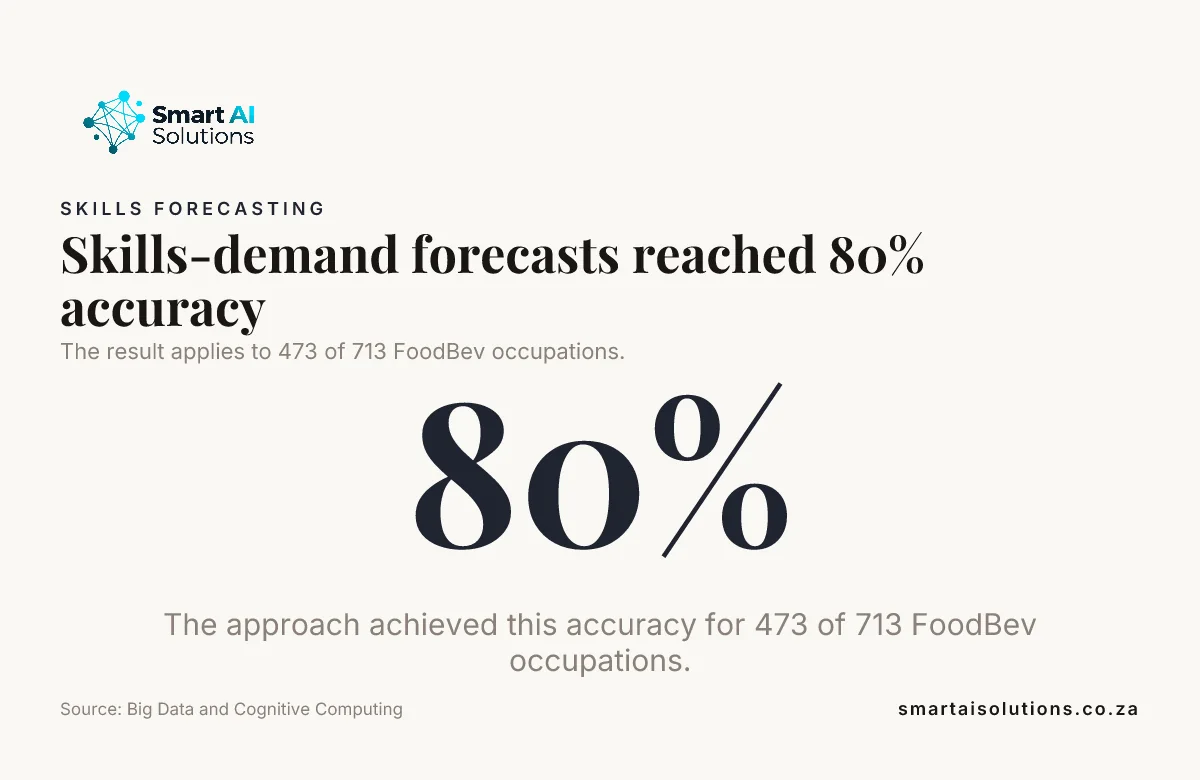
The result applies to 473 of 713 FoodBev occupations. In the same study the figure was 474 of 522 (91%) for the chemical sector, so accuracy depends on the dataset as much as the method. Source: Big Data and Cognitive Computing
Our broader AI integration and automation services include machine-learning forecasting, churn prediction, anomaly detection and risk assessment, with demand planning also covered on the location pages. Predictive Analytics is priced from R35,000 per project. Assess any proposed model, ours included, against your own baseline, cost of error and validation criteria.
Plan for deployment, then monitoring and ongoing use
Ask how predictions will reach users and systems, whether through a dashboard, an alert or an operational integration. Forecasts that sit apart from the tools and routines people use are less likely to influence decisions.
Agree who owns the outputs and follow-up actions, and give users guidance on when to act, investigate or override a recommendation. An override process should let staff record why they did not follow a prediction, which creates useful context for later review.
After launch, monitor input-data changes and forecast performance. Shifts in business patterns or deteriorating results can signal that the model needs investigation or retraining.
Compare forecasting consultants on relevant problem experience, validation practice, integration capability and a clear handover plan. Our Data Analytics & Reporting service provides automated data pipelines, dashboards and reporting, which help connect analytics outputs with ongoing business use.
The images below show business analytics and reporting rooms of the kind where predictions reach decision-makers.


Questions to ask predictive analytics consultants before you sign
- Which decision will this forecast support, and who acts on it?
- What simple baseline will the model be compared with, and on which held-out periods?
- Which data sources will be joined, how often do they refresh, and who owns each definition?
- Which error measure fits our cost of over-forecasting and under-forecasting?
- How will predictions reach our staff: a dashboard, an alert or an integration?
- What is in the handover, and who retrains the model when results slip?
Frequently asked questions
What do predictive analytics consultants cost in South Africa?
It depends on how many data sources need connecting, how clean the history is and how many decisions the forecasts must support. Our Predictive Analytics service is priced from R35,000 per project, and the scope is set after a data assessment.
Can predictive analytics forecast demand for a product with no sales history?
Yes, a consultant can estimate initial demand using comparable products, category patterns, product attributes, planned distribution and launch conditions. Treat this as a cold-start estimate and update it as actual sales arrive.
How far ahead should a business forecast?
Choose a horizon that gives the business time to respond, such as arranging stock, staffing or budgets. Forecasts usually become less certain further into the future, so review performance separately for each horizon you plan to use.
Can a small business benefit from predictive analytics?
Yes, a small business can benefit when it has a recurring decision and a usable record of relevant activity, even if that record lives in spreadsheets or a basic sales system. A focused forecast for one costly or time-consuming decision can be more useful than a large analytics programme.
Do predictive analytics forecasts replace business judgment?
No. A forecast estimates outcomes from available information, while managers can account for new events, constraints or commitments that the data does not capture.
How should a business forecast demand for a newly opened branch?
Start with comparable locations and adjust for differences in catchment, product mix, opening hours and local trading conditions. Keep the branch's initial forecast separate from its observed results so the team can see when its own history becomes informative.
What should a predictive analytics consultant include in a handover?
Ask for a plain-language description of the model's inputs and intended use, along with operating instructions, known limitations and escalation contacts. A practical handover also identifies who can approve changes to data definitions and thresholds, and who grants access.
Conclusion
The best-fit South African predictive analytics consultants for business forecasting and decision support define the decision first, test whether the data can support it, and show how forecasts will be validated, delivered and monitored. Compare proposals by their business fit, transparent evaluation and workable handover, then expand only when a focused pilot proves useful in practice. To scope a first forecast for your business, contact our team.