
The short answerPredictive analytics services for businesses that need better operational forecasts turn historical records and current operating signals into estimates teams can plan around. Here is what to compare.
The short answer
Predictive analytics services for businesses that need better operational forecasts turn historical records and current operating signals into estimates teams can plan around. Here is what to compare.
Predictive analytics services for businesses that need better operational forecasts turn historical records and current operating signals into estimates that teams can plan around. The right service starts with the decision a forecast supports, checks the data and model behind it, and makes sure someone acts on the result.
This guide is for South African businesses comparing providers. It covers which forecast to start with, how to judge data readiness and forecast quality, and what to ask before you sign.
Key takeaways
| What to assess | Why it matters |
|---|---|
| Start with a business decision | A forecast should help an owner choose an action, such as ordering stock or adjusting capacity. |
| Set a useful horizon and level of detail | Teams need enough lead time to respond, without asking for detail the data cannot reliably support. |
| Check data readiness | Consistent histories and relevant operating drivers give models a sound basis for estimating what comes next. |
| Test against actual outcomes and a baseline | Backtesting and decision-specific error measures show whether a model improves planning. |
| Plan for uncertainty and ownership | Ranges, clear responsibilities and follow-up routines help teams respond when conditions change. |
What predictive analytics adds to operational forecasting
The three main types of analytics serve different purposes. Descriptive analytics explains what has happened. Predictive analytics estimates what may happen. Prescriptive analytics recommends an action. Keeping those jobs separate helps us judge whether a service delivers a forecast, a recommendation, or both.
A useful forecast states what it estimates, the time horizon, the level of detail and the uncertainty. A point estimate alone can hide how much the likely outcome could vary, which matters when a decision carries a high cost.
We start with the operational decision, not a preferred model. If a planning team needs to decide when to reorder, we assess the forecast by whether it improves that decision. How technically complex the modelling sounds is beside the point.
Predictive Analytics uses custom machine-learning models to analyse historical business data, generate forecasts, identify at-risk customers, detect anomalies, assess risk and support operational planning. It is priced from R35,000 per project and suits businesses that want forecasts alongside other predictive insights. Our broader predictive analytics service page explains the assessment and delivery process.


Retailers, healthcare providers, logistics teams and industrial operators can use operational forecasts to support planning, resource allocation and risk response. The right starting point is the forecast tied to a decision someone owns. For a wider introduction, see our overview of predictive analytics for South African businesses.
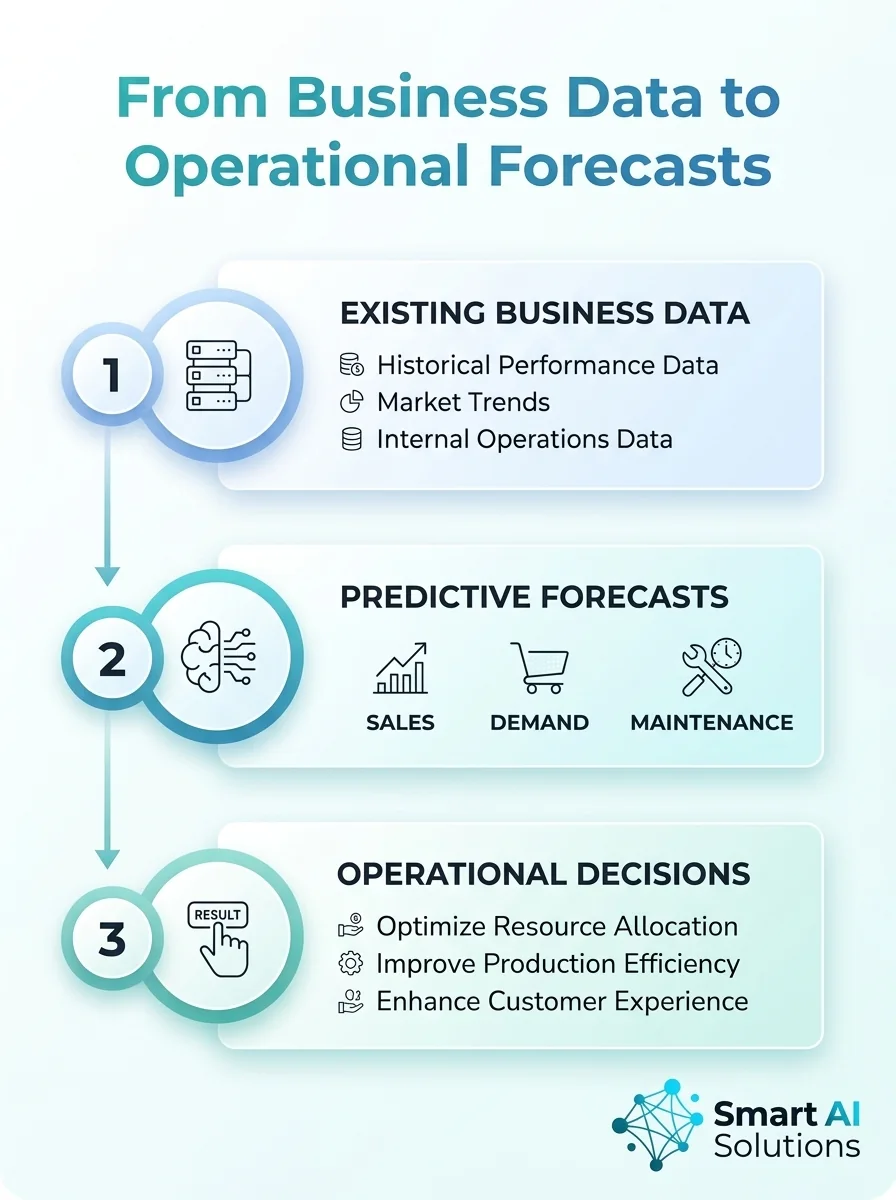
See how analytics services turn business data into operational forecasts. The infographic shows the path from data inputs to actionable predictions.
Choose a forecast that matches the decision and lead time
Choose demand forecasting when teams need to plan product quantities. Choose revenue forecasting when the decision concerns sales targets, budgets or cash planning. In both cases, start where an accountable owner can take a clear action.
Sales and revenue forecasting uses historical performance, market conditions, seasonality and pipeline data to estimate future revenue. It is relevant when planning depends on expected income instead of individual product quantities.
Lead time decides whether a forecast is usable. A stock projection needs to arrive early enough to place an order, while a staffing or capacity forecast must leave enough time to adjust schedules and resources. Estimates usually become less certain the further ahead they look, so replenishment, staffing and maintenance each need their own window.
Set the detail to match the decision, such as product, location or time period. A forecast split into many small segments can be harder to support with consistent data, so finer detail is useful only when it changes the action a team takes.
Demand forecasting can inform product planning, while near-term forecasts can help with immediate stock decisions.
Connect operational forecasts to inventory and capacity plans
A demand estimate is an input to inventory planning. It is not an order instruction on its own. Teams should weigh reorder points, supplier lead times and carrying costs together to decide when to replenish and how much to buy.
When stock needs differ across products or locations, forecasts can help teams focus planning at those levels.
Use demand by location and time period to guide capacity planning and workforce forecasting, including staffing levels and resource schedules. An accountable team should review exceptions so a forecast informs a schedule without dictating it automatically.
Forecasts are estimates. Use prediction ranges or scenarios when uncertainty could change a costly decision. Planning for higher and lower demand gives teams options to consider before stock, staffing or capacity is committed.
The Operations and Logistics AI service includes demand forecasting to support operational planning.

Check data readiness before choosing a modelling approach
Useful operational forecasts combine historical outcomes with relevant drivers. Depending on the use case, those inputs may include seasonality, promotions, usage patterns or supplier lead times, because the model needs both the result being forecast and context that helps explain it.
Before modelling, resolve inconsistent definitions, missing periods, duplicate records and changes in data capture. Otherwise the model may learn patterns caused by recording problems instead of real operating conditions.
Time-series models, including exponential smoothing and ARIMA, suit cases where past values and recurring patterns carry useful information. Regression and tree-based machine-learning methods can help when external drivers and interactions between factors are important.
Not every operational question is a quantity. Classification models estimate how likely an event is, such as a piece of equipment failing. Clustering groups branches or products with similar demand so teams can compare like with like. Include calendar effects, such as public holidays or planned operating schedules, when they plausibly change demand or workload.
Check whether business systems can provide data at the required frequency and level of detail. Late or mismatched inputs limit how well a forecast can support daily decisions, even when the modelling approach is appropriate.
We can also assess how data feeds into reporting and forecasting through data analytics and reporting. This helps teams examine data definitions, source systems and the pipelines that prepare inputs for planning.
Test forecast quality with backtesting and uncertainty
Backtesting shows how a model would have performed on data it had not yet seen. Train it on earlier periods, compare its predictions with later actual results, and preserve the order of time so information from the future does not leak into the test.
Compare the model with a sensible baseline, such as carrying forward the latest value or using the same period from the previous season. A more complex model earns its place when it improves on that simpler alternative for the decision at hand.
Choose error measures based on the cost of being wrong. Under-forecasting can leave a business short of stock, while over-forecasting can tie up cash in excess inventory, so one headline accuracy score may not describe the operational impact.
Review errors and prediction ranges by location and by product, and again when conditions change. A strong average can hide unreliable forecasts in a critical segment, where a planning team needs a clearer view of risk.
Embed forecasts in routines, alerts and maintenance decisions
Put forecasts where teams already plan, such as their dashboards, planning tools or alerts. Define who reviews each signal, the threshold that triggers action and the response they own, so that a prediction leads to a decision and does not sit unused.
Predictive analytics can also support maintenance planning by giving teams time to prepare service work and parts before equipment failure disrupts operations. Predictive maintenance analyses sensor and operational data to flag likely equipment failures ahead of time. Treat a failure-risk score as an input to your maintenance procedures, not as proof that an asset has failed, and weigh each alert against inspection findings and operating requirements.
Monitor forecast errors and incoming data after deployment. When repeated misses appear, investigate the cause and adjust the model when operating conditions, data or business practices have changed.
Revisit the forecast's purpose as well when products, processes or decision lead times change. During each review, separate recurring seasonal patterns from one-off disruptions, because a model trained on routine periods will not handle unprecedented events reliably. The fix might be retraining, new inputs, a changed threshold or a return to a simpler baseline. Record why, so planners understand the updated output.
Scope a pilot that reaches the planning routine
Test one well-defined forecast, such as demand, churn or equipment risk, and one decision first. Bundling unrelated forecasts makes it hard to tell whether any of them works. Pick a business unit or period the team can evaluate consistently, and agree the success measure before the pilot starts, for example fewer stock-outs against last season's baseline.
Name who looks after data pipelines, model updates and integration issues after go-live. If deployment depends on connecting the forecast to existing systems, our AI integration services cover that part.
Compare predictive analytics services beyond the model
There is no universally best predictive analytics software or service. We compare options by whether their data assessment, outputs, integrations, monitoring and support match the business decision and the way its teams work.
- Discovery: Does the service assess data sources, quality and volume before proposing an approach?
- Scope: Are data integration, forecast outputs and operational handover clearly defined?
- Testing and monitoring: How will the provider backtest and review performance after deployment?
- Team adoption: Will staff understand uncertainty and know how to respond to predictions?
- Decision fit: Does the proposal match the required horizon, acceptable error costs and planning routine?
Ask how implementation moves from discovery to deployment and how the service will fit with existing systems. Model terminology alone does not show whether a forecast will arrive in time, support the required decision or remain useful as operations change.
Frequently asked questions
How much historical data does a business need to start forecasting?
There is no universal minimum. A complete and representative record matters more than a large volume of inconsistent rows. When demand follows an annual cycle, several complete seasonal cycles give a team a stronger basis for distinguishing recurring patterns from one-off events.
How often should an operational forecast be refreshed?
Refresh it in step with the rate at which its key drivers change and the planning decisions it informs. A forecast tied to fast-moving demand may need more frequent updates than one used for a stable, long-range capacity plan.
Can predictive analytics forecast demand for a new product with little or no sales history?
Yes, teams can estimate early demand using comparable products, product attributes, launch plans and known distribution constraints. Because the estimate has less direct sales evidence, planning teams should leave room to revise it as real sales arrive.
What should a team do when actual results repeatedly fall outside a forecast's prediction range?
First check whether the actuals and forecast use the same definitions, periods and units, then investigate changes in demand or operations. Record any temporary planning override and use the findings to decide whether the inputs, forecast assumptions or model need an update.
How can a business protect sensitive data used for operational forecasting?
Limit access to the people and systems that need the data, and avoid including personal or commercially sensitive fields that do not contribute to the forecast. Set clear rules for data retention, use and access as part of the implementation process.
What do predictive analytics services cost in South Africa?
It depends on how many data sources need connecting, how clean the history is and how many forecasts the business needs. Our Predictive Analytics service is priced from R35,000 per project, and the scope is set after a data assessment.
Can a small business use predictive analytics without a data science team?
Yes. An external service can handle the specialised modelling. The business still needs someone who knows the workflow, owns the decision and will act on the forecast.
Can a forecast account for a promotion or a planned shutdown?
Yes, when the event is recorded in a usable form and included as an input or a scenario. Keeping planned events apart from normal trading patterns shows which assumptions depend on the event going ahead.
Conclusion
Predictive analytics services for businesses that need better operational forecasts should begin with a clear decision, use data that reflects real operations and show uncertainty in a form teams can act on. We recommend comparing providers on testing, integration, ownership and ongoing monitoring as well as modelling, so forecasts become practical inputs to inventory and staffing decisions, and to capacity and maintenance planning. To scope a forecast for your business, contact our team.