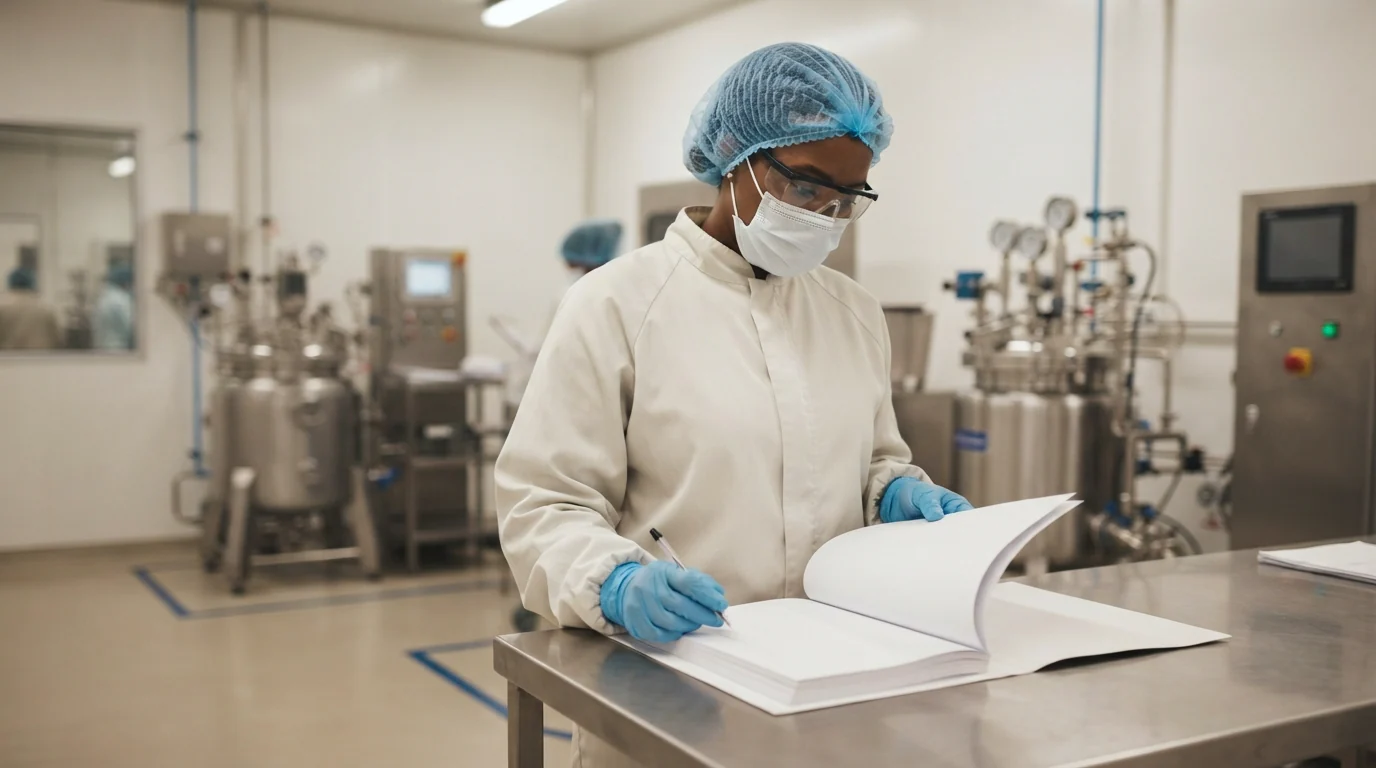
The short answerThe South African Health Products Regulatory Authority (SAHPRA) regulates all medicines, medical devices, and clinical trials in South Africa.
The short answer
The South African Health Products Regulatory Authority (SAHPRA) regulates all medicines, medical devices, and clinical trials in South Africa.
Why Is Compliance the Biggest Bottleneck in SA Pharma?
Direct answer: The South African Health Products Regulatory Authority (SAHPRA) regulates all medicines, medical devices, and clinical trials in South Africa. For pharmaceutical manufacturers, compliance with SAHPRA's Good Manufacturing Practice (GMP) guidelines isn't optional -- it's the cost of operating. According to the Pharmaceutical Industry Association of South Africa (PIASA), compliance documentation accounts for an estimated 30-40% of total production time at many facilities.
Current as of 31 May 2026: This article has been reviewed for the 2026 South African AI, SEO, and automation market. Pricing, platform capabilities, Google rich-result rules, and AI model features change quickly, so verify live vendor documentation before procurement. For privacy and data handling, use the Protection of Personal Information Act as the baseline; for search and structured-data implementation, use Google Search Central.
That's not a technology problem on the surface. It's a documentation problem: batch records, quality control logs, deviation reports, change control documentation, validation protocols, stability studies, and adverse event reports. Each must be accurate, complete, traceable, and audit-ready at all times.
But beneath the documentation surface, there is a technology opportunity. Most of these documents follow structured formats with predictable data fields. AI can assist with generation, validation, cross-referencing, and anomaly detection -- not replacing the pharmacist's judgement, but reducing the hours spent on paperwork that follows repeatable patterns.
This article examines where AI fits in South African pharmaceutical manufacturing, with specific attention to SAHPRA requirements, POPIA constraints, and the practical realities of GMP compliance.
TL;DR: South African pharmaceutical manufacturers spend 30-40% of production time on compliance documentation. AI-assisted batch record generation, quality control documentation, and deviation tracking can significantly reduce that burden while improving SAHPRA audit readiness -- but it must be validated under GMP guidelines.
How Can AI Assist With Batch Record Automation?
Batch manufacturing records (BMRs) are the backbone of pharmaceutical compliance. Every production batch requires a detailed record of ingredients, quantities, equipment, process parameters, in-process checks, environmental conditions, and operator actions. SAHPRA's GMP guidelines (aligned with PIC/S standards) mandate that these records be complete and contemporaneous.
Manually creating and verifying batch records is labour-intensive. A single batch record for a tablet product might run to 30-50 pages. Multiply that by hundreds of batches per year, and the documentation volume is staggering.
Where AI Fits in Batch Records
- Template generation: AI creates batch record templates pre-populated with product-specific parameters, reducing setup time for each new batch
- Data entry validation: As operators enter in-process data, AI validates entries against expected ranges and flags anomalies in real time
- Completeness checks: Before a batch record is submitted for QA review, AI scans for blank fields, unsigned sections, and missing data points
- Cross-referencing: AI compares batch data against the master manufacturing formula and flags any deviations automatically
What AI Cannot Replace
- Operator signatures and manual verifications required by GMP
- Quality Person (QP) release decisions
- Professional judgement on out-of-specification results
- Regulatory submissions to SAHPRA -- these remain human-reviewed and human-signed
Validation Requirements
Any AI system used in GMP-regulated batch record processes must itself be validated. SAHPRA follows PIC/S Annex 11 (Computerised Systems) guidelines, which require:
- Documented user requirements specification (URS)
- Installation, operational, and performance qualification (IQ/OQ/PQ)
- Electronic signatures compliant with 21 CFR Part 11 principles
- Audit trail integrity -- every data entry, modification, and deletion must be logged
Smart AI Solutions field note: From our assessments of pharmaceutical operations, the average QA team spends 4-6 hours reviewing a single batch record. AI-assisted completeness and validation checks can reduce that review time by 40-50%, allowing QA professionals to focus on judgement-based decisions rather than clerical verification.
| Industry | AI Adoption Rate (SA) | Top Use Case | Avg ROI |
|---|---|---|---|
| Financial Services | 65% | Fraud detection | 300%+ |
| Healthcare | 45% | Patient scheduling | 200%+ |
| Manufacturing | 55% | Predictive maintenance | 250%+ |
| Retail | 50% | Demand forecasting | 180%+ |
What Does AI-Assisted Quality Control Documentation Look Like?
Quality control (QC) in pharmaceutical manufacturing generates enormous volumes of documentation. Every raw material is tested on receipt. Every in-process sample is analysed. Every finished product batch is tested against specification before release.
SAHPRA's GMP requirements mandate that all QC data be traceable, attributable, legible, contemporaneous, original, and accurate -- the ALCOA+ principles.
How AI Supports QC Documentation
- Certificate of Analysis (CoA) generation: AI auto-generates CoAs from laboratory information management system (LIMS) data, reducing transcription errors
- Specification compliance checking: Test results are automatically compared against registered product specifications. Out-of-specification (OOS) results trigger immediate alerts and investigation workflows.
- Trend analysis: AI monitors QC data trends over time, identifying gradual drifts before they become OOS events. This is proactive quality management rather than reactive firefighting.
- Environmental monitoring: Clean room temperature, humidity, and particulate data is continuously monitored and logged. AI flags environmental excursions and cross-references them with batch production timelines.
Stability Studies
SAHPRA requires stability data to support product shelf life claims. Stability studies run for months or years, generating periodic test data that must be tracked and reported.
- AI manages stability study schedules, sending reminders for upcoming test points
- It tracks results against registered stability specifications
- It generates stability summary reports for SAHPRA submissions
- It predicts shelf life trends using statistical modelling of existing data
Implementation note: We've found that stability study management is one of the most under-digitised areas in South African pharmaceutical companies. Many facilities track stability pull dates on wall calendars or spreadsheets. AI scheduling is a quick win with measurable compliance benefit.
How Does Adverse Event Reporting Benefit From AI?
Pharmaceutical companies in South Africa are required to report adverse drug reactions (ADRs) to SAHPRA through the National Adverse Drug Event Monitoring Centre (NADEMC). Timely and accurate reporting is both a legal obligation and a patient safety imperative.
The reporting burden is significant. Each adverse event report requires structured data: patient demographics, product details, reaction description, outcome, causality assessment, and follow-up information.
AI-Assisted Adverse Event Processing
- Case intake: AI extracts structured adverse event data from unstructured sources -- emails, phone call transcripts, healthcare professional letters
- Case classification: AI categorises events by seriousness (serious vs. non-serious) and expectedness (listed vs. unlisted in the package insert)
- Regulatory timeline tracking: SAHPRA requires serious adverse events to be reported within 15 calendar days. AI monitors timelines and escalates cases approaching deadlines.
- Duplicate detection: When the same event is reported through multiple channels, AI identifies potential duplicates for manual review
- Periodic safety reporting: AI compiles data for Periodic Safety Update Reports (PSURs) by aggregating case data, calculating reporting rates, and identifying signal detection trends
The POPIA Dimension
Adverse event reports contain sensitive health information about identifiable individuals. POPIA's special personal information provisions (Section 26) apply directly. AI systems processing adverse event data must:
- Process health data only with explicit consent or under the POPIA healthcare exemption
- Maintain strict access controls
- Ensure data minimisation -- only the information required for regulatory reporting should be captured
- Provide audit trails for all data access and modifications
What Are the Temperature Monitoring and Cold Chain Requirements?
Many pharmaceutical products in South Africa require temperature-controlled storage and distribution. SAHPRA's GMP guidelines mandate validated cold chain management for temperature-sensitive products, and the WHO GDP (Good Distribution Practice) guidelines apply to pharmaceutical distribution.
South Africa's climate and infrastructure add complexity. Summer temperatures routinely exceed 30 degrees Celsius in inland areas, and load shedding disrupts cold storage facilities regularly.
AI-Enhanced Temperature Monitoring
- Real-time surveillance: IoT sensors in warehouses, cold rooms, and transport vehicles feed continuous temperature data to an AI monitoring system
- Predictive alerts: AI predicts temperature excursions before they happen -- if a cold room's compressor shows declining efficiency, the system alerts maintenance before the temperature rises above threshold
- Load shedding response: AI integrates with Eskom's published load shedding schedules and calculates thermal drift models for each storage area. It prioritises generator allocation and triggers product relocation protocols when backup power is limited.
- Excursion impact assessment: When a temperature excursion does occur, AI cross-references the excursion duration and severity against product stability data to assess whether the product remains within specification
Documentation
- All temperature data is logged automatically with tamper-evident timestamps
- AI generates temperature mapping reports for warehouse qualification
- It produces transport temperature certificates for each shipment
- Excursion reports are pre-drafted for QA review and investigation
Smart AI Solutions insight: Most pharmaceutical facilities we've assessed in South Africa have temperature monitoring systems -- but they're reactive. The alert comes after the excursion. By then, product may already be compromised. AI's value is in the predictive layer: seeing the excursion coming and acting before product is at risk.
What Supply Chain Traceability Does SAHPRA Require?
SAHPRA's regulatory framework requires pharmaceutical manufacturers and distributors to maintain full traceability of products from active pharmaceutical ingredient (API) sourcing through to patient delivery. This isn't just regulatory box-ticking -- it's essential for recall management, counterfeit detection, and supply chain integrity.
AI-Powered Traceability
- Batch genealogy: AI maintains a complete genealogy for every batch -- linking API suppliers, excipient lots, manufacturing records, packaging materials, and distribution records into a single traceable chain
- Recall readiness: If a recall is necessary, AI can identify all affected batches within minutes rather than the days or weeks that manual investigation requires
- Serialisation and track-and-trace: South Africa is moving toward pharmaceutical serialisation requirements. AI supports serialisation data management, aggregation, and verification across the supply chain
- Supplier qualification: AI monitors supplier performance data (delivery timeliness, quality metrics, audit findings) and flags risks before they affect production
Import and Export Compliance
South African pharmaceutical manufacturers that export must comply with destination country requirements in addition to SAHPRA. AI helps manage this complexity:
- Maintaining a regulatory intelligence database for each export market
- Cross-referencing batch documentation against destination-specific requirements
- Generating export certificates with the correct format for each regulatory authority
- Tracking regulatory changes in export markets and alerting the regulatory affairs team
How Do GMP Requirements Shape AI Implementation?
Good Manufacturing Practice doesn't just govern what you produce -- it governs how you manage information about what you produce. Any AI system introduced into a GMP environment becomes part of the validated system landscape and must comply with SAHPRA's computerised systems requirements.
Key GMP Principles for AI
- Data integrity: All AI-processed data must maintain ALCOA+ compliance. The AI system cannot alter, delete, or obscure original data.
- Validation: The AI system must be validated for its intended use with documented IQ/OQ/PQ protocols.
- Change control: Any modification to AI algorithms, training data, or business rules must go through the site's change control system.
- Access control: Role-based access must restrict who can configure, modify, and override AI outputs.
- Audit trail: Every AI decision, recommendation, and data transformation must be logged and reviewable.
Practical Implications
This means you can't simply plug in an off-the-shelf AI tool and start using it in production. The implementation process must include:
- User requirements specification aligned with GMP processes 2. Vendor qualification (is the AI provider GMP-aware?) 3. System validation before go-live
- Standard operating procedures (SOPs) for AI system use 5. Training records for all users 6. Periodic review and re-validation
It sounds heavy -- and it is more involved than AI implementation in non-regulated industries. But the payoff is significant: validated AI systems reduce human error, improve consistency, and strengthen your compliance posture during SAHPRA inspections.
How Should a Pharmaceutical Company Assess AI Readiness?
Not every pharmaceutical operation is ready for AI. Readiness depends on data maturity, system infrastructure, and organisational culture. Here's how to assess where you stand:
Data Readiness
- Are your batch records, QC data, and deviation reports digitised, or still paper-based?
- Do you have a LIMS or ERP system with structured, exportable data?
- How far back does your digital data history go? (AI needs 12-24 months minimum for trend analysis)
System Readiness
- What manufacturing execution system (MES) or ERP do you use?
- Does it offer API access or integration capabilities?
- Is your IT infrastructure validated under PIC/S Annex 11?
Organisational Readiness
- Does your QA team understand and support AI-assisted processes?
- Is there a designated change control pathway for new computerised systems?
- Will management invest in the validation effort required before go-live?
Where to Start
For most South African pharmaceutical manufacturers, the highest-value starting point is one of three areas:
- Batch record completeness checking -- fast to implement, immediately reduces QA review time 2. Temperature monitoring intelligence -- especially valuable given load shedding risks
- Deviation and CAPA trend analysis -- identifies systemic issues before they become critical findings during SAHPRA inspections
Pick one area, validate the AI system properly, demonstrate results, and then expand.
Ready to Assess AI Readiness for Your Pharmaceutical Operation?
South African pharmaceutical manufacturers face a unique regulatory landscape under SAHPRA, combined with infrastructure challenges like load shedding and a competitive global export market. AI can meaningfully reduce the compliance documentation burden, improve quality oversight, and strengthen supply chain traceability -- but only when implemented within a validated, GMP-compliant framework.
The starting point is an honest assessment of your data maturity, system capabilities, and organisational readiness. We investigate your operation's specific context before recommending any tools or approaches, because pharmaceutical AI that isn't GMP-validated is a compliance liability, not an asset.
Explore how AI integration works in regulated environments, or book a free AI readiness assessment to evaluate your operation's starting point.
Related Resources:
- API Integration Best Practices for AI
- Integration Checklist: Preparing Your Systems for AI
- AI Integration Services
- Take Our Free AI Readiness Assessment
Our team at Smart AI Solutions, led by Loxly Atkinson, has implemented t
Further Reading:
- McKinsey AI insights hese solutions across multiple South African industries.
Frequently Asked Questions
How can AI assist with batch record automation?
AI generates pre-populated batch record templates, validates operator data entries against expected ranges in real time, checks for completeness before QA review, and cross-references batch data against the master formula. QA review time can be reduced by 40-50%.
How does adverse event reporting benefit from AI?
AI extracts structured adverse event data from unstructured sources, classifies events by seriousness and expectedness, monitors SAHPRA reporting timelines, detects duplicate reports, and compiles data for Periodic Safety Update Reports. POPIA provisions for health data apply strictly.
What are the temperature monitoring and cold chain requirements?
SAHPRA mandates validated cold chain management for temperature-sensitive products. AI provides real-time surveillance, predictive excursion alerts, load shedding response planning, and automatic impact assessments when excursions occur.
How do GMP requirements shape AI implementation?
AI systems in GMP environments must be validated with documented IQ/OQ/PQ protocols, maintain ALCOA+ data integrity, go through change control for any modifications, enforce role-based access control, and maintain complete audit trails of all decisions and data transformations.
How should a pharmaceutical company assess AI readiness?
Assess data readiness (are records digitised with 12-24 months of history), system readiness (does your MES or ERP offer API access), and organisational readiness (does QA support AI-assisted processes). Start with batch record checking, temperature monitoring, or deviation trend analysis.