The short answerIt depends on what the chatbot must handle, which systems it connects to, which channels it answers on and what it costs to run each month, and you agree the full budget before anything is built.
The short answer
It depends on what the chatbot must handle, which systems it connects to, which channels it answers on and what it costs to run each month, and you agree the full budget before anything is built.
What does it cost to launch a custom AI chatbot for a small or mid-sized business in South Africa? At Smart AI Solutions a custom AI chatbot starts from R15,000 once-off setup, and the final AI chatbot cost depends on what the bot must do, which systems it connects to, and how much support, hosting and AI model usage you budget for after launch.
This guide is for South African owners and managers pricing their first chatbot. It covers what belongs in a quote, how the main chatbot pricing models differ, which costs come back every month, and how to keep the first project small enough to measure.
Key takeaways
| Question | Quick answer |
|---|---|
| What is a local starting-price reference? | Our AI chatbots and assistants service starts from R15,000 once-off setup. A Cape Town chatbot service page is another local reference point. The final budget depends on scope. |
| What should our budget include? | Separate discovery, content preparation, development, integrations, testing and training from recurring model, hosting, messaging, maintenance and support charges. |
| Does a custom chatbot need a model built from scratch? | No. A business can often use an existing AI model and connect it to a prepared knowledge base, workflows and business systems. |
| What drives ongoing costs? | Conversation volume, model usage, channels, hosting and storage, monitoring, updates and human support all affect monthly spend. |
| How should we control the first project budget? | Launch a proof of concept for one useful use case, define success measures and expand only after reviewing real conversations and results. |
| How do we know whether the project is worthwhile? | Compare the full cost of the chatbot with measurable changes in staff time, service capacity, lead handling and customer outcomes. |
What does a custom AI chatbot cost in South Africa?
Our own starting point is from R15,000 once-off setup for a custom AI chatbot. The final amount depends on the conversation flows, channels and integrations involved, so treat any "from" price as a starting point and not as a complete project budget.
Scope changes the bill more than anything else. A chatbot audit and a rebuild are separate service options. Don't reuse either as an estimate for a new chatbot.
A chatbot connected to business systems can add a separate implementation line. An AI integration service and a WhatsApp automation service cover different work, so ask whether setup, usage and support are included in the proposal.
For small and mid-sized businesses, the launch fee is only part of the question. Build a total-cost view that includes implementation and the ongoing costs you expect to incur, then compare that with what it costs today to handle the same work by hand. For the wider picture beyond chatbots, see our guide to AI development cost in South Africa.
Choose a pricing model that fits the work
Subscription pricing, usage-based pricing and hybrid arrangements can all suit a business chatbot. They just bundle costs differently. Compare what each chatbot pricing model includes before judging a monthly amount on its own.
| Pricing model | How it works | What to examine |
|---|---|---|
| Subscription | A recurring fee covers access to a platform or service, sometimes with set features or usage limits. | Check setup, user or conversation limits, integrations, support level and charges for going over included usage. |
| Usage-based | Charges rise or fall with activity, such as model calls, messages or processed data. | Ask what counts as billable usage and how the provider reports it. Longer conversations and more complex tasks can use more resources. |
| Hybrid | A fixed implementation or monthly fee is combined with variable AI, messaging or infrastructure charges. | Request a clear split between fixed fees and costs that change with volume, plus a way to monitor usage. |
For ongoing development support, the Foundation Partner, Growth Partner and Enterprise Partner are developer-rental plans, from R15,000 per month. They are not once-off chatbot launch prices.
For a South African budget, keep local implementation work in South African rand and identify software, AI model usage or cloud charges billed in another currency. When a recurring service is priced in a foreign currency, rand exchange-rate movements can change its cost in your accounts even if your usage stays the same.
Before choosing between a subscription and a usage-based plan, estimate conversation volume for a quiet month, a typical month and your busiest period. A low headline fee can get expensive at peak volume, and a fixed plan can be poor value in a quiet month. Ask what event triggers a usage charge. Per-conversation and per-resolution pricing can define their units differently, so check whether repeated messages, handovers to staff and unresolved queries count.
Decide between a platform, a builder and a custom build
A pricing model describes how you pay. The build approach decides what you are paying for, and it changes which costs matter most.
| Approach | Best fit | Budget focus |
|---|---|---|
| Subscription platform | A business that wants a ready-made service with set plan features | Recurring fee, included usage, add-ons and overage charges |
| Configurable builder | Standard question-and-answer flows that staff can maintain with little technical work | Plan limits and the staff time spent maintaining flows |
| Custom development | Distinct workflows, business data sources or system connections | Discovery, build, testing, ownership and continuing support |
A builder only saves money if your team can update content and conversation paths without outside help, so test that before you commit. Check too whether the channels or integrations you need cost extra on the plan you are looking at.
What makes a chatbot development quote rise?
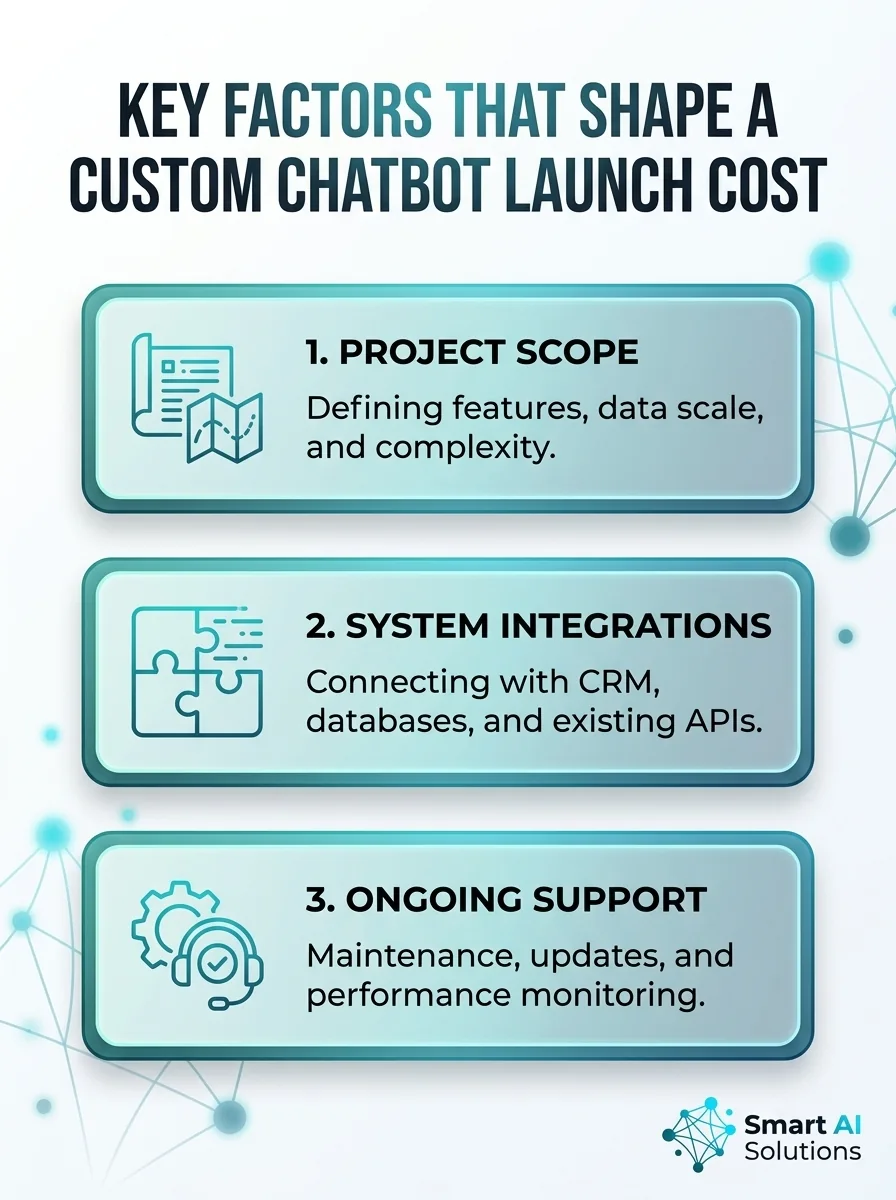
The main drivers of chatbot development cost are scope, data quality, integrations, channels and testing. A bot that answers a defined set of common questions from approved content is a smaller job than one that checks orders, updates a CRM, qualifies leads and transfers complex cases with conversation history.
- Conversation scope: List the questions and tasks the first version must handle, plus the requests it should send to a person.
- Knowledge base preparation: FAQs, product details, policies and support documents need to be current, consistent and organised. Cleaning and maintaining this content takes real work.
- API integration: Connecting a chatbot to a CRM, booking tool, payment workflow, accounting platform or POS system adds design, access, testing and error-handling work. You also have to decide what the chatbot is allowed to read and what it can change.
- Channels and languages: Website chat, WhatsApp, email and social channels can each require setup and testing, and each channel usually needs its own conversation paths and handover rules. Supporting additional South African languages means testing wording, code-switching and escalation with the expressions and spellings your customers actually write.
- Security and reliability: Access controls, logging, fallback behaviour, backups and a clear human handover affect implementation and ongoing support.
A custom AI chatbot usually does not require training a foundation model from scratch. We can often use an existing model and connect it to a business-specific knowledge base, then add prompts, safeguards and integrations that fit the workflow.
These visuals show the customer-facing chatbot experience and the technical team work behind AI delivery. Both matter when a quote covers the interface as well as implementation and ongoing development.

Separate upfront development from running costs
The launch budget covers the work needed to plan, build and release the chatbot. Running costs start when it begins serving customers. Then they continue for as long as the business relies on it.
| Upfront implementation | Recurring operating costs |
|---|---|
| Discovery and workflow mapping | AI model usage and messaging fees |
| Knowledge-base preparation and content loading | Hosting, storage and monitoring |
| Conversation design and development | Maintenance, security updates and answer-quality reviews |
| API integration, testing and deployment | Support, staff training refreshers and content updates |
Conversation volume affects recurring costs because more customer interactions can mean more model calls, messages and system activity. The length and complexity of those interactions matter too, so ask for usage reporting and a way to set internal alerts or spending limits.
Hosting and storage should be visible as separate budget lines, even when a provider bundles them into a plan. Ask who monitors availability, fixes issues, updates the knowledge base and reviews incorrect or incomplete answers after launch.
To see the full cost of ownership, add both columns up over the same period, such as the first year: the setup fee, twelve months of expected operating costs and an allowance for upkeep. Upkeep is easy to leave out. Knowledge-base updates, corrections to wrong answers, security work and planned improvements need either a recurring allowance or separately scoped work.
Build POPIA and local workflows into the scope
Privacy requirements under the Protection of Personal Information Act (POPIA) affect what the chatbot collects, where information is processed, how long it is retained and who can access it. Before development starts, map the information flow and decide which details the bot needs to handle. Our guide to POPIA compliance for AI chatbots goes deeper.
- Identify personal information the chatbot may collect, including contact details, order information or appointment requests.
- Document where that information is processed and stored, and which service providers handle it.
- Set a retention period and a process for removing information that is no longer needed.
- Decide who can view conversation records, and who removes or changes access when staff roles change.
- Define when the bot must stop, explain its limits and hand the conversation to a person.
- Test access permissions, logs and escalation routes with realistic customer scenarios.
Local workflows also shape cost. If the bot needs to connect customers to South African payment steps, messaging channels, local booking systems or a business POS, include those connections in the estimate instead of treating them as later add-ons.
Where a business needs WhatsApp as a core channel, the WhatsApp chatbot cost belongs in the same estimate. Compare the chatbot scope with a specific WhatsApp automation service, and check its scope against the setup, messaging and extra integrations in your own proposal.
Compare quotes line by line
Two chatbot proposals are comparable only when they cover the same work, deliverables, ownership and support. Ask each provider to complete the same scope checklist and mark every item as included, excluded or separately priced.
| Quote section | What to ask for |
|---|---|
| Discovery | Which workflows, customer questions and success measures will the team map? |
| Data preparation | Who cleans, approves and updates the knowledge base? |
| Development | Which features, channels, languages and fallback behaviours are included? |
| Integrations | Which systems and API connections are covered, and how will failures be handled? |
| Testing and deployment | What test cases, acceptance criteria, launch steps and rollback plan are included? |
| Training and handover | What documentation and staff training will the business receive? |
| Post-launch support | What response times, monitoring, bug fixes, updates and usage reports are included? |
| Ownership and fees | Who owns the code, prompts and conversation flows, and which charges recur or vary with usage? |
| VAT | Is the total quoted with or without VAT? A VAT-inclusive total can't be compared directly with one that excludes it. |
Ask for the assumptions behind every integration, channel and workflow. Find out what information a staff member receives when the bot hands over a conversation, and which team fixes technical issues.
For a reliable estimate, give providers your current FAQs and policies, sample customer conversations, target channels, required integrations, expected handover cases and a clear description of the first task the bot should complete. Also state who will approve content and who will maintain it after launch.
If you are not yet sure which use case to start with, our free AI readiness assessment can help you sort out priorities before you ask anyone for a quote.
When a business already has a chatbot, a focused review can clarify whether it needs fixes or a rebuild. A chatbot audit and rebuild service can help assess that choice.
Start with a proof of concept and measure value
The most controlled way to limit chatbot development costs is to begin with one useful task. Choose a frequent, low-risk customer need, such as answering approved FAQs or capturing leads, then add booking, order lookup or account actions only when the first use case performs well.
- Set a baseline: Record how staff currently handle the selected questions, including time spent, handoffs and common delays.
- Define acceptance criteria: Agree which test questions the bot must answer, when it must escalate and what counts as a successful handover.
- Run a controlled pilot: Test with real customer-style questions and a limited workflow before opening the bot to every channel.
- Review answer quality: Check incorrect, incomplete and escalated conversations, then update the content or flow. Track unresolved queries and staff corrections after release, so fixes follow real usage.
- Expand deliberately: Add integrations, languages or channels only when the pilot shows a clear operational reason.
Estimate return on investment by comparing the full implementation and operating costs with measurable changes in staff time, service capacity, lead follow-up or completed bookings. Keep the baseline and review period consistent so the business can distinguish chatbot impact from unrelated changes. Count human review and maintenance on the cost side, so the result reflects the work that stays with your team.
We can also use a simple AI savings calculator as a starting point for thinking through possible savings, then test those assumptions against the business's own workload and costs.
Frequently asked questions
Can I build my own AI chatbot for my small business?
Yes, you can create a basic chatbot with a no-code platform or connect an existing AI model to your own information. A custom build becomes more useful when you need reliable business-specific answers, controlled handover, privacy safeguards or connections to systems your team already uses.
How much does an enterprise AI chatbot cost?
Enterprise chatbot costs depend on the number of systems, data controls, channels, user groups and support requirements involved. The budget should also account for governance, security reviews and service commitments, on top of the chatbot interface.
Should our chatbot collect payment-card details or identity documents?
Keep sensitive details out of open chat wherever possible, and direct customers to a secure, purpose-built workflow when they need to submit them. Design the bot to collect only the information needed for its task and to escalate sensitive requests to an authorised person.
What happens if the AI model or chatbot service goes offline?
Specify a fallback route, such as showing business contact details, capturing a request for later follow-up or transferring the customer to a human channel. Ask who monitors outages and how the business will communicate service interruptions to customers.
Who should own the chatbot's code, prompts and customer conversation records?
Put ownership and access rights in the agreement, including rights to the code, configuration, knowledge-base material and exported conversation records. Define how the business receives its materials and data if the working relationship ends.
How can we prevent the chatbot from giving outdated answers?
Assign a content owner who updates the knowledge base when prices, policies, products or processes change. Include a review cadence and a way for staff to flag questionable answers so the business can correct the source content and retest the bot.
Can we launch the chatbot before connecting it to our CRM?
Yes. You can start with a standalone information or lead-capture flow and add the CRM integration later. Decide before the pilot how staff will record and follow up on leads in the meantime, so customer requests don't get lost between systems.
How can we stop chatbot usage costs from spiking unexpectedly?
Ask for usage alerts, a spending limit or a clear escalation step before the bot goes past its expected volume. Agree what the system should do when it reaches that limit, such as switching to a simpler response path or sending customers to a human channel.
What should the chatbot do with high-risk questions?
Set clear boundaries for topics where a wrong answer could cause harm, and route those questions to a qualified staff member instead of letting the bot improvise. Keep approved wording for routine information, and review escalated cases for gaps in the bot's scope. Our guide to consistent answers from approved company information goes further.
Conclusion
What does it cost to launch a custom AI chatbot for a small or mid-sized business in South Africa? Our chatbots start from R15,000 once-off setup, and the full budget depends on scope, data preparation, integrations, channels and ongoing usage and support.
For a sound decision, compare like-for-like quotes, separate launch work from operating costs, and begin with a measurable proof of concept. A clear first use case, sensible POPIA practices and a tested human handover help keep the project focused while giving the business a practical way to judge its return.
To scope your first use case, contact Smart AI Solutions.