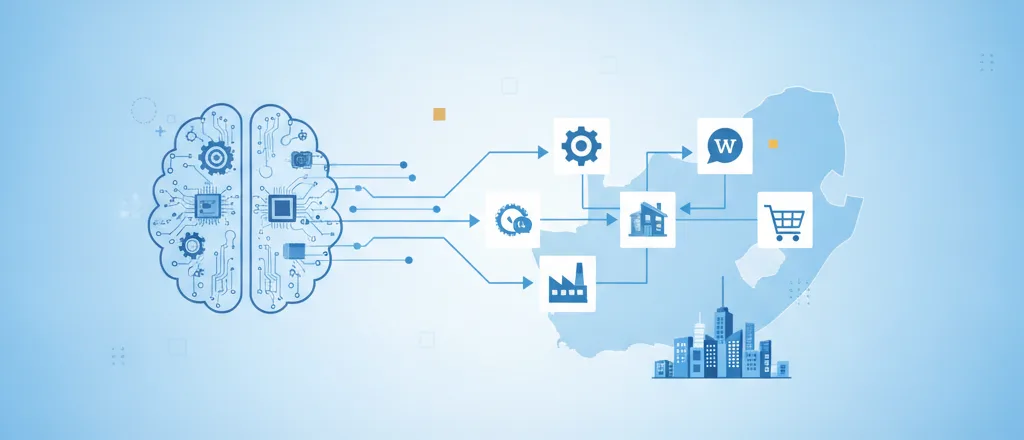
The short answerThis guide explains how South African marketing teams use AI sentiment analysis to understand customer emotions, personalise messaging and improve campaign response.
The short answer
This guide explains how South African marketing teams use AI sentiment analysis to understand customer emotions, personalise messaging and improve campaign response.
What Is Customer Sentiment at Scale?
Direct answer: Your customers express opinions constantly: social media posts, product reviews, email responses, support tickets, and survey feedback. Each contains emotional signals about your brand, products, and messaging. But analyzing thousands of interactions manually is impossible.
Current as of 31 May 2026: This article has been reviewed for the 2026 South African AI, SEO, and automation market. Pricing, platform capabilities, Google rich-result rules, and AI model features change quickly, so verify live vendor documentation before procurement. For privacy and data handling, use the Protection of Personal Information Act as the baseline; for search and structured-data implementation, use Google Search Central.
AI sentiment analysis automatically detects emotions in text: positive, negative, neutral, and specific feelings like frustration, excitement, satisfaction, or confusion. This transforms outreach campaigns from generic blasts into personalized communications that resonate emotionally.
Teachers unions and member organisations leverage sentiment analysis to improve member engagement, while hospitality businesses use it to improve review management.
Marketing teams that use AI sentiment analysis can see which messages land well and which cause frustration, so they can adjust targeting and wording before small problems grow.
How AI Sentiment Analysis Works
Natural Language Processing
AI analyzes text using NLP techniques:
Lexicon-Based Analysis: Compares words against dictionaries of positive and negative terms. "Great" and "excellent" score positive. "Terrible" and "frustrated" score negative.
Machine Learning Models: AI trained on large sets of labeled examples learns to detect sentiment from context, sarcasm, and nuance that lexicons miss.
Emotion Detection: Beyond positive/negative, AI identifies specific emotions: joy, anger, sadness, fear, surprise, disgust.
Aspect-Based Sentiment: Understands sentiment about specific topics. "The product quality is excellent but customer service was terrible" expresses mixed sentiments about different aspects.
South African Context
Global AI models sometimes struggle with South African language patterns. Effective sentiment analysis for SA markets considers:
- Local slang and expressions
- Code-switching between English and Afrikaans/isiZulu
- Cultural communication norms
- Regional dialects and terminology
Our customer journey lab implements culturally aware sentiment analysis.
Applications in Outreach Campaigns
Email Campaign Optimization
Pre-Send Sentiment Testing: Analyze email copy before sending to identify potentially negative language, confusing messaging, or missed emotional opportunities.
For example, an e-commerce company might find that "Last Chance!" subject lines create anxiety rather than urgency, and test a friendlier line such as "Final Hours for Your Favorites" against it.
Response Analysis: Analyze customer email responses to understand campaign reception. Positive sentiment indicates successful messaging. Negative sentiment signals need for adjustment.
Personalized Follow-Up: Tailor follow-up communications based on sentiment in initial responses. Enthusiastic responses get aggressive sales outreach. Neutral responses get educational content. Negative sentiment triggers support interventions.
Social Media Monitoring
Brand Sentiment Tracking: Monitor social mentions to understand overall brand perception and identify sentiment shifts requiring response.
Campaign Performance: Measure social sentiment about campaigns in real-time. Adjust messaging if negative sentiment emerges.
Influencer Selection: Identify influencers whose audience sentiment aligns with your brand values.
Crisis Detection: Alert teams immediately when negative sentiment spikes, enabling rapid response.
For example, a retail brand that spots a negative sentiment spike about a promotion gone wrong can post a clarification quickly, before the problem spreads.
Customer Segmentation
Sentiment-Based Segments: Group customers by expressed sentiment: brand advocates (strong positive), satisfied customers (moderate positive), neutral, at-risk (moderate negative), detractors (strong negative).
Targeted Campaigns: Each segment receives messaging addressing their specific sentiment:
- Advocates: Referral requests, testimonial invitations
- Satisfied: Upsell offers, loyalty programs
- Neutral: Educational content, engagement campaigns
- At-risk: Retention offers, feedback requests
- Detractors: Win-back campaigns, service recovery
Product Feedback Analysis
Review Sentiment: Automatically analyze product reviews to identify overall sentiment and specific praise or complaints.
Feature Prioritization: Understand which features generate positive sentiment (promote more) and negative sentiment (improve or fix).
Competitive Intelligence: Analyze sentiment about competitor products to identify opportunities.
For example, a software company that analyzes its product reviews might discover that its mobile app attracts far more negative sentiment than its desktop version. That insight tells the team to prioritize mobile improvements.
Discover analytics capabilities.
Implementation Strategy
Month 1: Foundation
Select Sentiment Analysis Platform: Choose between native tools (HubSpot, Salesforce Social Studio), specialized platforms (Brandwatch, Sprout Social), or custom AI.
Identify Data Sources: Determine which text sources to analyze (emails, social media, reviews, support tickets, surveys).
Establish Baselines: Measure current sentiment across channels before optimization.
Define Success Metrics: Response rates, customer satisfaction, brand sentiment scores, campaign conversion rates.
Month 2: Pilot Campaign
Sentiment-Optimized Campaign: Create campaign using sentiment insights from baseline analysis.
A/B Testing: Test sentiment-optimized messaging against standard approaches.
Real-Time Monitoring: Track sentiment as campaign runs.
Response Analysis: Measure sentiment in customer responses.
Month 3: Optimization & Expansion
Refine Based on Results: Adjust sentiment analysis parameters based on pilot learnings.
Expand to Additional Campaigns: Apply sentiment optimization to more outreach efforts.
Integrate with CRM: Connect sentiment scores to customer records for personalization.
Automate Workflows: Trigger actions based on sentiment thresholds.
Investment: depends on scale and sophistication, so scope it against the platform and data sources you choose
Return: comes from improved response rates and customer retention, which you should measure against the baselines you set in Month 1
Where It Applies
These are illustrative scenarios, not measured client results.
SaaS Company: Sentiment analysis on customer communications shows which users are unhappy early, so the team can intervene before they cancel and can time upsell offers to customers who are positive.
Retail Chain: Sentiment analysis on marketing campaigns and social monitoring shows which messages resonate and flags negative mentions quickly, so the brand can respond sooner.
Financial Services: Sentiment-based customer segmentation lets a firm tailor cross-sell offers to customers who are receptive, and spot dissatisfaction before it turns into complaints.
Best Practices
Combine Sentiment with Context
Sentiment without context misleads. "This product is insanely good!" is highly positive despite the word "insane." Use AI that understands context.
Monitor Sentiment Trends
Single data points matter less than trends. Is sentiment improving or declining? Are campaigns moving sentiment positively?
Act on Insights
Sentiment analysis without action wastes resources. Define clear workflows: when sentiment drops below threshold X, trigger response Y.
Validate Accuracy
Manually review a sample of AI sentiment classifications to verify accuracy before you rely on the results. Accuracy varies by tool, language and subject matter.
Respect Privacy
Analyze aggregate sentiment, not individual monitoring. Comply with POPIA requirements for customer data processing.
Learn about ethical AI implementation.
We work remotely with businesses across South Africa, and on-site in Cape Town.
Frequently Asked Questions
How accurate is AI sentiment analysis?
Sarcasm, mixed emotions, and nuanced language reduce accuracy. Accuracy improves with domain-specific training.
Can sentiment analysis work in multiple South African languages?
Yes, though accuracy varies by language. English and Afrikaans have excellent models. IsiZulu and other African languages have improving but less mature models. Plan for lower accuracy on non-English text.
What's the difference between sentiment analysis and opinion mining?
Sentiment analysis detects emotional tone. Opinion mining extracts specific opinions and aspects. Both are valuable. Most platforms combine both capabilities.
Should we analyze all customer communications?
Start with high-volume, high-impact sources: reviews, social media, email campaigns. Expand to support tickets and surveys as you prove value. Analyzing everything isn't necessary.
Ready to transform your outreach with sentiment analysis? Contact us for consultation on AI sentiment analysis for marketing and customer communications.
Explore customer experience optimization.
Related Resources: