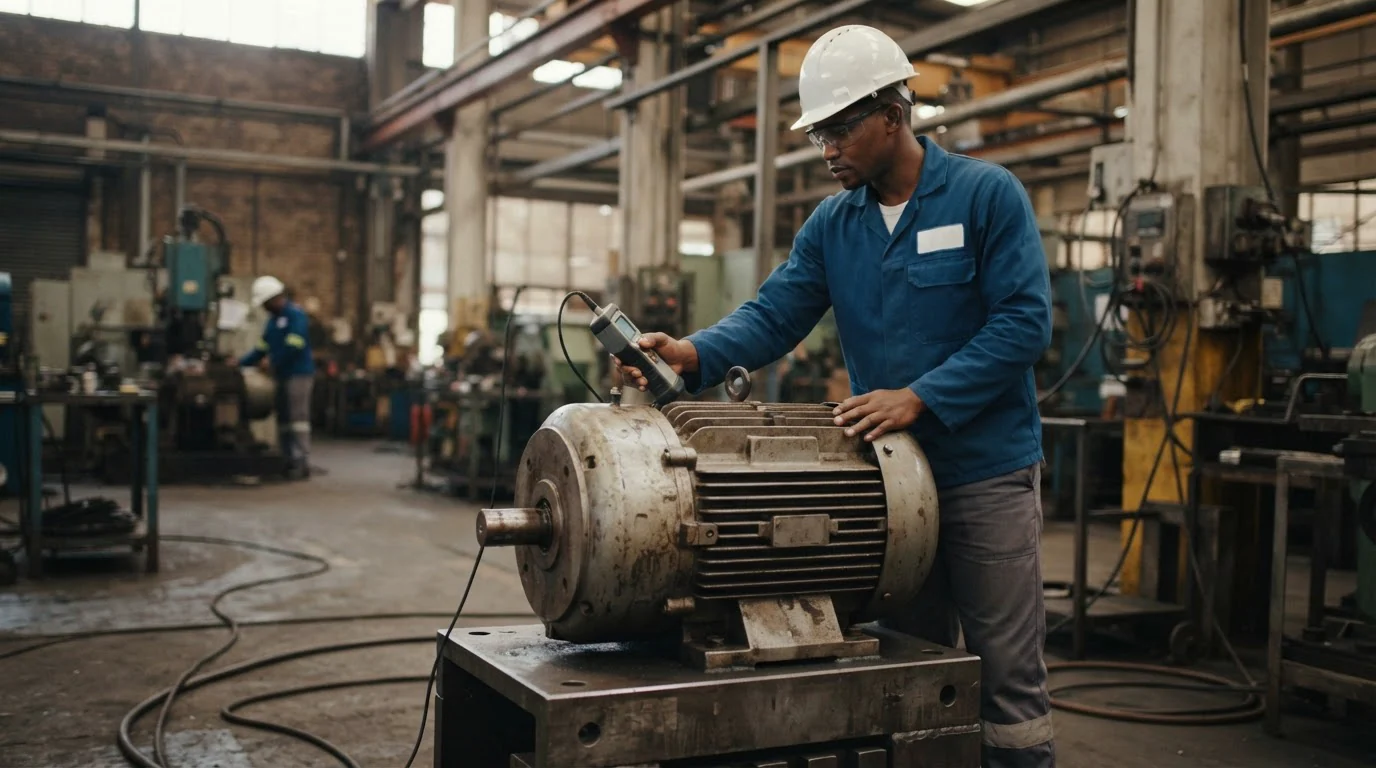
The short answerSouth African manufacturers face unique challenges: aging equipment, skilled labour shortages, and intense global competition.
The short answer
South African manufacturers face unique challenges: aging equipment, skilled labour shortages, and intense global competition.
What Is The Manufacturing Revolution Powered by AI?
Direct answer: South African manufacturers face unique challenges: aging equipment, skilled labour shortages, and intense global competition. Traditional reactive maintenance strategies cost local manufacturers millions annually in unexpected downtime, while production inefficiencies eat into already tight margins.
Current as of 31 May 2026: This article has been reviewed for the 2026 South African AI, SEO, and automation market. Pricing, platform capabilities, Google rich-result rules, and AI model features change quickly, so verify live vendor documentation before procurement. For privacy and data handling, use the Protection of Personal Information Act as the baseline; for search and structured-data implementation, use Google Search Central.
Artificial Intelligence is transforming this landscape. Leading manufacturers in Gauteng, Western Cape, and KwaZulu-Natal are deploying AI systems that predict equipment failures before they happen, optimize production schedules in real-time, and identify quality issues at speeds impossible for human inspectors.
Manufacturers can explore industry-specific AI solutions for predicting equipment failures and predictive maintenance for mining operations.
The results speak for themselves. Manufacturers implementing AI-powered predictive maintenance report 40-50% reductions in unplanned downtime, 25-30% increases in equipment lifespan, and maintenance cost savings averaging R2-4 million annually.
Understanding Predictive Maintenance
Traditional maintenance follows two approaches: reactive (fix it when it breaks) or preventive (service it on a schedule). Both are inefficient. Reactive maintenance causes costly production stoppages. Preventive maintenance often services equipment unnecessarily, wasting resources.
Predictive maintenance uses AI to monitor equipment condition in real-time, predicting failures before they occur. Machine learning algorithms analyze data from sensors, vibration monitors, temperature gauges, and production logs to identify subtle patterns indicating impending failure.
How AI Predictive Maintenance Works
Data Collection: Sensors monitor vibration, temperature, pressure, power consumption, acoustic signatures, and operational parameters across all critical equipment.
Pattern Recognition: Machine learning models analyze historical failure data alongside current sensor readings, identifying correlations invisible to human operators.
Failure Prediction: AI algorithms predict when specific components will fail, typically with 7-30 days advance warning depending on the failure mode.
Automated Scheduling: The system automatically schedules maintenance during planned downtime, orders spare parts in advance, and alerts technicians with specific diagnostic information.
Continuous Learning: Every maintenance event improves the model's accuracy, creating a self-improving system that gets smarter over time.
| Industry | AI Adoption Rate (SA) | Top Use Case | Avg ROI |
|---|---|---|---|
| Financial Services | 65% | Fraud detection | 300%+ |
| Healthcare | 45% | Patient scheduling | 200%+ |
| Manufacturing | 55% | Predictive maintenance | 250%+ |
| Retail | 50% | Demand forecasting | 180%+ |
Production Optimization Through AI
Beyond maintenance, AI transforms production itself. Modern manufacturing involves thousands of variables: raw material quality, machine settings, environmental conditions, operator experience, and supply chain timing. Optimizing these manually is impossible.
AI production optimization systems analyze these variables in real-time, making continuous micro-adjustments that maximize output while maintaining quality. A plastic injection moulding facility in Durban increased production by 22% without adding equipment simply by implementing AI optimization of cycle times, temperatures, and pressure settings.
Real-Time Quality Control
Computer vision AI inspects products at speeds no human can match. A Cape Town electronics manufacturer now inspects 100% of circuit boards using AI vision systems, catching defects that previously reached customers. Inspection time dropped from 45 seconds per board to 2 seconds, while defect detection improved by 300%.
The AI doesn't just identify defects; it traces them back to root causes. When defect rates increase, the system automatically correlates the issue with specific machines, operators, material batches, or environmental conditions, enabling immediate corrective action.
Adaptive Production Scheduling
AI scheduling systems optimize production sequences considering hundreds of constraints: machine availability, operator skills, material inventory, delivery deadlines, setup times, and quality requirements. These systems reschedule production dynamically as conditions change, maintaining optimal flow.
A Johannesburg automotive parts supplier reduced lead times by 35% using AI scheduling that automatically adjusts production priorities based on real-time demand signals from their ERP system and customer orders.
Implementation in South African Context
South African manufacturers often operate with mixed technology environments: modern CNC machines alongside decades-old equipment, sophisticated ERP systems connected to paper-based processes. AI implementation must accommodate this reality.
Starting with Existing Equipment
Modern AI doesn't require replacing equipment. Retrofit sensors and edge computing devices can monitor almost any machine, from 1980s presses to latest-generation robots. A food processing plant in Port Elizabeth implemented predictive maintenance on 30-year-old mixing equipment using R150,000 worth of sensors and achieved R1.8 million annual savings.
Data Integration Challenges
Most manufacturers have data trapped in silos: production data in SCADA systems, maintenance logs in spreadsheets, quality data in QMS software, and inventory in ERP. Our platform integrations service specializes in connecting these systems, creating the unified data foundation AI requires.
The integration challenge is real but solvable. Using APIs, webhooks, and custom connectors, we typically complete full data integration in 6-12 weeks, even for complex environments with legacy systems.
Skills and Training
Many South African manufacturers worry about skills gaps. The good news: modern AI systems are designed for existing teams. Maintenance technicians don't need data science degrees; they need interfaces showing "Motor 3 bearing failure predicted in 14 days" with clear action steps.
Our AI team enablement program trains your existing workforce to work alongside AI systems effectively. Most teams become proficient within 4-6 weeks.
Measuring ROI
AI implementation requires investment. Typical projects range from R500,000 for single-line predictive maintenance to R3-5 million for enterprise-wide optimization systems. How do you justify this?
Calculating Downtime Costs
Start by calculating your true downtime cost. For most manufacturers, one hour of unplanned downtime costs R50,000-R200,000 considering lost production, wasted materials, overtime labour, and delayed deliveries.
If AI reduces unplanned downtime by just 40 hours annually, that's R2-8 million in savings. Most implementations achieve 100+ hours of downtime reduction in the first year.
Efficiency Gains
Production optimization typically improves OEE (Overall Equipment Effectiveness) by 15-25%. For a facility producing R100 million annually, a 20% efficiency gain adds R20 million in revenue without capital expenditure on new equipment.
Quality Improvements
Reduce scrap rates, warranty claims, and customer returns. A metal fabricator reduced scrap from 8% to 2% using AI quality prediction, saving R4.2 million annually.
Learn more about quantifying AI ROI in our guide to AI for business growth.
Getting Started
Implementing AI in manufacturing doesn't require a massive transformation project. Start small, prove value, then scale.
Phase 1: Pilot Program (2-3 months)
Identify your most problematic equipment or production line. Implement predictive maintenance or optimization on this single area. Measure results rigorously: downtime reduction, efficiency gains, quality improvements.
Investment: R300,000-R800,000 Expected ROI: 200-400% in year one
Phase 2: Expansion (3-6 months)
With proven results, expand to additional equipment and production lines. Add quality control AI, production scheduling optimization, or energy management.
Investment: R1-2 million Expected ROI: 150-300% in year one
Phase 3: Enterprise Integration (6-12 months)
Integrate AI across all production facilities. Connect to ERP, supply chain, and business intelligence systems for enterprise-wide optimization.
Investment: R3-5 million Expected ROI: 120-200% in year one
Our AI audit service helps you identify the highest-impact starting points specific to your operation.
Success Stories
Automotive Component Manufacturer (Gauteng): Implemented predictive maintenance across 45 CNC machines. Results: 52% reduction in unplanned downtime, 28% increase in machine lifespan, R3.2 million annual savings. ROI achieved in 11 months.
Food Processing (Western Cape): Deployed AI quality control and production optimization. Results: 18% production increase, 65% reduction in quality defects, 31% reduction in energy costs. R5.8 million added annual profit.
Chemical Manufacturing (KZN): Implemented AI-powered process optimization and predictive maintenance. Results: 23% improvement in yield, 40% reduction in maintenance costs, 15% reduction in raw material waste. R7.1 million annual benefit.
Common Challenges and Solutions
Challenge: Legacy equipment lacks modern sensors Solution: Retrofit IoT sensors are inexpensive (R2,000-R15,000 per machine) and work with any equipment
Challenge: Limited IT infrastructure Solution: Edge computing processes data locally, minimizing network requirements
Challenge: Data quality issues Solution: AI can work with imperfect data; accuracy improves as data quality improves
Challenge: Change resistance Solution: Start with enthusiastic early adopters; success stories convert skeptics
Challenge: Skills gaps Solution: Modern AI systems are designed for existing teams with proper training
Our team at Smart AI Solutions, led by Loxly Atkinson, has implemented these solutions across multiple South African industries.
Frequently Asked Questions
How long does implementation take?
Pilot programs typically take 2-3 months from kickoff to measurable results. Enterprise-wide implementations range from 6-18 months depending on scale and complexity. Most manufacturers see positive ROI within the first year.
Do we need to replace existing equipment?
No. AI works with existing equipment using retrofit sensors and edge computing. We've successfully implemented predictive maintenance on equipment ranging from brand new to 40+ years old.
What if our data is incomplete or inconsistent?
AI systems can work with imperfect data and improve as data quality improves. We start with available data, identify gaps, and implement data collection improvements in parallel with AI deployment.
How much does predictive maintenance reduce downtime?
Typical reductions range from 30-50% for unplanned downtime. Results vary based on current maintenance practices, equipment age, and production environment. Conservative planning assumes 30% reduction; many manufacturers exceed 50%.
Can AI work with our existing ERP and MES systems?
Yes. We integrate with all major manufacturing systems including SAP, Oracle, Microsoft Dynamics, and industry-specific MES platforms. Custom integrations handle proprietary or legacy systems.
The Future of Manufacturing in South Africa
Global manufacturing is becoming increasingly competitive. South African manufacturers who embrace AI gain significant advantages: lower costs, higher quality, faster delivery, and greater flexibility.
The manufacturers thriving five years from now will be those investing in AI today. The technology is proven, accessible, and delivering measurable results for South African companies right now.
Ready to transform your manufacturing operation with AI? Contact our team for a consultation and facility assessment. We'll identify specific opportunities, quantify potential ROI, and create a phased implementation plan tailored to your operation and budget.
Discover how our operations control solutions can optimize your entire production environment, from predictive maintenance to quality control to production scheduling.
Related Resources: